
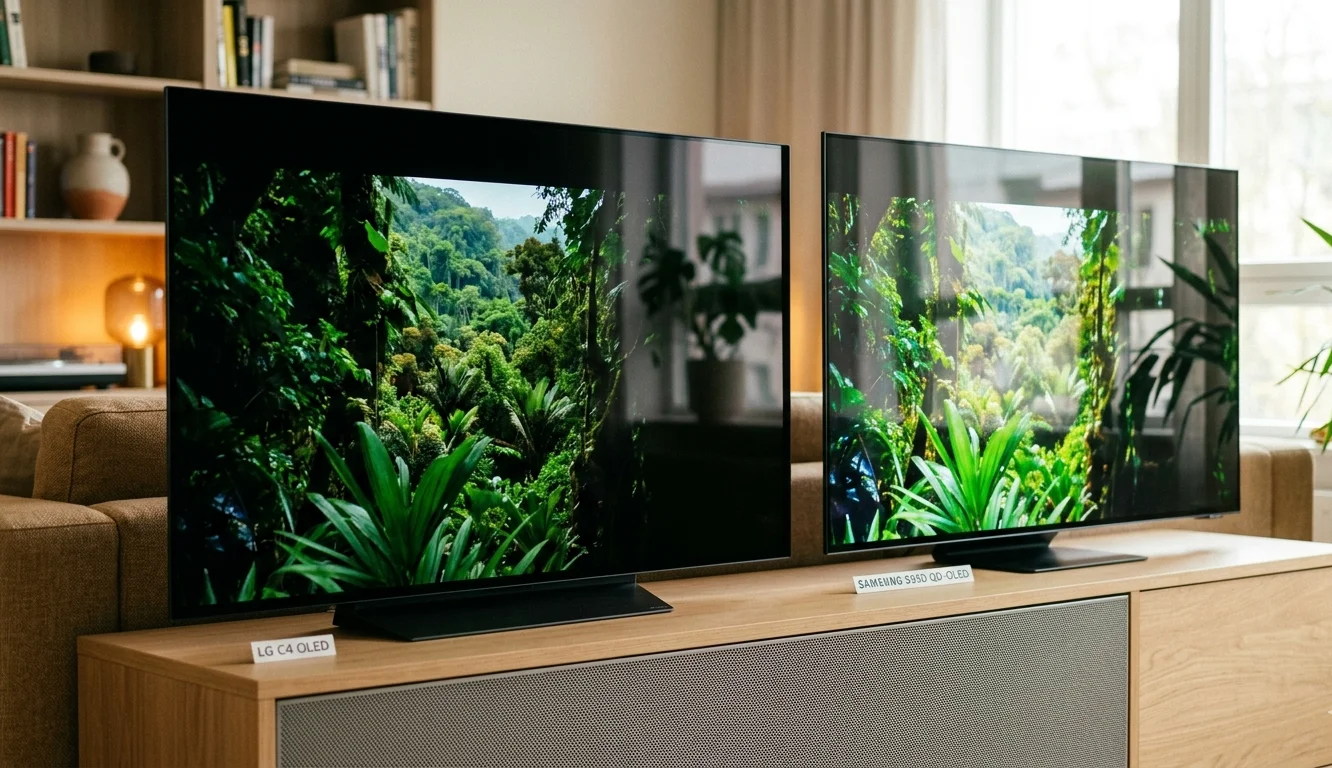
The Comprehensive Comparison Review
1. The Audiophile and Home Theater Quotient
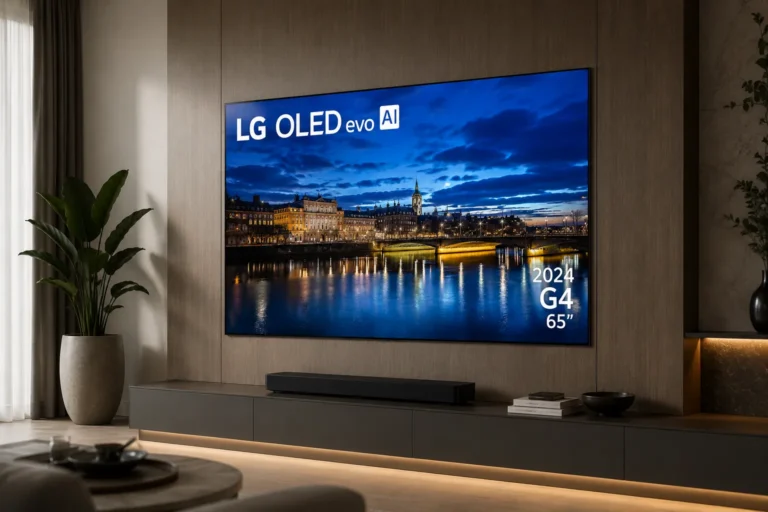
When building a top-tier home entertainment ecosystem, film lovers and gamers usually separate into two distinct technical paths.The LG C4 OLED represents the evolution of traditional, highly reliable White-OLED (WOLED) display tech, focusing on class-leading video processing, organic shadow detail tracking, and flawless format compatibility.The Samsung S95D QD-OLED breaks away from traditional design rules, utilizing a layer of microscopic Quantum Dots to supercharge color vibrancy and luminance. It wraps this modern engine inside a striking, ultra-slim panel equipped with a glare-melting matte filter. This face-off evaluates how these two philosophies alter your visual experience under real-world viewing conditions.
THE ACOUSTIC AND VISUAL GRID
- Accurate & Natural Sound (Audio Architecture):
The visual battleground requires a solid sonic baseline, and both brands address this through contrasting hardware frameworks. The LG C4 deploys a downward-firing 2.2-channel system rated at 40W, relying heavily on its software engine to virtually upscale audio tracks to an artificial 9.1.2 sphere. It delivers clean, highly legible dialogue that sits neatly in the lower mid-range, though the compact cabinet struggles to resolve deep bass rumble.Samsung counters aggressively by embedding a physical 4.2.2-channel configuration pushing 70W of pure amplified power straight out of the S95D’s frame. By mounting dedicated mid-woofers directly to its back panel, the Samsung projects a noticeably broader, heavier soundscape. Using structural Object Tracking Sound Plus (OTS+), it creates a cohesive spatial story—letting you physically trace the sound of an engine panning from the left corner of the room across to the right. - Flat & Extended Frequency Response (Tone Mapping & Color Space):
In the domain of panel luminance, their technical stories diverge dramatically. The LG C4 handles HDR content by using its classic pixel layout to maintain absolute tracking stability across dark, moody cinematic scenes. Its tone mapping follows the standard video curve with extreme care, ensuring that highlight tracking remains completely balanced.The Samsung S95D uses its quantum-dot engine to deliver an incredibly wide color volume that remains perfectly saturated even at maximum brightness. While the LG C4 tops out around 1,000 nits in an isolated testing window, the Samsung screen pushes past 1,600 nits, achieving an industry-shattering peak of ~2,000 nits on localized HDR highlights. This creates a remarkably vibrant viewing experience where bright reflections, crackling fires, and brilliant sunbursts pop off the canvas with intense realism. - Wide & Deep Soundstage (The Matte Panel vs. Glossy Contrast Story):
The spatial narrative takes an unexpected turn when analyzing how these screens interact with your physical living room. The LG C4 uses a traditional, highly polished glossy glass display. This classic filter preserves perfect, infinite contrast ratios in a dark home theater environment, keeping blacks looking as deep and ink-like as a dark night sky. However, the glossy coat acts like a mirror when placed across from an open window, reflecting lamps and furniture back at the viewer.Samsung completely flips this script by deploying a revolutionary glare-free matte screen layer on the S95D. This microscopic texture disperses incoming ambient light waves entirely, effectively melting away distracting living room glare. The downside to this matte strategy reveals itself under bright overhead lighting, where ambient light can diffuse across the anti-reflective layer, lifting perfect blacks into a very dark purple-gray shade. - Low Distortion (Processing Precision & Picture Cleanliness):
Image processing acts as the brain behind the panel, and both systems deploy advanced silicon to manage picture cleanliness. LG’s alpha 9 AI Processor Gen7 specializes in keeping compressed streaming content looking pristine, using machine-learned noise reduction to smooth out pixelation in dark background scenes.Samsung’s NQ4 AI Gen2 Processor utilizes 20 distinct neural network layers to continually map and upscale video feeds. When upscaling low-resolution cable feeds or older 1080p content, the Samsung engine dynamically sharpens text edges and clarifies fine details without introducing artificial halos. The LG holds a small advantage in near-black macro-blocking control, preventing dark movie scenes from fracturing into fuzzy pixel blocks. - Excellent Dynamics & Detail (HDR Performance & Highlight Clarity):
When viewing high-fidelity 4K Blu-ray transfers, the structural contrast between these two panels tells a fascinating story. The LG C4 excels at rendering subtle, ink-black shadow details, making it the perfect companion for a dimly lit home theater room where you want to see every crease of a dark coat in a shadow-heavy scene.The Samsung S95D shifts the narrative toward sheer visual impact. The extreme color brightness of its quantum-dot engine means that bright neon signs, flashlight beams, and specular reflections shimmer with incredible energy, completely avoiding the color washing that can sometimes occur on standard WOLED panels. - Superior Build Quality (Chassis Engineering & Cable Layout):
From a structural perspective, both displays look exceptionally premium, but they approach cable management differently. The LG C4 features an ultra-slim panel design along its upper half, but hooks into a thicker plastic electronic hump at the bottom to house its inputs, inputs, and power boards.The Samsung S95D achieves a uniform, paper-thin 11.2mm depth profile across its entire frame. To execute this minimalist design, Samsung completely strips all processing boards and physical inputs off the chassis, relocating them to an external Slim One Connect Box. This separate metal hub rests neatly in your media cabinet, linking to the floating panel via a single, nearly invisible transparent fiber cable. - Effortless & Fatigue-Free Listening (Smart Interface & Daily Usability):
Daily navigation on both television platforms is smooth, driven by polished webOS (LG) and Tizen (Samsung) interfaces. LG utilizes its signature “Magic Remote,” which lets you control an on-screen mouse cursor by simply waving your wrist in mid-air. This makes typing password fields and shifting through streaming apps completely effortless.Samsung’s Tizen interface layouts prioritize fast, grid-based content discovery hubs. Samsung includes a sleek, ultra-slim remote equipped with an integrated solar panel on the back, completely removing the need to ever swap out dead AAA batteries.
The Sonic and Visual Journey: 4 Content Test Benchmarks
1. “Blade Runner 2049” — Neo-Tokyo Flyby Scene
- LG C4 OLED: The deep, infinite black voids of the futuristic skyline are rendered flawlessly, keeping the surrounding star fields locked against dark backgrounds with pristine contrast. Ryan Gosling’s internal vehicle console glows softly without washing out surrounding details, holding a remarkably balanced, cinematic look.
- Samsung S95D QD-OLED: The massive holographic advertisements blast into the room with eye-popping neon saturation. The orange and pink glowing accents look spectacular, while the matte screen completely isolates the movie from your room’s lighting, pulling you directly into the scene.
2. “Mad Max: Fury Road” — The Desert Sandstorm Chase
- LG C4 OLED: The lightning bolts arc across the swirling red sandstorms with crisp, fast response. The processing engine maps the intense dust gradients smoothly, avoiding jagged transitions. The audio engine keeps the roar of the car exhausts clean and centered below the display panel.
- Samsung S95D QD-OLED: The blinding desert sun explosions register with intense physical energy, forcing you to blink during bright transitions. The orange flames and exploding debris display a staggering amount of color volume, while the S95D’s back-firing woofers deliver a punchy, rumbling bass track that matches the chaotic action on screen.
3. “Our Planet” — Shallow Coral Reef Deep Dive
- LG C4 OLED: The tropical waters look natural, clear, and cleanly upscaled, preserving fine sand and swimming schools of fish with realistic clarity. The processing maintains deep, realistic water tones that match natural ocean environments.
- Samsung S95D QD-OLED: The quantum-dot layer turns this nature documentary into a vibrant display showcase. Neon green sea anemones and bright orange clownfish display an extreme level of color saturation that looks incredibly vivid. The matte layer keeps the screen entirely free of window reflections, making it feel like you are looking directly into a pristine glass aquarium.
4. “Call of Duty: Warzone” — 120Hz/144Hz Low-Latency Gaming Test
- LG C4 OLED: Shows exceptional performance in Game Mode, running four full-bandwidth HDMI 2.1 ports at 4K/120Hz. Input lag feels nonexistent, and the pop-up Game Optimizer panel lets you monitor frame rates and brighten dark corners instantly so you can spot hidden opponents.
- Samsung S95D QD-OLED: Pushes gaming performance even further by supporting a native 4K/144Hz input rate for high-end PC rigs. The tracking feels fluid, and input responses register instantly. In addition, the ~2,000-nit highlight brightness ensures that sun reflections glinting off sniper scopes look amazingly realistic, giving you an edge in competitive matches.
TECHNOSYNE SCORE CARD
Who Is It For?
- Choose the LG C4 OLED if: You are a purist movie lover who watches content primarily in a light-controlled, dim home theater room, values pristine shadow details, and demands full Dolby Vision hardware passthrough for Netflix and 4K Blu-ray collections.
- Choose the Samsung S95D QD-OLED if: You are looking for a spectacular display for a bright living space with large windows, demand high gaming refresh rates, prefer a clean wire-free wall mount, and want the absolute brightest, most vibrant color output available on the market today.
Highs & Lows
LG C4 OLED
- HIGH: Flawless infinite contrast loops and perfect black levels in dark viewing spaces.
- HIGH: Full native support for Dolby Vision, Dolby Atmos, and DTS audio processing.
- LOW: The glossy glass screen can act like a mirror when placed across from bright windows.
- LOW: Lower peak brightness numbers compared to next-generation quantum-dot setups.
Samsung S95D QD-OLED
- HIGH: Shattering ~2,000-nit peak brightness paired with rich color volume.
- HIGH: Revolutionary matte panel filter completely destroys room reflections.
- LOW: Misses Dolby Vision compatibility entirely, forcing a down-scale to standard HDR10.
- LOW: Bright room lights can diffuse over the matte coat, slightly lifting dark shadow areas.
Matching Soundbar & Audio Ecosystems
- For the LG C4 OLED: Pairs beautifully with the LG S95TR Soundbar system. This audio package hooks directly into the C4 via WOW Orchestra software sync, combining the TV’s internal drivers with the soundbar’s upward-firing arrays to create a massive, unified Dolby Atmos wall of sound.
- For the Samsung S95D QD-OLED: The definitive partner is the ultra-slim Samsung HW-Q990D flagship soundbar system. It utilizes wireless Dolby Atmos transmission technology to match the clean look of your One Connect Box, linking with the S95D via Q-Symphony to build a massive, theatrical listening bubble across 11.1.4 audio channels.
Final Conclusions & 6-GRID Alternatives
The Samsung S95D wins the crown for pure hardware innovation, color brightness, and reflection management, cementing its top slot on our Elite Grid Tier. However, if you are looking to build a dark-room home theater hub and want total Dolby Vision formatting compatibility, the LG C4 OLED stands as an exceptionally reliable, high-performance option.
Technosyne 6-GRID Alternatives Combo:
- The Upgrade Choice (Elite Tier Speaker Combo): KEF LS50 Meta Studio Setup. To match the S95D’s flagship visual presentation, upgrading your audio to an external KEF point-source bookshelf speaker setup builds an elite home theater space that built-in TV drivers cannot match.
- The Value Choice (Value Tier TV): Hisense U8N (Mini-LED). If you want a giant 65 or 75-inch screen that offers massive peak brightness for under $1,000, dropping down to this high-value mini-LED panel is a fantastic budget option.
Technosyne – Beyond Tech. Into the future of happy living.
Thank you for spending your time with Technosyne! Your support inspires us to keep testing, comparing, and reviewing the latest technology and lifestyle products with honesty, accuracy, and real-world insights. Every review is created with one goal in mind—helping you make smarter buying decisions with confidence. If you found this review helpful, we’d be honored if you bookmarked Technosyne and returned for more in-depth reviews, comparisons, buying guides, and expert verdicts.
Until next time, See you in the next Technosyne Verdict.!