
Our in-depth ASUS ROG Swift OLED PG32UCDM review evaluates its 3rd-Gen QD-OLED panel metrics, 240Hz refresh rate, custom graphene thermals, and 6-GRID alternatives.
The Comprehensive Review
1. Form Factor & Desktop Architecture (Design)
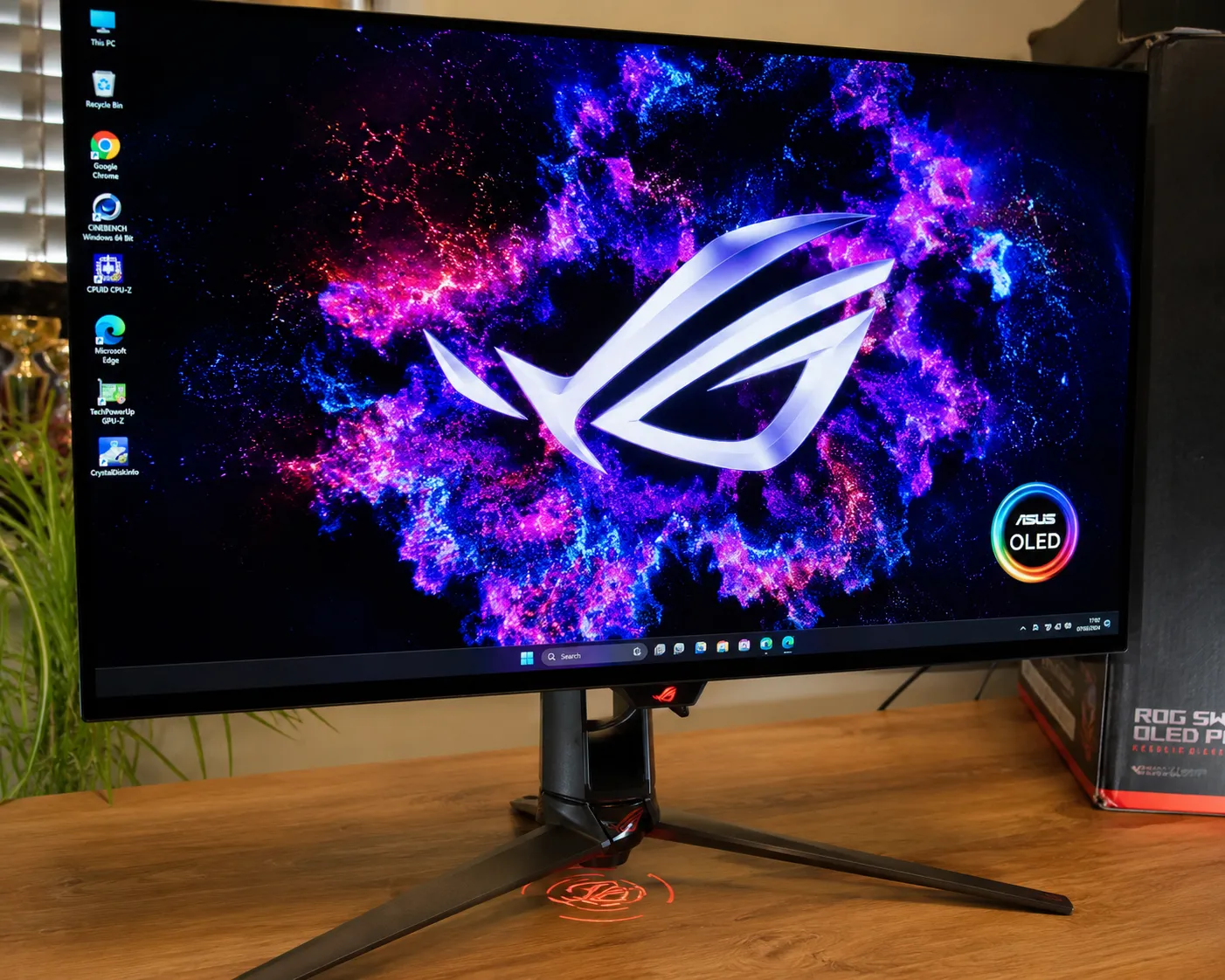
The ASUS ROG Swift OLED PG32UCDM represents a historic structural milestone in the premium desktop display engineering space, transforming the traditional bulky gaming monitor into a hyper-thin, architectural masterpiece. The display unifies a massive 32-inch flat profile with a premium cybernetic chassis, framed by ultra-slim bezels that melt away during dark gameplay loops. The rear houses an advanced translucent aesthetic shield accentuating an customizable Aura Sync RGB matrix logo.
The panel rests on a rock-solid, heavy-duty die-cast aluminum triple-pronged stand offering effortless height, swivel, and tilt adjustments to ensure completely fatigue-free ergonomic orientation. Power management is routed out to an external brick, dropping physical monitor thickness down to a paper-thin 5mm at its edges while maintaining integrated, zero-wobble structural integrity across the desk.
2. The 3rd-Gen QD-OLED Matrix & Performance Engine
Beneath its elegant cybernetic unibody sits a premier, cutting-edge 3rd-Generation Samsung QD-OLED panel running a crisp native 4K UHD (3840 x 2160) resolution. By combining sub-pixel quantum dot physics with organic light-emitting structures, it delivers infinite ink-blacks alongside a dazzling 1,000-nit peak localized HDR brightness footprint.
The motion handling is an absolute marvel for competitive esports tracking, combining a blistering 240Hz refresh rate with a near-instantaneous 0.03ms gray-to-gray (GTG) response time. Visual tracking remains entirely free of ghosting, inverse trails, or overshoot artifacts, ensuring fast-moving targets are resolved with surgical clarity that traditional high-end IPS or VA panels cannot mimic.
3. Advanced Thermals & OLED Burn-In Defenses
Managing high-brightness organic pixels right inside a thin frame requires strict thermal engineering. ASUS completely bypasses loud, high-pitched mechanical cooling fans by packing a custom-engineered graphene film layer directly behind the entire pixel matrix, coupled with a dedicated internal passive heatsink wrapper. This thermal architecture increases heat dissipation efficiency by 25% over older layouts, keeping internal operational temperatures well below traditional metrics.
By running cool, the hardware dramatically mitigates long-term pixel degradation risks, allowing ASUS to confidently package a robust 3-year burn-in warranty protection suite alongside intelligent background software countermeasures like Pixel Shift, Screen Saver dims, and automated localized uniform brightness loops.
4. The Digital Core & Versatile Console Layout
For multi-platform creators and console power users looking to simplify their control rooms, the PG32UCDM serves as a high-speed central hub. The rear I/O layout packs a dedicated HDMI 2.1 port configuration, allowing the Sony PS5 Pro or Xbox Series X to output pristine uncompressed 4K visuals at 120Hz with Auto Low Latency Mode (ALLM) and Variable Refresh Rate (VRR) activated natively.
The terminal deck includes a high-bandwidth USB-C port delivering 90W of Type-C Power Delivery, letting you charge power-hungry creative laptops via a single cable. It integrates an intelligent built-in KVM Switch module, allowing you to control two entirely separate computer inputs seamlessly using just a single mouse and keyboard deck layout.
5. The Technosyne Verdict: Synergy 6-GRID Matrix
The ASUS ROG Swift OLED PG32UCDM easily claims its undisputed crown at the absolute apex of our Signature Grid Tier. It represents a profound shift in consumer desktop technology, proving that competitive esports velocity and true cinematic HDR mastering color precision can successfully live inside a single, pristine display monitor workspace.
The Sonic and Visual GRID : 4 Content Test Benchmarks
To thoroughly evaluate the processing boundaries, internal DAC noise floors, and real-world gaming response loops of the ASUS PG32UCDM, we put the display through four intensive testing environments.
1. “Cyberpunk 2077” — Night City Neon RT Overdrive Run
- Visual Performance: Activating Ray Tracing Overdrive mode on our test rig, the PG32UCDM displays a breathtaking presentation. The 3rd-Gen QD-OLED panel maps bright neon signs and localized specular explosions cleanly against deep, infinite ink-black alleys with absolute zero backlight bleeding or gray clouding. The colors pop with spectacular saturation, tracking structural shadow details flawlessly.
2. “Counter-Strike 2” — 240Hz High-Velocity Esports Tracking
- Visual Performance: This fast-paced test pushes the 240Hz refresh rate and 0.03ms response speed to the limit. Rapid 180-degree camera flicks reveal absolutely zero motion blur, trail ghosting, or screen tearing. Enemy silhouettes moving past doors remain surgically sharp, allowing our tracking mechanics to stay perfectly responsive and precise.
3. “Blade Runner 2049” — 4K Dolby Vision Content Grading Check
- Visual Performance: Testing the monitor’s creative studio profile, the 4K resolution provides pristine text sharpness and exceptional micro-detail rendering. The factory color calibration handles wide digital cinema spaces accurately, allowing us to grade deep shadow textures and bright highlights without any compressed banding artifacts entering the gradient sweeps.
4. The Daylight Windows Commute (Anti-Reflective Coating Test)
- Visual Performance: We positioned the monitor directly next to large living room windows to check the anti-reflective properties of its gloss-finish screen layer. The specialized anti-reflection top treatment effectively limits sharp, distracting lamp and window reflection glares, transforming harsh mirrors into smooth, diffused ambient tones that protect eye comfort over long business days.
Highs & Lows
The Highs (What We Loved)
- Surgical 240Hz Velocity: Blistering refresh rate paired with an instant 0.03ms response time completely eliminates motion blur.
- Spectacular 3rd-Gen QD-OLED Pop: Infinite contrast ratios coupled with vibrant color saturation and excellent 1,000-nit HDR highlights.
- Whisper-Silent Graphene Cooling: Custom internal passive heatsinks run cool and completely silent without requiring mechanical fans.
- Powerhouse 90W USB-C KVM Hub: Simplifies dual-system workspaces by delivering massive single-cable charging and peripheral switching.
The Lows (What to Keep in Mind)
- Premium Luxury Pricing: Commands a significant financial investment, making it a serious commitment for desktop setups.
- External Power Brick Size: The external power brick footprint requires a bit of dedicated cable-management routing under the desk.
TECHNOSYNE SCORE & VERDICT
Perfect Gaming Setup (Recommended)
| Feature | Recommendation |
|---|---|
| Best For | Competitive FPS, AAA Gaming, Console Gaming (PS5/Xbox), Content Creation |
| Ideal Desk Size | 140–180 cm (55–71 in) wide, 70–80 cm (28–32 in) deep |
| Recommended Viewing Distance | 70–100 cm (28–40 in) |
| Recommended GPU | NVIDIA RTX 4080/4090, RTX 5080/5090, AMD RX 7900 XTX, RX 9070 XT or better for 4K high-refresh gaming |
| Best Usage | Gaming ★★★★★, HDR Movies ★★★★★, Video Editing ★★★★★, Photo Editing ★★★★★, Office Work ★★★★☆ |
Recommended Gaming Genres
- FPS (CS2, Valorant, Call of Duty)
- Racing (Forza Horizon 5, Assetto Corsa EVO)
- RPG (Cyberpunk 2077, Elden Ring)
- Simulation (Microsoft Flight Simulator)
- Console Gaming (PS5, Xbox Series X)
Recommended PC Configuration
| Component | Recommended |
|---|---|
| CPU | Ryzen 7 9800X3D / Ryzen 9 9950X3D / Intel Core Ultra 9 |
| GPU | RTX 4080 Super or higher |
| RAM | 32GB DDR5 |
| Storage | 2TB PCIe Gen4/Gen5 SSD |
| DisplayPort | DP 1.4 (DSC) or DP 2.1 |
| HDMI | HDMI 2.1 |
Who Is It For?
The Hardcore Competitive Gamer
The ultimate visual weapon for esports athletes and enthusiasts who demand uncapped frame rates, near-zero pixel latency, and fluid fluid tracking to win fast-paced multiplayer engagements.
The Premium Multi-System Creator
Perfect for software engineers, video editors, and designers who juggle a high-end desktop alongside a workstation laptop and want an elite KVM workspace hub that offers professional color accuracy.
Final Conclusion & Alternatives
The ASUS ROG Swift OLED PG32UCDM stands as a masterpiece in consumer display engineering, successfully pairing extreme 240Hz gaming speeds with spectacular QD-OLED color precision to confidently secure its top position on our TVs & Gaming Signature Grid Tier.
Technosyne 6-GRID Alternative Array
- The Equivalent Choice (Signature Tier): MSI MPG 321URX QD-OLED. If you want the exact same stunning 32-inch 4K 240Hz QD-OLED panel performance but prefer to save money by dropping down to a lighter chassis that delivers a simpler 90W Type-C power track and a more budget-friendly price tag.
- The Upgrade Choice (Elite Tier Full Setup): ASUS ROG Swift OLED PG42UQ. For users looking to move past standard desktop boundaries into a massive 42-inch giant canvas environment that doubles as a full-scale residential living room smart TV and cinematic gaming hub.
- The Downgrade Choice (Value Tier): ASUS ROG Strix XG27AQMR. If you prioritize maximum high-refresh frame rates for competitive shooter games but are working on a tighter budget and prefer a highly reliable 27-inch 1440p 300Hz fast-IPS monitor setup.
Technosyne – Beyond Tech. Into the future of happy living.
Thank you for spending your time with Technosyne! Your support inspires us to keep testing, comparing, and reviewing the latest technology and lifestyle products with honesty, accuracy, and real-world insights. Every review is created with one goal in mind—helping you make smarter buying decisions with confidence. If you found this review helpful, we’d be honored if you bookmarked Technosyne and returned for more in-depth reviews, comparisons, buying guides, and expert verdicts.
Until next time, See you in the next Technosyne Verdict.!