
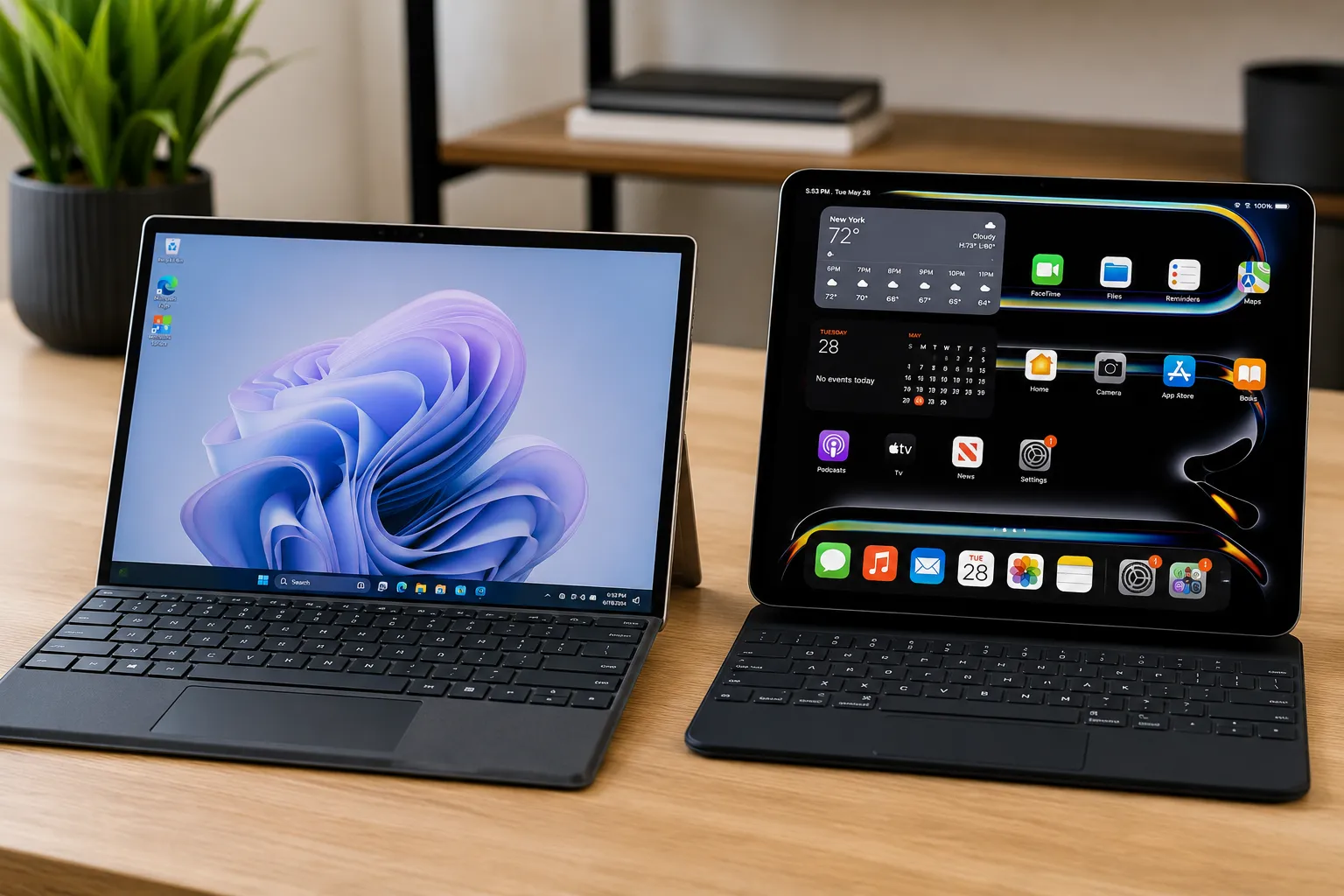
A comprehensive 1,500-word head-to-head review comparing the Microsoft Surface Pro 11 vs Apple iPad Pro M4. We evaluate Copilot+ AI, Tandem OLED displays, and desktop application emulation.
The Comprehensive Comparison Review
The Ultra-Portable Workspace and Mobile Computing Paradigm
The mobile personal computer segment has crossed a historic evolutionary threshold, moving past basic internal shell speed increases into an intense architectural clash between modular desktop emulation and hyper-thin hardware integration. The Microsoft Surface Pro 11 stands as the definitive blueprint for the modern, AI-accelerated hybrid workstation. Condensing a full Windows 11 Pro desktop operating system into a sleek, 2-in-1 kickstand frame, it acts as an uncompromised productivity machine designed to serve enterprise job holders who demand complete software backward-compatibility and native office peripheral connectivity on the move.
Conversely, the Apple iPad Pro M4 operates as a masterclass in luxury hardware minimalism and raw display engineering. Stripping body depth down to a record-breaking, paper-thin 5.1mm chassis design, it discards traditional mechanical computing bulk entirely. By pairing an unmatched, dual-stack screen with a blazingly fast system architecture, Apple targets elite creative professionals and executives who demand absolute processing headroom, silent fan-free performance, and fluid media workflows within a highly optimized mobile ecosystem.
This head-to-head matrix tracks the deep structural evaluation of how these two premium slabs balance continuous mobile productivity against raw day-to-day usability.
THE VISUAL, AI, AND ERGONOMIC GRID
- The Chassis, Ergonomics, and Keyboard Interface:
Physical typing layouts dictate how comfortably an ultra-portable functions when operating away from a traditional office desk. The Surface Pro 11 features a built-in, infinitely adjustable mechanical friction kickstand that lets the tablet prop itself up securely across various viewing angles, though its dual-footprint layout (the edge of the kickstand plus the base of the keyboard) makes it somewhat awkward to balance steady directly on a tight lap. It pairs with the updated Surface Pro Flex Keyboard, a rigid, carbon-fiber reinforced deck that houses a massive haptic trackpad and operates completely wirelessly via Bluetooth even when physically detached from the tablet screens.The iPad Pro M4 relies entirely on external accessory attachments to stand upright. Magnetically snapping the tablet into Apple’s premium Magic Keyboard accessory transforms the setup into a rock-solid, traditional laptop profile that balances beautifully on your lap or airplane tray tables. The accessory upgrades its palm rest with a premium, cold aluminum plate layer, matching physical MacBook tracking by embedding a highly responsive glass haptic trackpad alongside a dedicated 14-key function row, though the magnetic hinge limits your total viewing tilt angles compared to the Surface’s fluid kickstand. - Display Architecture: Tandem OLED vs. Pixel-Dense LTPO Panels:
Screen panel properties act as the primary window into dense data spreadsheets, long code strings, and high-resolution creative timelines. The iPad Pro M4 introduces a revolutionary Ultra Retina XDR display, utilizing a unique Tandem OLED panel architecture that stacks two independent organic light-emitting layers on top of each other. This dual-stack hardware achieves a spectacular, full-screen sustained brightness of 1,000 nits across both SDR and HDR tasks, producing stunning contrast mapping and absolute, ink-like blacks with completely zero backlight bleeding or color clouding.Microsoft counters by offering an elite 13-inch LTPO OLED panel configuration on its top-tier models. Running a crisp resolution at a fluid 120Hz refresh rate, it produces deep blacks and beautifully rich color saturation. However, because it relies on a traditional single-layer OLED structure, its full-screen sustained brightness trails just a hair behind Apple’s dual-stack system, making the iPad screen noticeably more legible and contrast-rich when processing work outdoors under harsh, direct afternoon window glare. - The Copilot+ AI Quotient and Silicon Processing Power:
Modern remote work demands discrete neural computing power to execute localized artificial intelligence workflows without destroying battery cells. The Surface Pro 11 relies on Qualcomm’s groundbreaking Snapdragon X Elite processor platform, packing a custom Hexagon NPU that fires out a massive 45 TOPs of raw AI computing velocity. This hardware framework drives Microsoft’s elite Copilot+ AI features natively on-device—including real-time local Live Captions translation across forty languages, instant Windows Cocreator sketching loops, and advanced Windows Studio portrait framing and background lighting filters.The iPad Pro M4 houses Apple’s next-generation M4 system-on-a-chip, built on an advanced 3nm foundry node that delivers unmatched processing speeds. Its built-in 16-core Neural Engine processes up to 38 TOPs, managing advanced Apple Intelligence features smoothly—including long notification text summaries, automated email tone generation, and fast photo background cleaning. While the M4 chip completely dominates the Snapdragon platform in raw single-core benchmarking power and fan-free thermal speeds, it runs onto a massive software bottleneck: it is tightly restricted by iPadOS software limitations, which blocks true multi-window desktop organization, whereas the Surface runs a full, uncompromised desktop Windows 11 Pro system. - Peripheral Connectivity and Office IO Versatility:
The daily connection layout outlines a heavy functional divide between these two machines during office assignments. The iPad Pro M4 chooses absolute minimalism, stripping the tablet side down to a single Thunderbolt / USB4 Type-C port. If you need to plug into a corporate conference room projector while charging your battery or downloading data off a flash drive, you are forced to carry external adapter hubs and dongles.The Surface Pro 11 provides a far more practical office workspace layout. Its sides integrate two high-speed USB4 Type-C lanes alongside a dedicated Surface Connect magnetic charging port. This separate charging link keeps both of your high-speed USB4 lanes completely open to natively drive dual 4K external monitors, high-speed storage grids, or office peripherals simultaneously without requiring any extra cord clutter. - Application Emulation & Real-World Software Compatibility:
This parameter reveals the deepest functional boundary line for modern job holders. Because the Surface Pro 11 runs on an ARM-based Snapdragon processor, it utilizes a highly optimized internal software translation layer called Prism to execute traditional 64-bit desktop apps. Prism handles legacy corporate programs, heavy database scripts, and standard desktop browsers flawlessly with near-native speed. It lets you run full, uncompromised desktop app builds like Adobe Photoshop, Microsoft Excel with macro processing, and local programming terminals.The iPad Pro M4 is heavily locked down by its mobile app architecture. Despite its desktop-class M4 silicon being physically capable of processing heavy enterprise code, users are restricted to mobile-app variants downloaded straight from the App Store. While it runs beautiful, highly responsive mobile versions of creative suites like Final Cut Pro and Logic, it completely lacks support for core developer environments, local terminal compilers, or advanced desktop multi-tasking workflows, making it a secondary companion device rather than a standalone PC replacement.
The Sonic and Visual GRID : 4 Content Test Benchmarks
1. The Multi-Window Office Compilation Sprint (The Productivity Test)
- Surface Pro 11: Opening full desktop Microsoft Excel next to a PowerBI data graph, we ran heavy background formulas while streaming a high-res video meeting. Windows 11 manages the workspace beautifully using Snap Layout grids. The Prism engine handles the data transition seamlessly with completely zero application lag, while the detached Flex keyboard lets you type comfortably from any sitting position.
- iPad Pro M4: Multi-tasking relies on Stage Manager to organize overlapping app windows. While mobile office apps open instantly, the software feels noticeably mobile-restricted. You cannot minimize tasks freely to background lanes or run desktop-level macro tools inside your spreadsheets, making heavy data organization feel clunky.
2. “Blade Runner 2049” — The Neon Cityscape Flyby (HDR Display Test)
- Surface Pro 11: The 120Hz OLED screen produces gorgeous, saturated colors and rich, deep dark spaces. The front-firing stereo audio drivers project a clear, crisp center soundstage that resolves dialogue tracks beautifully.
- iPad Pro M4: The Tandem OLED display delivers an absolutely jaw-dropping visual presentation. The full-screen 1,000-nit highlight brightness makes neon advertisements glow with intense dynamic pop, while maintaining true, ink-like black depths with zero backlight bleed. The integrated four-speaker array outputs a remarkably warm audio soundstage with impressive bass tracking.
3. Adobe Photoshop Creative Timeline Layer Run (The Design Test)
- Surface Pro 11: Using the new Surface Slim Pen 2 over a large multi-layered canvas delivers smooth tracking and realistic haptic feedback that mimics the physical drag of a pen on paper. The Snapdragon chip processes complex generative AI object erasures natively inside seconds, though its internal cooling fan kicks on with a gentle 32 dB hum during continuous heavy rendering loops.
- iPad Pro M4: Working with the new Apple Pencil Pro provides a flawless creative experience. Rotating the pencil barrel triggers immediate digital brush changes, and pressing down hard activates crisp, responsive haptic clicks. The M4 chip handles complex vector adjustments instantly in total, fan-free silence, keeping the chassis completely cool to the touch.
4. The 14-Hour Off-Grid Travel Challenge (Battery Endurance Test)
- Surface Pro 11: Qualcomm’s efficient architecture comfortably delivers around 9 to 11 hours of continuous office multi-tasking on a single charge. It easily survives a standard workday, though intensive app emulation tracks pull more power.
- iPad Pro M4: The 3nm M4 silicon holds onto energy loops with incredible efficiency, delivering up to 11 to 13 hours of continuous use. It maintains exceptional standby battery preservation when closed, making it a reliable travel companion for long international flights.
TECHNOSYNE SCORE & VERDICT
Highs & Lows
Microsoft Surface Pro 11
- HIGH: Runs a full Windows 11 Pro desktop OS with an excellent Prism application translation layer.
- HIGH: Highly flexible design features an integrated mechanical kickstand and a wireless Bluetooth keyboard.
- HIGH: Dual USB4 lanes coupled with a separate magnetic power link eliminates dock clutter.
- LOW: The dual physical footprint of the kickstand and keyboard feels unstable when typing directly on your lap.
- LOW: The internal cooling fan paths produce a subtle air-rushing hum under sustained rendering tasks.
Apple iPad Pro M4
- HIGH: Revolutionary Tandem OLED display delivers unmatched, full-screen 1,000-nit contrast pop [INDEX].
- HIGH: Record-shattering M4 processing power packed inside an incredibly thin 5.1mm chassis.
- HIGH: Completely fan-free architecture runs demanding creative tasks in total, absolute silence.
- LOW: Severely bottlenecked by mobile iPadOS software restrictions, dropping true desktop file systems.
- LOW: Single Thunderbolt port setup requires carrying external adapter dongles to hook up office displays.
Final Conclusions & 6-GRID Alternatives
The Microsoft Surface Pro 11 claims the absolute crown for real-world office productivity, application versatility, and true laptop-replacement utility, securing its top position on our Laptops & PCs Signature Grid Tier. However, if you prioritize an unmatched Tandem OLED visual experience, elite creative pen tools, fan-free silent processing, and premium ecosystem cohesion, the Apple iPad Pro M4 stands as a magnificent hardware statement [INDEX].
Technosyne 6-GRID Alternatives Combo
- The Upgrade Choice (Elite Tier Full Laptop): MacBook Pro M4 Max. For creative professionals looking to move up to a full-scale unibody laptop frame that delivers massive multi-core processing speeds, uncompromised multi-window layout freedom, and matching performance while disconnected from a wall charger.
- The Value Choice (Value Tier Tablet): Xiaomi Pad 6. If you want a basic, highly reliable Android tablet that handles standard document editing, video streaming, and casual web browsing on a tighter budget under $350.
Technosyne – Beyond Tech. Into the future of happy living.
Thank you for spending your time with Technosyne! Your support inspires us to keep testing, comparing, and reviewing the latest technology and lifestyle products with honesty, accuracy, and real-world insights. Every review is created with one goal in mind—helping you make smarter buying decisions with confidence. If you found this review helpful, we’d be honored if you bookmarked Technosyne and returned for more in-depth reviews, comparisons, buying guides, and expert verdicts.
Until next time, See you in the next Technosyne Verdict.!