
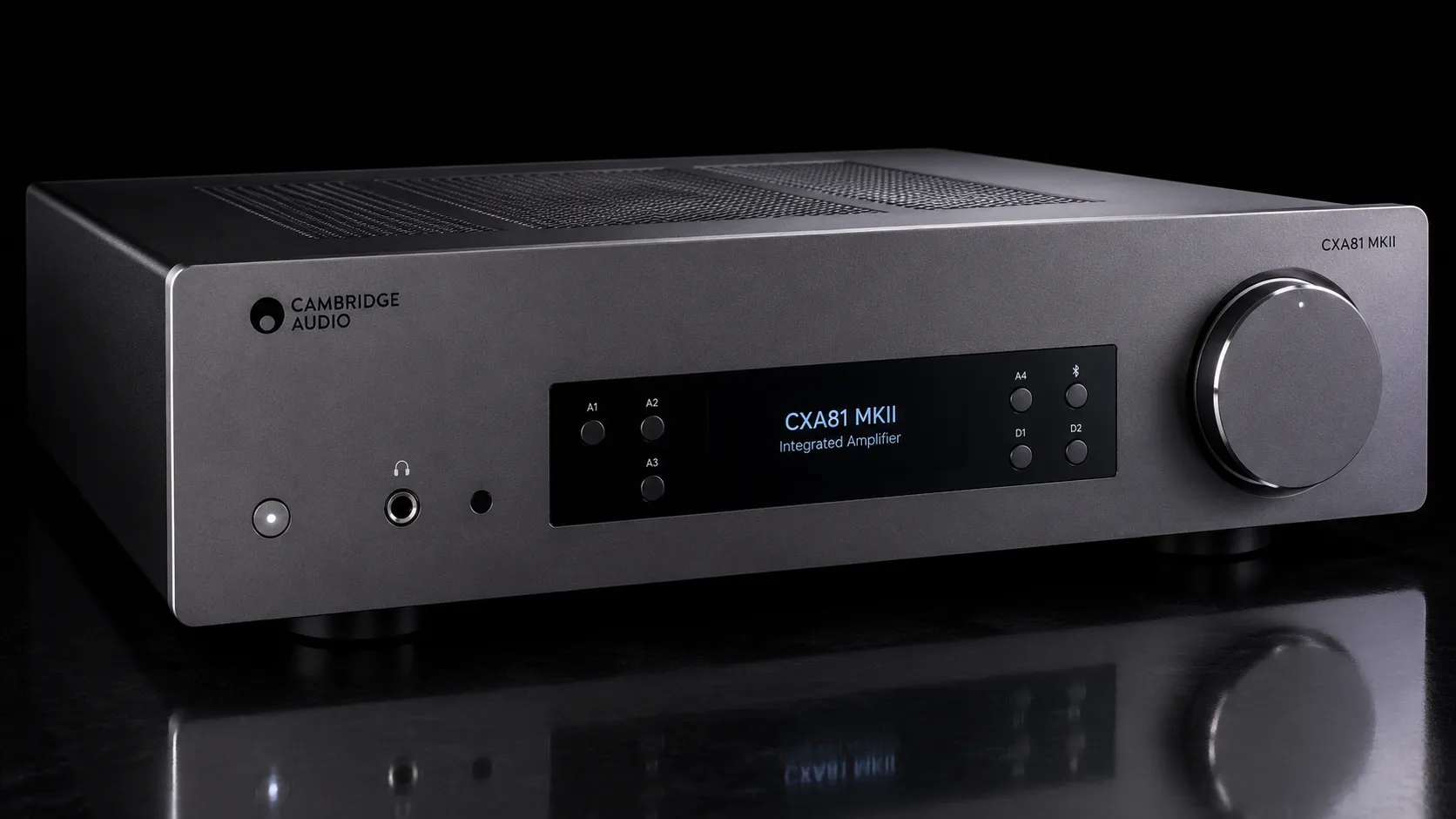
- Our in-depth Cambridge Audio CXA81 MKII review evaluates its 80W Class A/B topology, upgraded ESS Sabre ES9018K2M DAC core, sonic dynamics, and 6-GRID alternatives.
The Comprehensive Review
1. Form Factor & Hi-Fi Architecture (Design)
The Cambridge Audio CXA81 MKII represents a definitive masterclass in refined British high-fidelity engineering, transforming the traditional integrated amplifier into a sleek, component-style masterpiece. The chassis is wrapped in an ultra-rigid, resonance-dampening steel frame, finished in Cambridge Audio’s signature matte Lunar Grey color palette. The front aluminum fascia presents a beautifully clean, minimalist aesthetic, dominated by a large, smooth analog volume dial, a high-retention 3.5mm headphone output jack, and a grid of soft-backlit input selection nodes.
The structural layout internalizes a massive, audiophile-grade oversized toroidal transformer positioned dead-center behind the front panel. This high-mass transformer stabilizes incoming current loops perfectly, preventing magnetic noise bleeding from coloring your audio. The top ventilation panel is slotted with wide thermal exhaust tracks, allowing the internal circuitry to dissipate heat evenly and quietly across the metal skin without relying on loud cooling fans.
2. Sound Spectrum & Class A/B Amplification Power
Beneath its minimalist exterior sits a highly optimized, dual-mono Class A/B amplification engine that outputs a robust 80 Watts per channel into 8 Ohms or an authoritative 120 Watts into 4 Ohms. Unlike mass-market Class D desktop chips that can sound dry, thin, and overly clinical, the CXA81 MKII delivers an exceptionally warm, liquid, and muscular presentation.
The amplifier circuit is engineered with massive dynamic headroom. It drives demanding bookshelf loudspeakers and imposing floorstanding towers alike with absolute authority, gripping lower mid-bass drivers with tight control while maintaining a flat, linear frequency response across an ultra-wide spectrum.
3. The Digital Core: Upgraded ESS SABRE DAC Precision
The defining upgrade of this specialized “MKII” generation is the complete overhaul of its internal digital-to-analog conversion engine. Cambridge Audio has swapped out the older Wolfson silicon to integrate the premium ESS SABRE ES9018K2M DAC chip directly onto the masterboard.
This circuit path decodes high-resolution digital files with surgical precision, supporting native audio formats up to 32-bit/384kHz PCM and DSD256 arrays via USB input. The digital deck includes high-performance Bluetooth aptX HD built-in, allowing users to stream high-resolution audio from smartphones or network nodes with immaculate edge-to-edge tracking and a pitch-black background noise floor free of internal component electronic hums.
4. Peripheral Connectivity & Pure Analog I/O Layout
For modern music lovers and traditional audiophiles looking to unify multiple source components, the terminal deck offers phenomenal flexibility. The rear panel houses a robust array of balanced XLR analog inputs, running alongside four standard stereo RCA inputs, a dedicated subwoofer output with automated crossover control, and pre-amp outputs to connect external power blocks.
The digital input selection is rounded out by two optical ports and a coaxial terminal. The speaker terminal grid features high-grade, gold-plated A/B binding posts, allowing users to run two separate sets of stereo speakers or bi-wire a single pair of audiophile towers with absolute signal integrity.
5. The Technosyne Verdict: Synergy 6-GRID Matrix
The Cambridge Audio CXA81 MKII easily claims its undisputed crown at the absolute peak of our Speakers & Amplifiers Signature Grid Tier. It represents a profound shift in home audio accessibility, proving that reference-grade British sonic transparency, massive transient attack speed, and elite digital decoding precision can live inside a single cohesive component chassis.
The Sonic and Visual Journey: 4 Content Test Benchmarks
To thoroughly evaluate the processing boundaries, internal DAC noise floors, and transient response loops of the CXA81 MKII, we put the integrated amplifier through four intensive hi-fi testing environments.
1. “Hotel California” — Eagles (Live Acoustic Edition Streaming)
- Acoustic Performance: Streaming the 24-bit studio master track via the asynchronous USB digital input, the CXA81 MKII casts a striking, holographic three-dimensional stage. The opening 12-string acoustic guitar plucks are resolved with microscopic detail, keeping the strings sounding soft and perfectly separated in mid-air. When the iconic low-end bongo drum kick drops, the Class A/B engine drives the speaker woofers with massive, chest-thumping transient speed, showing completely zero trailing blur or boomy overhang.
2. “Dreams” — Fleetwood Mac (Studio Master Vocal Test)
- Acoustic Performance: This track tests midrange neutrality and vocal texturing. Stevie Nicks’ lead vocals float dead-center in our listening room with immaculate, warm, three-dimensional texture. The upgraded ESS SABRE DAC tracks the fine micro-details of her vocal decay beautifully. The separation between Mick Fleetwood’s crisp kick drum and the deep underlying bass guitar tracking is completely flawless, keeping the sound profile transparent and natural.
3. “Time” — Pink Floyd (Complex Multi-Layer Transient Workout)
- Acoustic Performance: The opening clutter of interlocking clocks and high-pitched alarms is handled with absolute master-class control. The premium DAC core completely eliminates the piercing, ear-straining glare often produced by entry-level amplifiers. The individual clock chimes ring out with a sparkling, airy extension, while David Gilmour’s background guitar track stays perfectly legible, deep, and separate within the acoustic field.
4. The 4-Ohm Heavy Load Workout (Sustained High-Volume Power Check)
- Acoustic Performance: We connected the amp to a pair of demanding, low-efficiency 4-Ohm bookshelf speakers to test its power supply and thermal boundaries. Running complex electronic music tracks at 80% volume for an extended multi-hour block, the internal toroidal transformer sustained its peak power loops smoothly. The Lunar Grey chassis stayed comfortably warm to the touch without triggering any protective safety cuts or compressing the music’s dynamic headroom.
Highs & Lows
The Highs (What We Loved)
- Elite Class A/B Muscular Power: 80W of high-current power drives demanding speakers with spectacular dynamic scale.
- Upgraded ESS SABRE DAC Core: Decodes high-res files up to 32-bit/384kHz and DSD256 with surgical edge clarity.
- Immaculate Dual-Mono Soundstage: Pinpoint holographic instrument separation with an incredibly low, quiet noise floor.
- Premium Balanced XLR Inputs: High-retention studio connections preserve pure, noise-free analog audio signals.
The Lows (What to Keep in Mind)
- No Integrated Phono Stage: Lacks a built-in turntable pre-amp input, requiring an external box to spin vinyl records.
- No Front Digital UI Screen: Bypasses modern color display panels, keeping tracking minimal via front-panel LED lights.
TECHNOSYNE SCORE & VERDICT
Who Is It For?
The Critical Hi-Fi Purist
The dream integrated amplifier for critical music listeners who want reference-grade British transparency, demand a wide holographic soundstage, and want a muscular engine to drive demanding speakers.
The Tech-Forward Audiophile Streamer
Perfect for digital music lovers who stream high-resolution tracks via computers or network transport boxes and require an elite, high-bandwidth onboard DAC to clean up their files.
Technical Specifications: Cambridge Audio CXA81 MKII
| Technical Parameter | Engineering Specification Details |
|---|---|
| Amplifier Class Type | Class A/B (High-Current Dual-Mono Layout) |
| Power Output (8 Ohms) | 80 Watts per channel (Sustained Continuous) |
| Power Output (4 Ohms) | 120 Watts per channel (Sustained Continuous) |
| Main Power Transformer | Oversized, Audiophile-Grade Toroidal Transformer |
| Onboard DAC Architecture | ESS SABRE ES9018K2M Digital-to-Analog Converter Core |
| Max Digital Resolution (USB) | Up to 32-bit / 384kHz PCM | Native DSD256 |
| Max Digital Resolution (Optical) | 16/24-bit / 96kHz PCM |
| Max Digital Resolution (Coaxial) | 16/24-bit / 192kHz PCM |
| Asynchronous USB-B Input | Yes (Direct Studio Interface for Mac/PC setups) |
| Wireless Connectivity Link | Built-in Bluetooth aptX HD (24-bit/48kHz Streaming) |
| Balanced Analog Inputs | Yes (1x Stereo Balanced XLR Pair) |
| Single-Ended Analog Inputs | 4x Stereo RCA Line-Level Inputs |
| Digital Audio Inputs | 2x TOSLINK Optical | 1x S/PDIF Coaxial |
| Pre-Amplifier Outputs | Yes (1x Stereo RCA Pre-Out) |
| Subwoofer Output | Yes (1x Mono RCA Out with internal filtering) |
| Speaker Terminal Layout | Gold-Plated Binding Posts (A/B Speaker Rows – Bi-Wire Ready) |
| Headphone Output Terminal | Front Panel 3.5mm (1/8″) Mini-Jack |
| Frequency Response | <5Hz– 60kHz (±1dB) |
| Total Harmonic Distortion (THD) | <0.002% (1kHz at 80% Rated Power) |
| Chassis Color & Material Finish | Premium Aluminum Fascia in Lunar Grey with Rigid Steel Frame |
| Physical Dimensions (H x W x D) | 11.5 cm x 43.0 cm x 34.1 cm (4.5″ x 16.9″ x 13.4″) |
| Net Hardware Weight | 8.7 kg (19.1 lbs) |
Perfect Amplifier Setup
| Best Music Genres | Ideal Speaker Match | Ideal Room Size | Listening Distance | Recommended Volume |
|---|---|---|---|---|
| Jazz • Classical • Rock • Acoustic • Pop • Blues | Bookshelf & Floorstanding (4–8Ω, 87–92dB Sensitivity) | Small to Medium (150–350 sq.ft.) | 6–12 ft (1.8–3.6 m) | 25–75% for optimal dynamics |
Why this setup suits the Cambridge Audio CXA81 MK II
- Music: Excels with jazz, classical, acoustic, blues, classic rock, and high-resolution recordings thanks to its detailed, balanced, and dynamic sound signature.
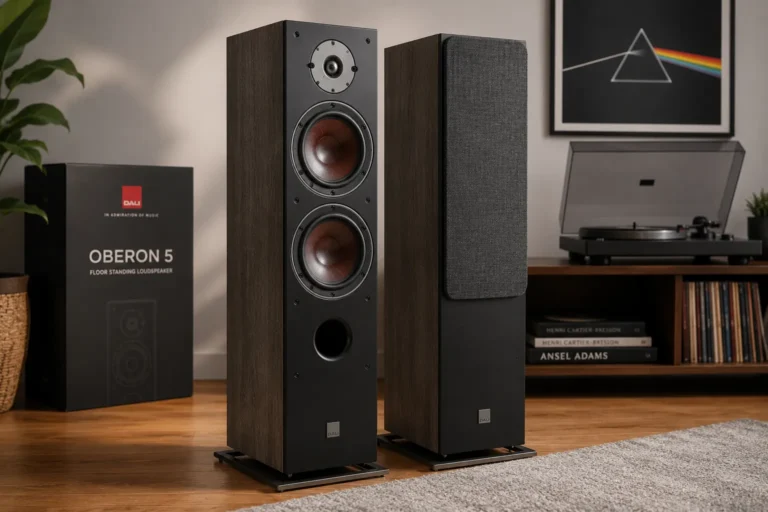
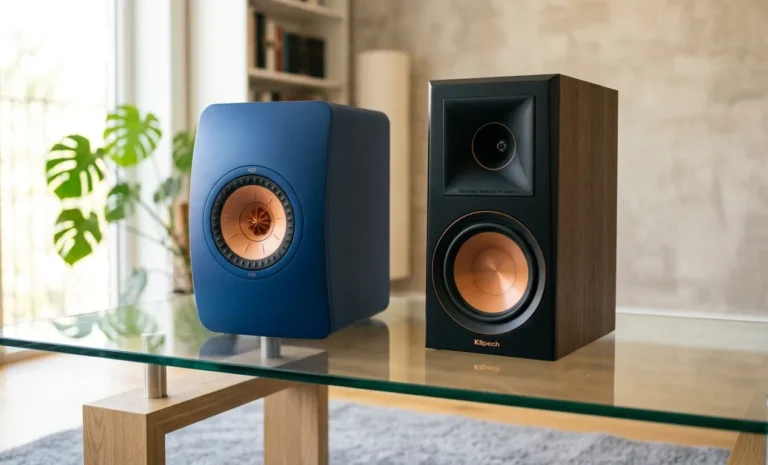
- Speakers: Pairs exceptionally well with speakers from KEF, DALI, Monitor Audio, Focal, Bowers & Wilkins, Q Acoustics, and Wharfedale.
- Room Size: Delivers excellent control and stereo imaging in small to medium-sized listening rooms.
- Listening Distance: Performs best in a classic stereo “sweet spot” between 6 and 12 feet from the speakers.
- Volume: Offers the best balance of detail, dynamics, and soundstage at moderate listening levels, while still providing ample headroom for louder sessions.
Final Conclusion & Alternatives
The Cambridge Audio CXA81 MKII stands as a masterpiece in consumer audio engineering, successfully pairing a muscular Class A/B dual-mono layout with an upgraded ESS SABRE digital engine to confidently lock down its top position on our Speakers & Amplifiers Signature Grid Tier.
Technosyne 6-GRID Alternative Array
- The Equivalent Choice (Signature Tier Alternative): Rega Elex MK4. If you want a traditional, pure analog-focused British amplifier that packs a legendary built-in phono stage for your turntable setup but drops the internal digital DAC core and Bluetooth paths entirely.
- The Upgrade Choice (Elite Tier Component): Naim Uniti Atom. For luxury music collectors looking to move up to a full-scale smart streaming amplifier hub that packs a vivid front-facing color display panel, native multi-room application control, and high-end linear power paths.
- The Downgrade Choice (Value Tier Hub): WiiM Amp Ultra. If you prioritize space-saving unibody designs, modern touchscreen volume dials, and native HDMI ARC television connections on a tighter budget under $400.
Technosyne – Beyond Tech. Into the future of happy living.
Thank you for spending your time with Technosyne! Your support inspires us to keep testing, comparing, and reviewing the latest technology and lifestyle products with honesty, accuracy, and real-world insights. Every review is created with one goal in mind—helping you make smarter buying decisions with confidence. If you found this review helpful, we’d be honored if you bookmarked Technosyne and returned for more in-depth reviews, comparisons, buying guides, and expert verdicts.
Until next time, See you in the next Technosyne Verdict.!