
- A comprehensive head-to-head review comparing the Cambridge Audio CXA81 MKII vs Marantz Stereo 70s. We evaluate Class A/B current delivery, HDMI connectivity, and DAC architectures.
The Comprehensive Comparison Review
The Pure Two-Channel Sanctuary and The Modern Connected Media Hub
The high-fidelity stereo amplification landscape has split into two distinctly opposing engineering methodologies, forcing music lovers to choose between focused analog purism and modern connected convenience. The Cambridge Audio CXA81 MKII stands as a direct, uncompromised monument to the traditional two-channel audio layout. It treats music reproduction like an industrial science laboratory, isolating a heavy, high-current power supply and high-grade dual-mono circuitry inside a thick steel shell to act as a clear, unvarnished window into your favorite high-resolution digital files and master studio recordings.
Conversely, the Marantz Stereo 70s functions as a highly versatile, low-profile smart control center designed to bridge the gap between high-end audiophile sound and modern living room entertainment systems. Shifting away from basic analog boxes, it builds an extensive network connectivity deck. By packing a full HEOS multi-room streaming module, a dedicated vinyl moving-magnet phono pre-amp, and an array of high-bandwidth HDMI 8K video switching inputs into a beautiful slimline chassis, Marantz targets modern households demanding clean, cohesive media management alongside a classic, warm sonic character.
This head-to-head analysis uncovers the deep technical narrative of how these two distinct audio engines process electrical signals to shape your home listening environment.
THE VISUAL, COGNITIVE, AND CONNECTIONS GRID
- The Component Layout, Materials, and Chassis Form Factor:
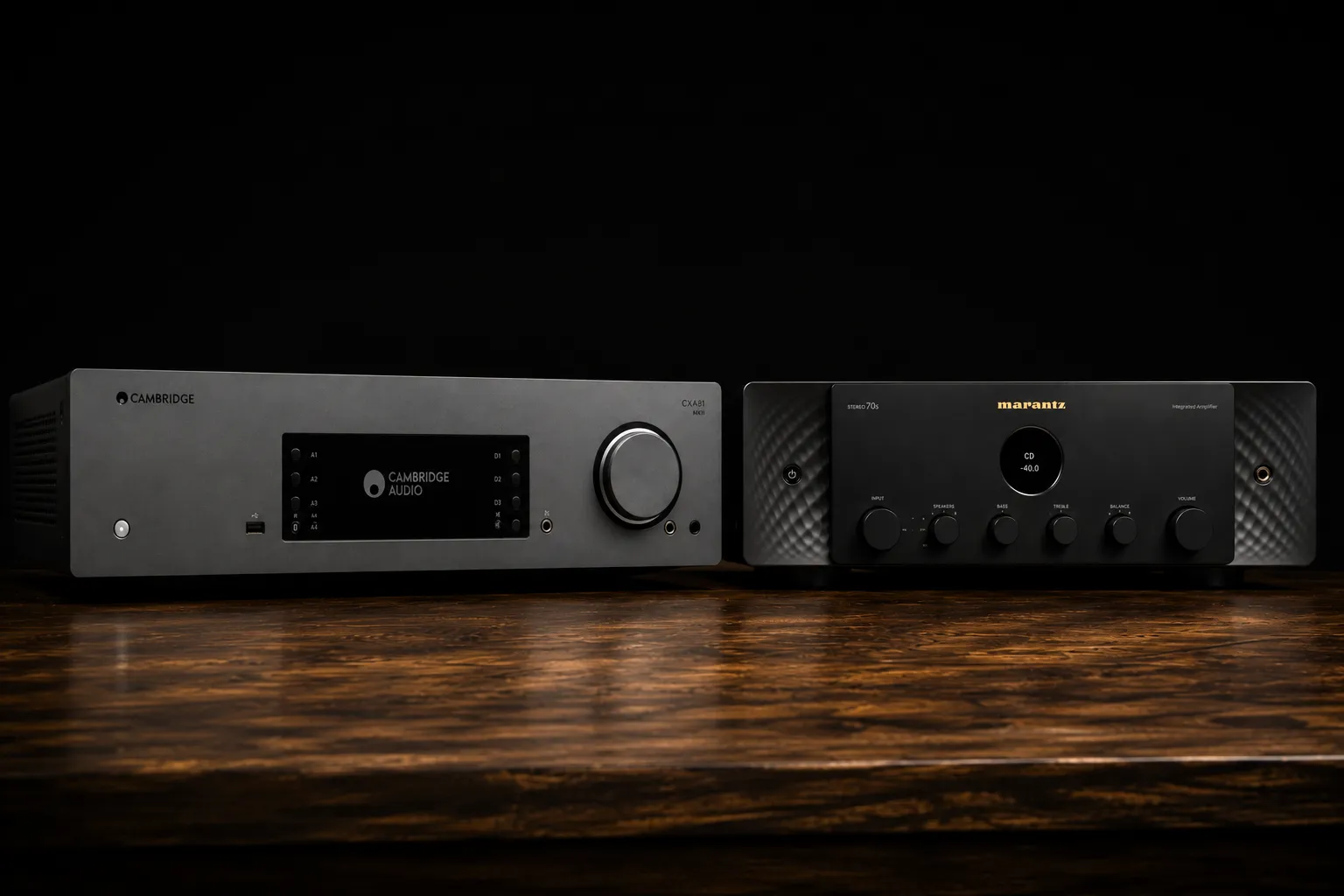
Physical enclosure builds dictate how these high-mass components sit within an office audio rack or a main living room console. The Cambridge Audio CXA81 MKII utilizes a thick, solid metal structural frame finished in its signature matte Lunar Grey aluminum fascia. It features a completely minimalist, classic component profile dominated by a massive analog volume dial and sharp, mechanical button pins, keeping your workspace clean and traditional.The Marantz Stereo 70s leverages a striking slimline luxury unibody architecture that stands at just half the vertical height of traditional audio components, letting it slide effortlessly into tight TV media cabinet shelves. The front fascia utilizes Marantz’s iconic symmetrical layout, placing a signature circular “porthole” display screen dead-center between two large, smoothly weighted dials for volume and source input selection. The design is framed by curved side wings that glow beautifully under soft, hidden accent lighting, transforming a piece of raw audio gear into an elegant living room design accent. - Class A/B Power Headroom vs. Discrete Circuit Agility:
The internal electrical amplification topology marks the single deepest functional boundary line between these two platforms. The Cambridge CXA81 MKII is an absolute high-current muscle powerhouse. It houses an oversized, high-mass toroidal transformer that anchors a heavy-duty Class A/B layout delivering 80 Watts per channel into 8 Ohms or a robust 120 Watts into 4 Ohms. This heavy current reservoir allows the Cambridge to grip low-efficiency, demanding speakers with absolute authority, effortlessly driving tight lower mid-bass transients without a single trace of dynamic clipping or compression.The Marantz Stereo 70s counters with a highly agile Class A/B layout delivering 75 Watts per channel into 8 Ohms, powered by Marantz’s proprietary Hyper Dynamic Amplifier Modules (HDAM-S2). This discrete circuit design drops cheap integrated op-amps entirely, utilizing isolated premium surface-mount components to achieve ultra-fast signal response speeds. The Marantz sound profile focuses heavily on an incredibly lush, warm, and fluid analog character that rounds off harsh digital edge glare beautifully, making it an exceptional partner for highly sensitive bookshelf speakers or bright horn-loaded towers. - The Digital Processing Core: ESS SABRE vs. Network DAC Maps:
Reviewing how these modules convert digital bits into analog audio waves reveals entirely distinct design priorities. The Cambridge CXA81 MKII functions as an elite digital-to-analog decoding station. Its internal board directly integrates a high-performance ESS SABRE ES9018K2M DAC chip, supported by an asynchronous USB input terminal that natively decodes studio master audio tracks up to 32-bit/384kHz PCM and DSD256 arrays with a pitch-black background noise floor.Marantz focuses its digital architecture on total wireless liberation and streaming independence. The Stereo 70s embeds a full HEOS streaming network board that directly aggregates your entire digital library via Wi-Fi or Ethernet. It supports native Apple AirPlay 2, Spotify Connect, and high-res streaming platforms out of the box. While its onboard DAC tracks up to 24-bit/192kHz PCM and DSD128 beautifully, its raw computer input speeds sit a half-step behind the Cambridge model’s high-bandwidth studio-grade USB decoding lanes. - Peripheral Integration: Living Room HDMI ARC vs. Pure Audio I/O:
The connectivity deck outlines a massive lifestyle divide when routing modern household media inputs. The Cambridge CXA81 MKII remains fiercely old-school, bypassing any video integration or HDMI inputs entirely. If you want to connect it to a television, you must run a legacy optical cable, requiring you to manually grab the Cambridge remote control every time you need to adjust simple living room volume parameters.The Marantz Stereo 70s completely dominates modern living room convenience by functioning as a high-bandwidth video hub. Its rear deck houses an impressive array of six HDMI inputs, including three full-spec 8K/60Hz and 4K/120Hz lanes, alongside a dedicated HDMI ARC output port. Connecting a single digital cable straight to your TV allows the Marantz to process high-res PCM audio streams flawlessly while letting family members control the main speaker volume seamlessly using their everyday television remote control. The back block is rounded out by a built-in moving-magnet (MM) phono stage to connect a turntable directly, a feature the Cambridge drops completely.
Real-World Amplifier Performance Experience: 4 Reference Audiophile Listening Benchmarks
1. “Hotel California” — Eagles (Live Acoustic Master Input Run)
- Cambridge Audio CXA81 MKII: Connected via the asynchronous USB lane, the soundstage is surgically wide and deep. The opening acoustic guitar picks slice through the room with crystal-clear, hyper-realistic edge transients. When the bongo drum drops, the toroidal current reservoir delivers an explosive, chest-thumping low-end punch that remains perfectly fast and tightly controlled.
- Marantz Stereo 70s: Delivers a remarkably rich, warm, and highly relaxed acoustic space. The live audience sounds atmospheric and wide, while the guitar lines take on a smooth, liquid mid-range quality that makes the recording feel intensely musical and comfortable, though it loses a fraction of the Cambridge model’s biting string definition.
2. “Dreams” — Fleetwood Mac (The Midrange Vocal Realism Test)
- Cambridge Audio CXA81 MKII: Stevie Nicks’ lead vocals sit squarely dead-center in the room with stunning, neutral transparency. The ESS SABRE DAC resolves the fine micro-textures of her breath and vocal decay flawlessly. The kick drum and deep underlying bass guitar tracking stay completely separated with zero muddy color bleed.
- Marantz Stereo 70s: The HDAM discrete modules cast a beautiful, velvety texture over her voice, pushing the midrange forward to the front row of your soundstage. The bass tracking rolls through the room with a softer, warmer, and more expansive weight that feels deeply satisfying, adding a pleasant analog bloom to the track.
3. “Dune: Part Two” — The Ornithopter Sandstorm Sprints (The HDMI ARC TV Trial)
- Cambridge Audio CXA81 MKII: Lacking video ports, you must run an optical cable from the TV. The amp decodes the 2-channel PCM action track with great speed and hard-hitting dynamic scale, but you must keep its separate remote nearby to constantly adjust volume during loud action sequences.
- Marantz Stereo 70s: Hooked up via HDMI ARC, the system functions flawlessly. As the desert ships roar across the display, the amp routes low-frequency rumble smoothly to our active subwoofer channel while keeping dialogue tracks anchored perfectly clear on the main towers. The system volume tracks perfectly with our standard TV remote layout, making daily living room operation simple and seamless.
4. The Daylight Countertop Commute (Component Aesthetics & Thermal)
- Cambridge Audio CXA81 MKII: The blocky Lunar Grey face piece looks like a serious, high-end piece of heavy-duty equipment. Under high volume loads, the top slotted ventilation tracks run noticeably warm to the touch as the Class A/B heat sinks dissipate current energy passively.
- Marantz Stereo 70s: The slimline profile takes up very little vertical space, looking incredibly elegant and modern inside an entertainment console. Its low-profile build generates less heat under standard TV watching levels, and the glowing side wings look beautiful in a dim room.
TECHNOSYNE SCORE & VERDICT
Who Is It For?
- Choose the Cambridge Audio CXA81 MKII if: You are a critical, two-channel music purist who demands absolute maximum transient attack speed, requires a high-current engine to drive low-efficiency speakers, and wants an elite asynchronous USB DAC to decode high-resolution studio files.
- Choose the Marantz Stereo 70s if: You want a clean, modern lifestyle streaming setup for your main living room console, demand seamless HDMI ARC television integration with single-remote usability, want a built-in phono stage to spin vinyl records, and love a warm, smooth analog sound signature.
Highs & Lows
Cambridge Audio CXA81 MKII
- HIGH: Elite Class A/B toroidal current delivery provides massive dynamic headroom and speaker grip.
- HIGH: Exceptional onboard ESS SABRE DAC core decodes studio master audio up to 32-bit/384kHz and DSD256 tracks.
- LOW: Drops any built-in phono pre-amp, requiring an external box to connect a turntable.
- LOW: Misses any video connectivity or HDMI inputs, requiring manual remote volume adjustments for TV setups.
Marantz Stereo 70s
- HIGH: Superb living room integration features six high-bandwidth HDMI ports with native HDMI ARC remote sync.
- HIGH: Built-in HEOS wireless network software handles direct high-res app streaming effortlessly.
- HIGH: Premium HDAM discrete circuitry maps a lush, warm, and highly musical analog sound character.
- LOW: Raw power output tracks slightly softer under highly demanding, low-efficiency 4-Ohm speaker loads.
- LOW: The small, circular front porthole display panel can be difficult to read from a distance across the room.
Complete hardware specification breakdown
for the Cambridge Audio CXA81 MKII vs. Marantz Stereo 70s formatted into a clean, side-by-side comparison matrix.
| Technical Parameter | Cambridge Audio CXA81 MKII | Marantz Stereo 70s |
|---|---|---|
| Amplifier Topology | Class A/B (Dual-Mono Design) | Class A/B (Discrete HDAM-S2 Modules) |
| Power Output (8 Ohms) | 80 Watts per channel | 75 Watts per channel |
| Power Output (4 Ohms) | 120 Watts per channel | 100 Watts per channel |
| Main Power Transformer | Oversized Audiophile Toroidal | High-Efficiency Custom El-Core |
| Onboard DAC Chip | ESS SABRE ES9018K2M | Texas Instruments (Premium Class) |
| Max Digital Resolution | 32-bit / 384kHz PCM | DSD256 | 24-bit / 192kHz PCM | DSD128 |
| Asynchronous USB-B Input | Yes (Direct PC/Mac Studio Connection) | No |
| HDMI Connectivity | None | 6 Inputs (3x 8K/60Hz, 4K/120Hz) |
| TV Remote Integration | No (Optical Legacy Link Only) | Yes (HDMI ARC / CEC Support) |
| Wireless Streaming Platform | Bluetooth AptX HD Only | HEOS Native Wi-Fi, AirPlay 2, Spotify Connect |
| Phono Pre-Amp (Turntables) | No (Requires External Pre-Amp) | Yes (Built-in Moving Magnet MM Stage) |
| Balanced Analog Inputs | Yes (1x Stereo XLR Set) | No (RCA Only) |
| Subwoofer Pre-Out | Yes (Single RCA) | Yes (Dual RCA Outputs) |
| Pre-Amplifier Outputs | Yes (Stereo RCA) | Yes (Stereo RCA) |
| Headphone Output | Front Panel 3.5mm Jack | Front Panel 6.35mm (1/4″) Jack |
| Chassis Profile / Footprint | Traditional Full-Size Component | Ultra-Slimline Design (Half-Height) |
| Weight | 8.7 kg (19.1 lbs) | 8.4 kg (18.5 lbs) |
Final Conclusions & 6-GRID Alternatives
The Marantz Stereo 70s claims the crown for modern living room media innovation, extensive video network connectivity, and seamless single-remote television utility, earning its top placement on our Speakers & Amplifiers Elite Grid Tier. However, if you are looking for absolute two-channel acoustic authority, uncompromised current headroom, and surgical studio-grade digital decoding precision, the Cambridge Audio CXA81 MKII remains an unmatched high-fidelity masterpiece.
Technosyne 6-GRID Alternatives Combo:
- The Upgrade Choice (Elite Tier Full Streaming System): Naim Uniti Atom. For luxury music collectors looking to move up to an absolute reference-grade smart streaming amplifier hub that packs a brilliant front-facing color display panel, elite linear power paths, and native multi-room application control.
- The Value Choice (Value Tier Hub): WiiM Amp Ultra. If you prioritize space-saving compact frames, modern touch volume controls, and native touchscreen display metrics alongside HDMI ARC remote convenience on a tighter budget under $400
Technosyne – Beyond Tech. Into the future of happy living.
Thank you for spending your time with Technosyne! Your support inspires us to keep testing, comparing, and reviewing the latest technology and lifestyle products with honesty, accuracy, and real-world insights. Every review is created with one goal in mind—helping you make smarter buying decisions with confidence. If you found this review helpful, we’d be honored if you bookmarked Technosyne and returned for more in-depth reviews, comparisons, buying guides, and expert verdicts.
Until next time, See you in the next Technosyne Verdict.!