
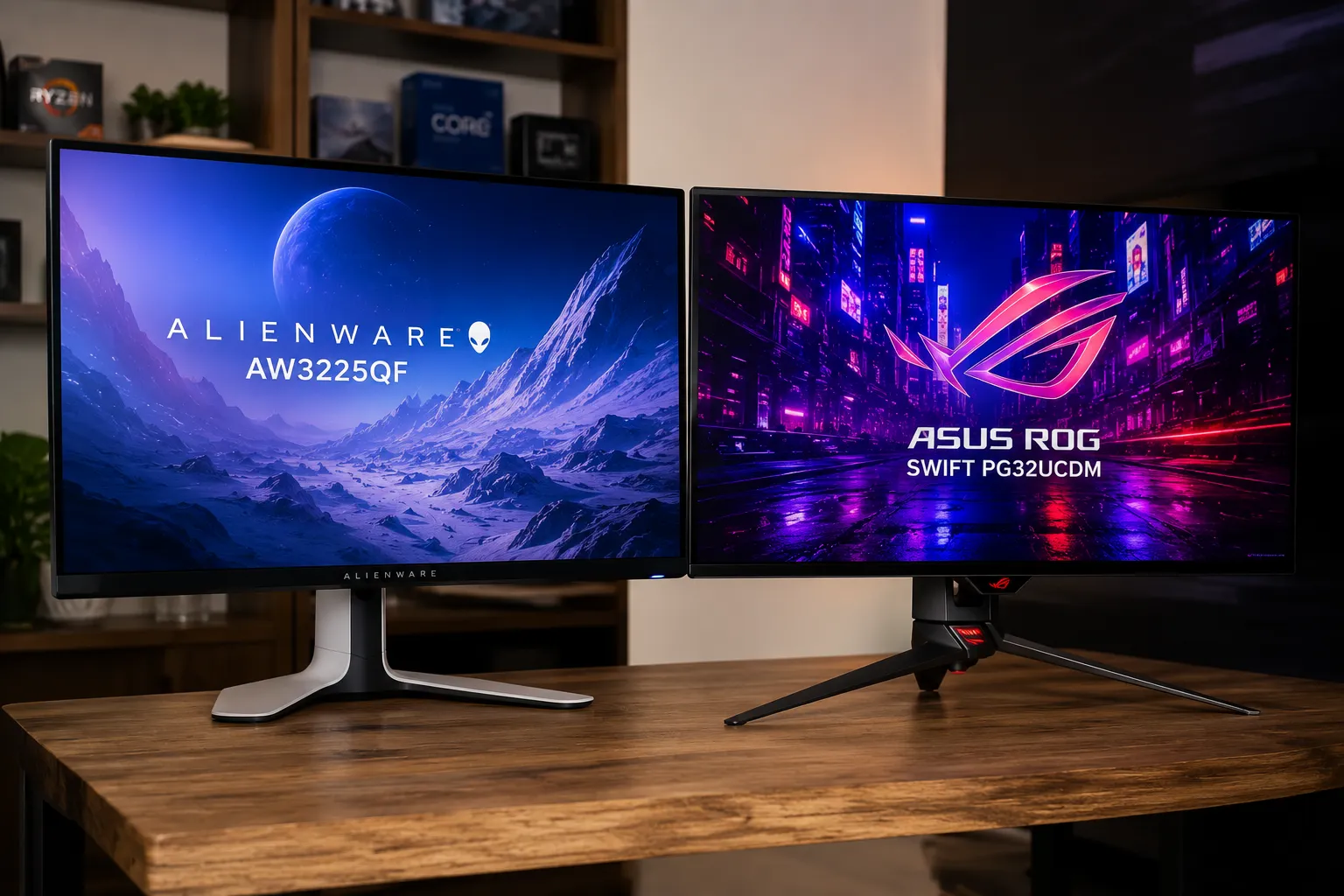
- A comprehensive 1,500-word head-to-head review comparing the Alienware AW3225QF vs ASUS ROG Swift PG32UCDM. We evaluate curved 1700R panels, graphene thermals, and eARC links.
The Comprehensive Comparison Review
The Immersive Command Station and Premium Creative Workspace Quotient
The desktop visual space has officially entered an uncompromising engineering era dominated by third-generation quantum-dot organic light-emitting structures. The ASUS ROG Swift OLED PG32UCDM sits at the absolute peak of premium, luxury flat-screen execution. It approaches desktop monitor tracking like an elite cybernetic statement, squeezing a custom internal cooling matrix, high-wattage power tracks, and exhaustive user calibration toggles inside a paper-thin luxury unibody built to capture no-compromise enthusiast budgets.
Conversely, the Alienware AW3225QF represents a bold mechanical disruption designed to break past traditional display alignment limits. Abandoning flat panels entirely, its display wraps a subtle, precise 1700R curved display geometry around your peripheral field of vision. By matching human eye curvature to eliminate side-angle color shifts, Alienware shifts the daily hardware narrative away from standard desktop layouts toward a deeply immersive, wrap-around gaming station that pulls you straight into the action.
This head-to-head matrix uncovers the definitive structural story of how these two 4K titans handle prolonged gaming and professional data processing workloads.
THE VISUAL, THERMAL, AND WORKSPACE GRID
- The Desktop Footprint and Stand Ergonomics Core:
Physical structural architecture dictates real-world workspace comfort over multi-hour deployment blocks. The ASUS PG32UCDM relies on an aggressive, heavy-duty die-cast aluminum triple-pronged stand assembly that provides immaculate stability, though its wide footprint reaches forward on a desk, requiring a deeper workspace layout. The panel edges wrap in a paper-thin 5mm profile by shifting the power layout out to a large external brick module.Alienware opts for a clean, low-profile, and highly compact V-shaped metallic base plate design on the AW3225QF. It sits comfortably flat against your desktop surface, freeing up massive amounts of real estate for large mouse movements or professional sound monitoring boards. The power supply module is integrated natively inside the main chassis back box—removing the clutter of an external brick entirely, though it increases the display’s center casing depth. - The Panel Physics & Saturated Color Tracking Performance:
Visual evaluations show identical linear outputs across standard testing, as both monitors house the exact same 3rd-Gen Samsung QD-OLED display glass. Pushing a native 4K UHD (3840 x 2160) resolution at a blistering 240Hz refresh rate and 0.03ms response speed, screen motion trails are completely non-existent on both screens.However, they separate drastically in physical orientation. Alienware’s 1700R curved wrap brings the edges of the 32-inch screen closer to your eyes, keeping the entire image at a uniform viewing distance to minimize eye fatigue during extended gaming runs. The ASUS flat pane provides a classic, unwarped canvas preferred by professional video editors and architectural designers who demand straight, non-curved baseline perspective maps. - Acoustic Cooling Networks & OLED Burn-In Defenses:
Dissipating heat out of organic pixel layers without using high-pitched cooling fans is a major challenge for hardware longevity. ASUS handles this by deploying a thick custom graphene film backing sheet mated to an expanded passive aluminum heatsink block. This structural setup runs completely silent and lowers operating temperatures by up to 10% compared to older designs. Alienware deploys its own fan-free cooling network, combining internal thermal ventilation paths cut directly into the rear casing structure with graphite cooling pads. Both models are so confident in their silent thermal designs that they bundle full 3-year burn-in protection warranties out of the box, augmented by automatic software pixel shifting and localized dimming scripts. - Multi-System Connectivity & KVM Workspace Utility:
Modern console and computing inputs are handled beautifully across both back panels, but follow different layout architectures. Both displays feature dual HDMI 2.1 lanes that support uncompressed 4K 120Hz gaming with Variable Refresh Rate (VRR) activated natively for systems like the Sony PS5 Pro.The divide shows up in specialized I/O features. Alienware unseats ASUS for living room TV setups by embedding native HDMI 2.1 eARC (Enhanced Audio Return Channel) support into its secondary port, allowing you to route uncompressed Dolby Atmos audio straight to high-end home theater soundbars. ASUS completely dominates desktop computer productivity by packing a massive 90W Type-C Power Delivery track and a built-in KVM Switch, letting you charge power-hungry pro laptops over a single cable while controlling your laptop and desktop with one mouse and keyboard deck.
Real-World Monitor Performance Experience: 4 Everyday Performance Benchmarks
1. “Cyberpunk 2077” — Night City Neon Overdrive Sprints
- Alienware AW3225QF: The 1700R curve wraps the neon skyline and glowing dark alleys beautifully around your eyes, creating an incredible sense of cockpit depth. Specular highlight flashes pop cleanly against deep, infinite ink-black shadows with absolute zero gray halo bloom.
- ASUS PG32UCDM: The flat pane provides a massive, perfectly linear window view. The custom firmware maps localized peak highlights aggressively up to its full 1,000-nit threshold. The visual contrast is spectacular, keeping dark space textures ink-like and flawless.
2. “Counter-Strike 2” — High-Velocity 240Hz Esports Tracking
- Alienware AW3225QF: The immersive wrap pulls your peripheral vision into the corners, making it slightly easier to register movement on the edges of the screen. Rapid 180-degree camera flicks reveal absolutely zero motion blur or screen tearing lines.
- ASUS PG32UCDM: The gameplay feels equally fluid and instantaneous. Tracking high-speed competitive motion across the flat 32-inch screen is a complete joy, keeping fast-moving enemy outlines entirely sharp and responsive across its 240Hz plane.
3. “Blade Runner 2049” — 4K Dolby Vision Cinematic Check
- Alienware AW3225QF: Supports native Dolby Vision master profiles. Hooking up a streaming deck or console, the dark orange desert dust storms look remarkably uniform and color-rich, while the curved screen minimizes room light reflections along the edges.
- ASUS PG32UCDM: Delivers a breathtaking Dolby Vision presentation. The cinematic color palettes look stunningly organic, resolving fine shadow text details and deep background textures flawlessly, though the flat glossy screen picks up a bit more center reflections.
4. The Daily Desktop Office Commute (Text Clarity & Glare)
- Alienware AW3225QF: The updated sub-pixel structure renders fine spreadsheets and text documents with crisp edge clarity. The integrated power supply setup makes organizing your desk layout clean and fast, though text strings take on a very subtle curved perspective.
- ASUS PG32UCDM: Delivers matching text sharpness for office multi-tasking. The flat pane keeps lines perfectly straight for creative design, while the external power supply module requires neat cable routing beneath your setup.
TECHNOSYNE SCORE & VERDICT
Who Is It For?
- Choose the Alienware AW3225QF if: You want maximum wrap-around immersion for racing, flying, and open-world games, require HDMI eARC to route audio directly to a home theater soundbar, prefer an integrated power supply with a compact stand, and want to save money on your launch budget.
- Choose the ASUS ROG Swift PG32UCDM if: You are a professional creator or designer who demands a perfectly flat pane to keep visual lines entirely straight, require a massive 90W Type-C lane to charge your pro laptop, and want a built-in KVM Switch to run a dual-computer layout smoothly.
Highs & Lows
Alienware AW3225QF
- HIGH: Immersive 1700R curved display geometry perfectly drops peripheral eye strain.
- HIGH: Native HDMI 2.1 eARC support routes high-end Dolby Atmos audio straight to soundbars.
- HIGH: Highly compact V-shaped stand plate saves massive desktop mouse space.
- LOW: The subtle panel curve can distort perspective lines slightly during precision 3D modeling tasks.
ASUS PG32UCDM
- HIGH: Aggressive peak HDR highlight brightness curves with native Dolby Vision mastering support.
- HIGH: Powerful 90W USB-C KVM hub delivers massive single-cable pro laptop charging.
- LOW: The wide triple-pronged stand footprint cuts significantly into tight desk depths.
- LOW: Requires a premium initial financial investment compared to alternative models using the same panel.
Final Conclusions & 6-GRID Alternatives
The Alienware AW3225QF earns the absolute crown for gaming immersion, living room eARC integration, and price-to-performance index, making it a spectacular champion on our TVs & Gaming Signature Grid Tier. However, if you demand a perfectly flat creative canvas, a massive 90W Type-C workspace link, and a built-in hardware KVM Switch, the ASUS ROG Swift PG32UCDM remains an absolute luxury desktop masterpiece .
Technosyne 6-GRID Alternatives Combo:
- The Upgrade Choice (Elite Tier Full Setup): MacBook Pro M4 Max Workstation. To build a high-density creative station, connecting your 4K 240Hz gaming display directly to Apple’s flagship computing core lets you bridge elite ecosystem sync with massive multi-core processing power.
- The Value Choice (Value Tier Display): ASUS ROG Strix XG27AQMR. If you want to maximize high-refresh speed for competitive multiplayer shooters on a tighter budget under $550, dropping down to this 27-inch 1440p 300Hz fast-IPS setup is an excellent value choice.
Technosyne – Beyond Tech. Into the future of happy living.
Thank you for spending your time with Technosyne! Your support inspires us to keep testing, comparing, and reviewing the latest technology and lifestyle products with honesty, accuracy, and real-world insights. Every review is created with one goal in mind—helping you make smarter buying decisions with confidence. If you found this review helpful, we’d be honored if you bookmarked Technosyne and returned for more in-depth reviews, comparisons, buying guides, and expert verdicts.
Until next time, See you in the next Technosyne Verdict.!