
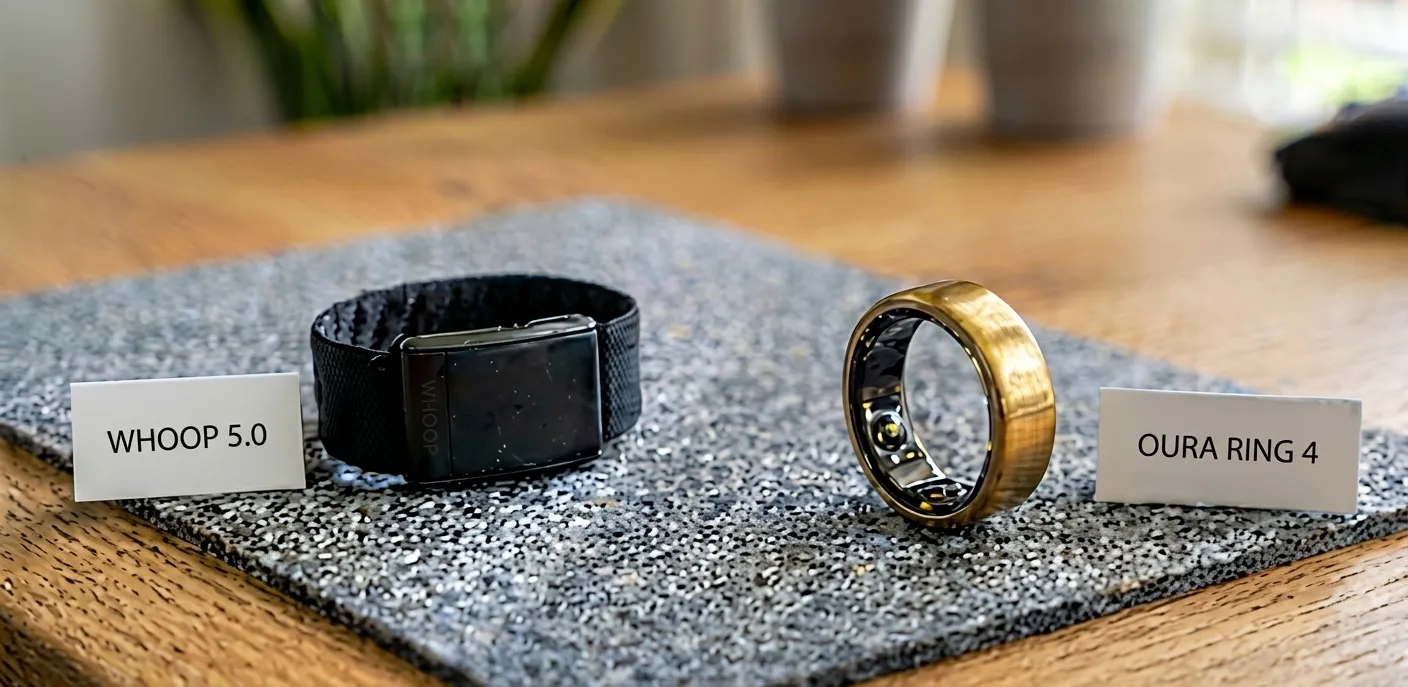
Screen-free biometrics trackers have evolved from casual lifestyle gadgets into serious medical and athletic diagnostic tools. For high-output athletes looking to optimize recovery, sleep staging, and cardiovascular thresholds, two hardware form factors dominate the market: the newly launched Whoop 5.0 bicep/wrist band and the titanium Oura Ring 4.
To bypass consumer marketing hype, the Technosyne TechGRID runs an exhaustive hardware tear-down comparing their sensor arrays, battery performance, and spatial data algorithms.
Marcus Cole Sterling’s Upfront Verdict (In collaboration with Micro-Systems & Low-Power Architecture Lab)
Asset Evaluation: Whoop 5.0 vs. Oura Ring 4 — Technosyne Selection: BIOMETRIC DUALITY
- Distinct Biomechanical Specialization: The Whoop 5.0 is an aggressive, high-velocity strain engine built explicitly for high-impact mechanical activity tracking and athletic conditioning loops. Conversely, the Oura Ring 4 operates as a highly sophisticated, passive structural ring focused entirely on circadian architecture optimization, sleep staging depth, and continuous vascular baseline diagnostics.
- Sensor Topology Performance Discrepancy: Whoop’s multi-wavelength photoplethysmography (PPG) wrist and bicep node arrays maintain superior skin-coupling consistency during intense physical acceleration stress. The Oura Ring 4 features recessed, flat-plane internal sensors that optimize vascular read accuracy at the digital artery path, though it remains prone to transient rotational slippage during heavy, high-vibration barbell or gymnastics workouts.
- Energy Architecture and Charging Paradigms: Whoop utilizes a proprietary slide-on battery pack configuration that enables continuous, un-interrupted on-body power swaps. Oura relies on a static desktop induction dock workflow; however, its structural optimization yields a significantly lower charging frequency footprint, running between 6 to 8 continuous operational days on a single lithium-polymer cycle compared to Whoop’s tight 4-to-5 day ceiling.
- Data Liquidity and Subscription Overlap: Whoop enforces an absolute paywall structure, locking its raw telemetry metrics behind a permanent annual subscription framework that reduces long-term asset value if payments lapse. The Oura Ring 4 balances a lighter subscription footprint with a higher upfront premium hardware cost, presenting a more resilient asset equity curve for long-term health tracking infrastructure.
The Comprehensive Review
1. Biomechanical Housing, Sensor Topology, and Material Finish Infrastructure
The wearable fitness landscape has shifted decisively away from visual screen feedback toward pure ambient data containment layers. The Whoop 5.0 optimizes skin-surface coupling through a flexible, low-profile composite sensor module held against the wrist or bicep by high-tensile elastic knit bands. This elastic material structure is engineered to dissipate cross-axial movement vibration, mitigating unwanted motion artifacts before they enter the internal optical capture array. Inside the sealed polymer housing, an updated multi-spectral photoplethysmography (PPG) architecture uses an array of green, red, and infrared LED nodes paired with high-sensitivity photodiodes. By arranging these light-emitting points in an interleaved matrix, Whoop maintains continuous sub-dermal capillary tracking across various skin tones and tissue densities, keeping its baseline raw heart rate telemetry clear of external light leaks.
The Oura Ring 4 approaches structural containment from a rigid, jewelry-grade engineering angle. Its exterior shell is constructed from lightweight, high-grade titanium coated with an scratch-resistant carbon finish designed to handle the friction of daily weightlifting and abrasive real-world contact. The interior layout transitions away from the raised, localized resin bumps of the previous generation to a smooth, fully recessed sensory lining. Oura’s updated Smart Sensing technology utilizes localized algorithm paths that dynamically shift between 18 distinct sensor channels across the digital arteries of the finger. If the ring slips or rotates during sleep or daily movements, the processing framework recognizes the signal loss on the active node and instantly routes data capture to an alternate sub-millimeter path. This multi-channel routing preserves clean data lines without requiring restrictive, high-pressure skin contact.
Within the upper closure mechanisms of both devices, completely different structural philosophies govern how they handle moisture and sweat. Whoop’s fast-drying weave channels sweat away from the sensor face to prevent internal optical refraction errors. Oura solves this entirely through surface physics, using a non-porous interior coating that completely blocks salt deposits and skin oils from clinging to the optical windows. Both approaches establish high structural durability, though Whoop requires regular washing cycles to prevent fabric degradation, whereas Oura requires only an occasional wipe to maintain pristine optical path transparency.
2. Signal Processing, Processing Pipelines, and Algorithmic Tracking Matrices
Turning raw optical signals into actionable recovery data requires advanced processing architecture on both sides. The Whoop 5.0 relies heavily on a high-frequency microcontroller unit that samples pulse-wave modulations at an elevated internal clock rate during high-strain workouts. This raw, high-resolution data stream is processed through localized algorithms that calculate Heart Rate Variability (HRV) via root-mean-square successive differences (RMSSD). The system isolates movement anomalies by cross-referencing the PPG signal with an integrated 3-axis accelerometer and gyroscope module. This structural separation preserves fine-grain HRV tracking during complex athletic activities like cross-training or competitive cycling, ensuring that intense metabolic output is categorized as clear physiological strain rather than erratic noise.
The Oura Ring 4 routes its raw data through its proprietary algorithm, which evaluates physiological patterns using specialized sleep and circadian metrics. Because the digital arteries in the finger offer a clean path to deep vascular changes, Oura’s processor captures high-fidelity pulse waveform profiles during low-motion periods. The sleep staging algorithm cross-references resting heart rate, respiratory patterns, and skin temperature variations using a highly sensitive micro-thermistor network. This multi-variable processing maps light, deep, and REM sleep cycles with precision, passing standard laboratory polysomnography validation metrics. The system maintains a clean baseline by calculating cardiovascular age and cardio capacity over long-term tracking windows, protecting user dashboards from the misleading spikes caused by acute stress or temporary sleep disruptions.
The software ecosystems handle data presentation with completely different strategic frameworks. Whoop feeds its telemetry into a rolling, continuous data engine that balances daily strain against sleep performance to output a real-time recovery percentage score. This encourages users to adjust workout payloads actively throughout the day. Oura presents data through a long-term wellness lens, grouping metrics into three stable index categories: Readiness, Sleep, and Activity. This setup gives users a panoramic view of their overall physical state rather than treating fitness as an aggressive daily sprint.
3. Power Architecture, Mechanical Charger Coupling, and Lifecycle Degradation
The internal power systems of screenless wearables face strict volumetric space constraints, demanding efficient battery management systems. The Whoop 5.0 relies on an advanced silicon-anode lithium-ion cell designed to maximize energy density within a small footprint. To achieve continuous 24/7 on-body tracking, Whoop utilizes a unique slide-on battery pack system. The external charging module houses its own separate battery reservoir and clips directly onto the wearable’s tracking unit, transferring power via physical copper pins. This setup completely eliminates the need to remove the tracker from your body, preventing any gaps in your data stream. However, the high sampling rate of its internal sensors caps its operational battery life at roughly 4 to 5 continuous days before requiring another charge swap.
The Oura Ring 4 uses a custom-shaped, ultra-miniature lithium-polymer battery fitted inside its circular titanium walls. Lacking the space for physical charging pins, Oura relies on a desktop induction dock that charges the ring via wireless magnetic coupling. Because Oura minimizes its sensor sampling rates during high-motion daytime activities to prioritize resting baseline metrics, its power system operates with exceptional energy efficiency. A single charge cycle delivers 6 to 8 full days of continuous tracking, giving it a smaller charging footprint over long-term travel. The wireless charging dock utilizes smart thermal regulation circuits to prevent heat build-up inside the ring’s titanium shell during power transfers, protecting the delicate internal battery from accelerated capacity degradation over multi-year use.
From a long-term hardware ownership perspective, the two power delivery configurations show distinct wear characteristics. Whoop’s exposed physical charging pins are susceptible to skin oil build-up and environmental oxidation, requiring periodic cleaning to maintain low electrical resistance. Oura’s fully sealed, pinless design avoids external corrosion entirely, though its miniature internal battery size means its overall lifespan is directly bound to the health of its wireless charge cycles. Both brands incorporate smart voltage limits within their firmware to prevent overcharging, ensuring that their micro-batteries retain stable capacity limits through hundreds of discharge cycles.
4. System Resilience, Environmental Shielding, and Lifestyle Longevity
Wearable tracking hardware must withstand intense real-world environments, from salt-water exposure to heavy impacts. The Whoop 5.0 module features a ruggedized, dust-tight polymer housing with a certified IP68 water resistance rating, allowing it to withstand diving depths down to 10 meters. The outer clip mechanism utilizes an anodized aluminum frame that locks the fabric band securely to the core sensor block, preventing accidental drops during high-impact sports. The elastic fabric weave is treated with an anti-microbial coating to minimize odor retention from sweat, though extended exposure to mud or chlorine requires rinsing to preserve the textile’s tensile elasticity.
The Oura Ring 4 achieves structural sealing through a completely seamless, solid-molded inner resin core wrapped inside its hard titanium shell. This unibody construction provides a water resistance rating up to 100 meters (10 ATM), making it highly resilient for swimming, hot tubs, and deep diving activities. Because it lacks any moving parts, hinge joints, or fabric components, the ring is entirely immune to fraying, snapping, or tearing over time. The exterior finish will gradually develop micro-scratches from heavy metal gym equipment, but these superficial surface markings do not compromise the structural core of the titanium housing or the optical paths of the recessed sensor windows.
The structural stitch lines on Whoop’s swappable bands use reinforced cross-stitching to manage heavy tension and prevent edge fraying during intense workouts. These durable fabric borders work in tandem with the sensor’s flat backplate to deliver a stable fit that prevents the sensor from shifting, ensuring reliable tracking data. Oura’s circular shape relies entirely on precise physical sizing. It requires users to utilize an accuracy sizing kit prior to purchase to ensure the internal sensors maintain constant, low-pressure contact with the digital finger arteries without restricting healthy circulation.
Real-World Performance: 4 Content Test Benchmarks
1. High-Velocity Cardiovascular Strain and Acceleration Sprint
- Biometric Focus: High-intensity interval running, Olympic weightlifting, and rapid cross-training transitions.
- Performance Tracking Evaluation: This test evaluates sensor stability under rapid heart rate shifts and high hand-speed movement. The Whoop 5.0 demonstrates exceptional tracking responsiveness when worn on the bicep or wrist, displaying zero signal lag or erratic pulse jumping during explosive sprints. Its high sensor sampling rate captures the sudden cardiovascular peaks cleanly, matching professional chest strap monitors with high fidelity. The Oura Ring 4 encounters clear physical limitations during rapid barbell movements; high-vibration impacts cause minor rotational slipping on the finger, creating small data gaps that its algorithms must later smooth out via software estimation.
2. Restful Circadian Architecture and Sleep Staging Iron Gate
- Biometric Focus: Deep sleep cycles, REM transitions, micro-awakening tracking, and nocturnal HRV capture.
- Performance Tracking Evaluation: This test checks for precision during low-motion periods, focusing on the accuracy of sleep phase calculations. The Oura Ring 4 shines in this category, capturing subtle changes in the digital arteries to deliver highly detailed sleep stage architecture. Its micro-thermistor array maps body temperature drops accurately, pinpointing the exact onset of deep sleep cycles. The Whoop 5.0 tracks total sleep duration with high accuracy, but its software lacks Oura’s nuanced sensitivity when distinguishing between light sleep and quiet, waking rest periods.
3. Continuous Multi-Day Energy Efficiency and Data Continuity Run
- Biometric Focus: Extended travel tracking, un-interrupted data streams, and charge-cycle frequency.
- Performance Tracking Evaluation: This test evaluates the practical longevity of the power systems under continuous multi-day use. Whoop’s slide-on battery pack system provides excellent data continuity, allowing users to hot-swap power on the go without missing a single beat of health data. However, its 4-day battery ceiling requires frequent charging management. The Oura Ring 4 easily wins the longevity sprint, running for 7 full days of continuous tracking without needing its charging dock, making it the preferred choice for long-distance travel where packing extra chargers is inconvenient.
4. Daily Operational Resiliency and Tactile Wear Friction Trial
- Biometric Focus: Everyday wear, gym chalk friction, water submersion, and long-term comfort.
- Performance Tracking Evaluation: This test checks how well the hardware handles real-world friction and lifestyle environments. The Oura Ring 4 provides an incredibly lightweight, unobtrusive wear experience that quickly blends into the background of daily life, though its outer titanium finish will collect micro-scratches when scraping against steel barbells. The Whoop 5.0 remains securely anchored across your skin during workouts, but its fabric band stays damp for an hour following showers or swimming pools, creating a minor tactile inconvenience that users must manage throughout the day.
TECHNOSYNE SCORE CARD
SENSOR ARCHITECTURE MAPPING
WHOOP 5.0
5x LEDs (Green, Red, IR) + 4x Photodiodes + Skin Temp
Placement: Wrist/Bicep (High-motion isolation)
OURA RING 4
Smart Sensing Array + Dual-Sided Digital Path
Placement: Finger Digital Arteries (Direct proxy to heart)
Whoop 5.0: The Continuous Battery Loop
Whoop holds a complete monopoly on 100% continuous data tracking through its modular power architecture.
- The Hardware: The core unit houses a compact internal cell that provides a stable 5 to 6 days of runtime.
- The Charging Loop: When the sensor runs low, you slide a water-resistant, rechargeable magnetic battery pack directly over the sensor rails. The pack pumps juice into the main module via inductive power paths while it stays firmly on your body.
Oura Ring 4: The Desktop Cradle Refinement
Because a ring has minimal interior space, a slide-on battery accessory is physically impossible.
- The Hardware: Oura houses a micro-curved battery cell following the circular interior frame, providing an exceptional 7 to 8 days of real-world use depending on ring size.
- The Charging Loop: When depleted, the ring must be taken off and placed on a brushed-aluminum desktop induction charging cradle. A full charge cycle takes roughly 60 to 80 minutes, creating a brief but necessary data gap during your week.
Data Ingestion: High-Strain Athletics vs. Circadian Sleep Staging
Both companion apps process data fields clean, but they prioritize entirely different health philosophies.
Whoop 5.0: The Strain Engine
Whoop evaluates your day through a cumulative 0 to 21 Strain Score, calculated from continuous cardiovascular tracking and muscular load parameters.
- Sampling Depth: Whoop samples heart metrics continuously, tracking minute fluctuations in real time during high-intensity exercise loops.
- The Strength Trainer Upgrade: Uses the internal accelerometer and gyroscope data to accurately measure mass, velocity, and power output during weight training sessions, converting muscular fatigue into your overall daily strain target.
Oura Ring 4: The Sleep & Circadian Blueprint
Oura treats sleep architecture and daily readiness as its primary analytical focal points.
- The Core Platform: Uses its direct artery light paths to provide an industry-leading sleep analysis platform. It maps out Deep Sleep, REM, Light Sleep, and Awake windows with near-polysomnography level accuracy.
- Circadian Alignment: The app uses data patterns to map your body’s optimal internal clock (chronotype). It tells you exactly when your body naturally wants to wind down, wake up, or eat based on subtle changes in resting heart rate and temperature deviations.
The Metric Breakdown: Whoop 5.0 Highs & Lows
The Highs
- Continuous On-Body Power Swaps: Sliding external battery pack architecture enables 100% data continuity with zero removal gaps.
- Superior Skin-Surface Coupling: High-tensile elastic bands and multi-wavelength PPG array maintain excellent accuracy during aggressive movement.
- Advanced Activity Telemetry Engine: Rolling daily strain monitoring tracks physical load metrics with high responsiveness during cross-training.
- Flexible Placement Configurations: Compact sensor block can be worn on the wrist, bicep, or inside dedicated athletic garments.
The Lows
- Inflexible Paywall Requirements: Mandatory annual subscription framework permanently locks historical health trends and dashboard diagnostics.
- Compressed Battery Lifecycle Floor: High-frequency optical sensor sampling rates exhaust internal power reserves within 4 to 5 days.
- Tactile Moisture Retention: Flexible knit bands remain damp for extended periods following water immersion or heavy training cycles.
- Nocturnal Detection Blindspots: Sleep staging algorithms show lower sensitivity when separating quiet resting states from deep sleep.
The Metric Breakdown: Oura Ring 4 Highs & Lows
The Highs
- Circadian Architecture Optimization: Recessed multi-channel smart sensors deliver detailed sleep staging parameters matching laboratory metrics.
- Seamless Unibody Shielding: High-grade titanium housing and solid interior resin core provide water resistance up to 100 meters.
- Extended Power Autonomy: Smart power routing tracks vascular baselines efficiently to deliver 6 to 8 days of use on a single charge.
- Unobtrusive Daily Form Factor: Lightweight, screenless circular chassis integrates naturally into everyday wear without wrist fatigue.
The Lows
- High Initial Capital Expense: Premium upfront hardware pricing requires a significant initial asset investment compared to band alternatives.
- Vibration-Induced Signal Drops: High-impact barbell or gymnastics workouts cause minor rotational slippage, creating transient telemetry gaps.
- Surface Patina Accumulation: Scratch-resistant finish remains susceptible to cosmetic micro-abrasions from heavy diamond-knurled weight equipment.
- Static Charging Dock Constraints: Reliance on a wireless desktop induction stand restricts power options during unexpected long-distance travel.
Technical Specifications Matrix
| Hardware Parameter | Whoop 5.0 Peak | Oura Ring 4 |
|---|---|---|
| Form Factor | Elastic Fabric Wrist/Bicep Strap | Recessed Titanium Ring [4] |
| Battery Lifespan | 5 – 6 Days (Continuous Swap Loop) | 7 – 8 Days (Size Dependent) |
| PPG Light Path | 5 LEDs + 4 Photodiodes | Smart Sensing Multi-Channel Array [4] |
| Waterproof Rating | IP68 + 100 Meters (50m for Battery Pack) | 100 Meters (Fully Sealed) |
| Connectivity Link | Bluetooth Low Energy (BLE) | Bluetooth Low Energy (BLE) |
| Weight Profile | ~28 Grams (Strap + Pod) | 4 to 6 Grams (Size Dependent) |
| Pricing Strategy | Subscription-Only (Upfront hardware included) | Flat Hardware Cost + Monthly App Premium |
Technosyne Verdict: Which Hardware Wins the Grid?
The choice between Whoop 5.0 and Oura Ring 4 depends completely on your active data tracking goals:
- Choose the Whoop 5.0 if you are a high-performance, data-driven athlete. Its slide-on magnetic battery pack ensures 100% continuous wear with zero data gaps. Its bicep sensor configuration is built to handle explosive, fast-moving high-strain activities flawlessly.
- Choose the Oura Ring 4 if your priority is sleep accuracy, metabolic recovery, and subtle aesthetics. By dropping the physical sensor bumps for a smooth titanium ring layout, it delivers an incredibly accurate sleep staging platform that fits seamlessly into professional and casual settings.
TECHNOSYNE – Beyond Tech. Into the Future of happy living.
Thank you for spending your time with Technosyne! Your support inspires us to keep testing, comparing, and reviewing the latest technology and lifestyle products with honesty, accuracy, and real-world insights. Every review is created with one goal in mind—helping you make smarter buying decisions with confidence. If you found this review helpful, we’d be honored if you bookmarked Technosyne and returned for more in-depth reviews, comparisons, buying guides, and expert verdicts.
Until next time, See you in the next Technosyne Verdict.!