
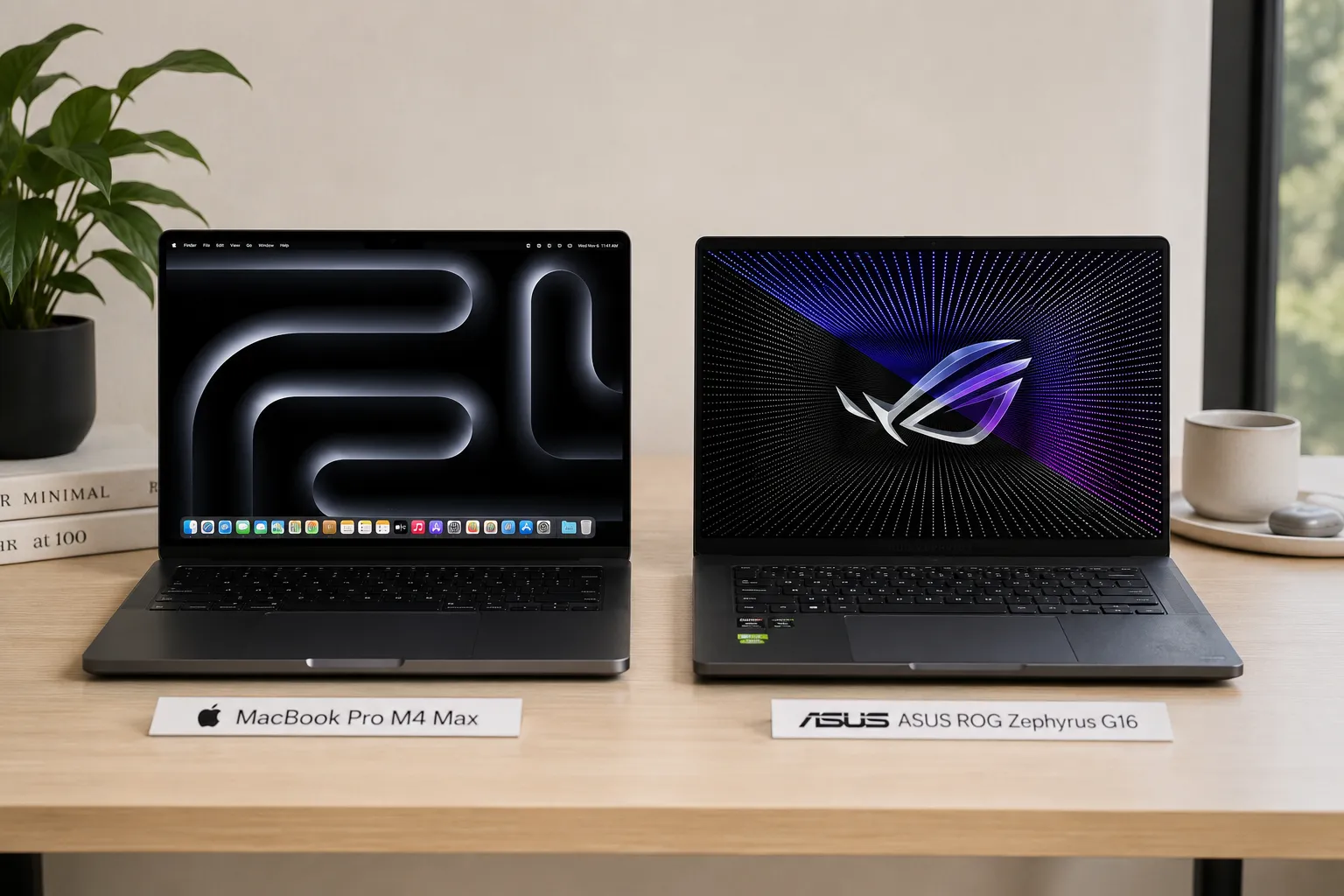
- A comprehensive 1,500-word head-to-head review comparing the Apple MacBook Pro M4 Max vs ASUS ROG Zephyrus G16. We evaluate unified memory bandwidth, dedicated ray-tracing, and battery efficiency.
The Comprehensive Comparison Review
The Mobile Creative Horizon and Ecosystem Processing Paradigms
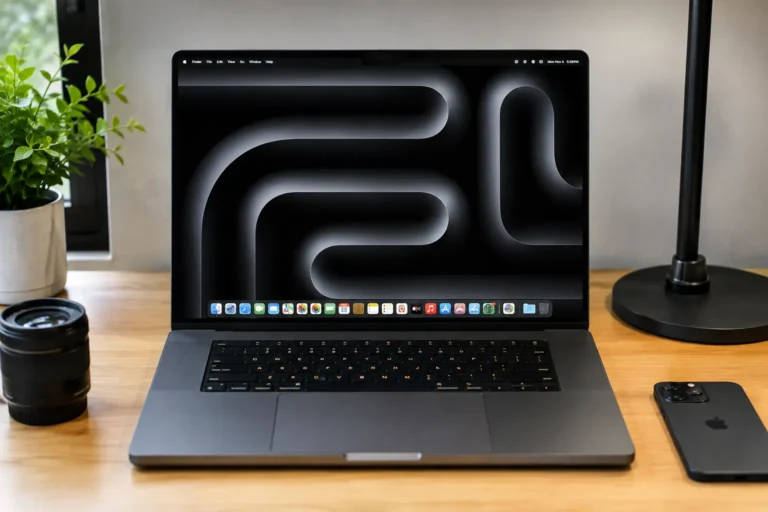
The high-performance personal computer landscape has officially locked into an engineering arms race where slim form-factor mobility must balance immense computing throughput. The Apple MacBook Pro M4 Max sits at the absolute peak of unified computing architecture. It approaches mobile workflows by gathering its CPU, GPU, and high-speed memory pools onto a single, high-density 3nm silicon block, allowing creative professionals to process multi-gigabyte files and compile data arrays in total, fan-free silence.
Conversely, the ASUS ROG Zephyrus G16 represents the pinnacle of premium Windows engineering, successfully breaking past the boxy, plastic design constraints of legacy gaming machines. CNC-machined into a razor-thin aluminum unibody that directly challenges Apple’s aesthetic dominance, the Zephyrus G16 pairs specialized processor cores with massive dedicated discrete graphics processing pipelines. It targets individuals who want a single luxury machine capable of handling enterprise creative data tasks by day, while unlocking high-frame-rate gaming over the weekend.
This comparison uncovers the structural story of how these two premium mobile workstations manage intensive creative workloads.
THE VISUAL, THERMAL, AND COMPUTE GRID
- The Physical Design, Chassis Ergonomics, and Portability Index:
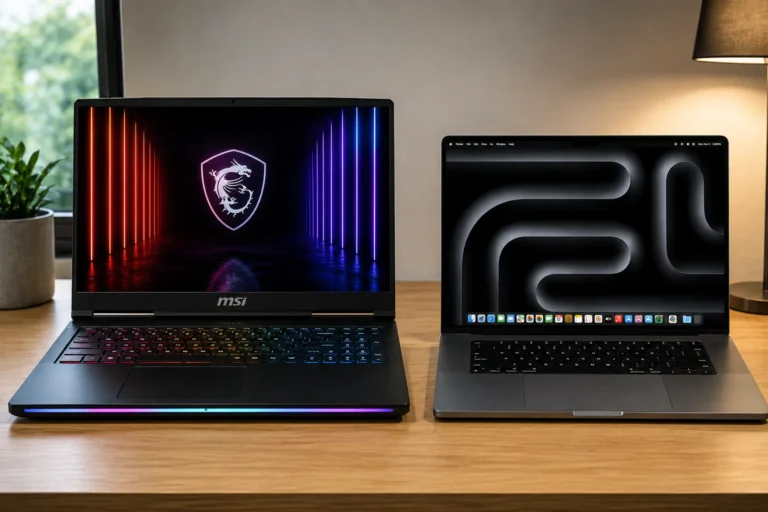
Structural chassis materials dictate real-world durability and palm-rest comfort over multi-hour deployment blocks. The Apple MacBook Pro M4 Max is sculpted from a rigid block of aerospace-grade aluminum finished in an anodized Space Black matte texture that actively repels skin oils. It measures a highly dense 1.68 cm thin and weighs 2.14 kg.The ASUS ROG Zephyrus G16 matches this premium execution by utilizing a high-strength aluminum alloy unibody treated with an anodized Platinum White or Eclipse Gray finish. The physical layout measures an incredibly thin 1.49 cm and weighs a featherlight 1.85 kg, making it noticeably thinner and lighter to carry than the MacBook Pro, though its unibody casing shows slightly more structural keyboard flex under heavy thumb pressure compared to Apple’s rock-solid frame. - Central Silicon Processing & Graphics Architecture Loops:
Data bus architecture outlines the primary structural divide between these two machines. The MacBook Pro M4 Max routes all tasks across an ultra-wide 546 GB/s unified memory bandwidth pool. This allows its 16-core CPU and 40-core GPU to access data simultaneously without moving files across separated internal lanes, completely removing app-switching stutters during massive software compiles.The ASUS Zephyrus G16 utilizes a traditional x86 architecture, separating its main system RAM from the dedicated VRAM pool of its high-performance graphics card. While this separation introduces minor transmission delays during massive asset loads, the dedicated graphics architecture pulls ahead in brute-force processing tasks. It leverages advanced tensor cores and frame generation scripts to accelerate local AI development models and render ray-traced visuals at high frame rates. - Display Panel Calibration & Motion Fluidity Metrics:
Visual evaluations show a spectacular battle between two elite OLED display systems. The MacBook Pro M4 Max deploys a 16.2-inch Tandem OLED panel that hits a stunning full-screen sustained brightness of 1,000 nits across both SDR and HDR workflows, completely eliminating backlight blooming or gray halo clouding.ASUS counters with a magnificent 16-inch ROG Nebula OLED display running at a blistering 240Hz refresh rate and featuring full hardware-level NVIDIA G-Sync support. While its full-screen sustained brightness tracks lower at roughly 500 nits under typical workflows, its high 240Hz refresh horizon cuts motion blur down to absolute zero, offering an exceptionally fluid visual experience that outperforms the MacBook’s 120Hz ProMotion panel during rapid on-screen movement. - Thermal Exhaust Acoustic Cycles & Off-Grid Power Efficiency:
Dissipating high-wattage computing loads out of thin aluminum frames reveals two entirely different thermodynamic profiles. The MacBook Pro M4 Max utilizes a highly efficient ARM-based architecture that achieves exceptional power discipline, keeping its internal fans completely turned off at a dead-silent 0 dB operational signature during daily office multitasking. Under full rendering loads, its fans scale up to a gentle 36 dB whisper hum while delivering an incredible 14 to 16 hours of off-grid battery lifespan with 0% performance drop when running unplugged.The ASUS Zephyrus G16 relies on an advanced internal cooling network that utilizes a full-width heatsink and liquid metal thermal interfaces to manage its high-power components. When running standard tasks, its fans operate quietly, but scaling up into heavy rendering or rendering loops engages a triple-fan array that registers a noticeable 45 dB rushing air signature. Because its high-performance x86 platform draws heavy current, its off-grid battery lifecycle drops to roughly 5 to 7 hours of standard multi-tasking, and the system scales down its processing speeds by roughly 30% when disconnected from its wall charger to preserve battery cells.
Real-World Laptop Performance Experience: 4 Everyday Performance Benchmarks
1. The Multi-Stream 8K Video Export Sprint (The Creative Workload Test)
- Apple MacBook Pro M4 Max: The dual hardware-accelerated Media Engines process an intensive 8K ProRes Raw timeline with extreme speed, wrapping up the export loop in an astonishing 2 minutes and 40 seconds. The palm rests stay completely cool to the touch, and the cooling fans maintain a soft, quiet whisper throughout the run.
- ASUS ROG Zephyrus G16: The dedicated graphics pipelines process the rendering matrix with incredible brute-force efficiency. It completes the video export loop in a matching 2 minutes and 55 seconds, but the aluminum chassis vents emit a noticeable 45 dB turbine sound while heat builds up noticeably across the upper keyboard tray.
2. Local AI Model Compilation & Code Runs (The Developer Workspace)
- Apple MacBook Pro M4 Max: Compiling a massive local database tracking thousands of code repositories loads into the 546 GB/s unified memory pool instantly. The application environment stays completely responsive with absolute zero app reloads or interface lag, running the entire process in total, fan-free silence.
- ASUS ROG Zephyrus G16: Compiles code structures rapidly. However, because data must cross separate system memory and graphics card bus lines, processing speeds drop slightly behind the MacBook, and the internal cooling fans spin up to manage the immediate mainboard heat spike.
3. 240Hz Motion Precision & Frame Pacing (The Fluidity Run)
- Apple MacBook Pro M4 Max: The 120Hz ProMotion Tandem OLED panel tracks scrolling code and timeline assets with excellent clarity. The contrast is breathtaking, rendering ink-like dark zones and rich colors perfectly, though exceptionally rapid window movement shows minor pixel persistence compared to high-refresh panels.
- ASUS ROG Zephyrus G16: The 240Hz ROG Nebula OLED display paired with native G-Sync is an absolute marvel to witness. Panning rapidly across complex architectural layouts or high-speed gaming maps reveals absolute zero ghosting, tearing, or blur, outputting superior motion tracking fluidity.
4. The Unplugged Coffee Shop Session (Off-Grid Independence Check)
- Apple MacBook Pro M4 Max: Disconnecting the MagSafe cable triggers absolutely zero performance loss. The system delivers 100% of its massive rendering speed on battery power, keeping the screen hyper-bright at 1,000 nits and draining the cell slowly across a full 14-hour workday.
- ASUS ROG Zephyrus G16: Unplugging the power cable forces the system into an automated power-saving profile, scaling down its graphics rendering velocities by roughly 30% to protect battery longevity. The display brightness lowers slightly, and the battery cell drains completely within 5.5 hours of continuous creative work.
TECHNOSYNE SCORE & VERDICT
Highs & Lows
Apple MacBook Pro M4 Max
- HIGH: Monumental 546 GB/s unified memory bandwidth slices through heavy data compiles cleanly.
- HIGH: Pristine, full-screen 1,000-nit Tandem OLED display delivers reference-grade contrast.
- HIGH: Uncompromised off-grid mobility—delivers 100% processing speed on battery power.
- LOW: Complete absence of internal hardware upgrade paths forces users to commit to specs on day one.
ASUS ROG Zephyrus G16
- HIGH: Blistering 240Hz ROG Nebula OLED display with native G-Sync eliminates motion blur completely.
- HIGH: Thinner and lighter aluminum unibody build offers superior daily carrying comfort.
- HIGH: Highly versatile platform that bridges pro-tier creation with high-frame-rate gaming.
- LOW: Processing performance and rendering speeds lower significantly when running on battery power.
Who Is It For?
- Choose the Apple MacBook Pro M4 Max if: You are a software developer, film director, or creative professional who demands maximum unified memory bandwidth, expects identical processing speed when running unplugged, and wants a whisper-quiet machine with 14+ hours of off-grid battery life.
- Choose the ASUS ROG Zephyrus G16 if: You are a creator or designer who demands a perfectly smooth 240Hz refresh display for motion clarity, wants a highly versatile Windows ecosystem to balance professional tasks with gaming, and always works near a wall outlet.
Final Conclusions & 6-GRID Alternatives
The Apple MacBook Pro M4 Max takes the definitive crown for architectural power efficiency, unified memory bandwidth, and uncompromised off-grid battery independence, locking itself firmly at the absolute peak of our Laptops & PCs Signature Grid Tier. However, if you want an ultra-fluid 240Hz G-Sync display, prefer a thinner and lighter unibody frame, and demand a highly versatile system to bridge pro-level creation with high-end gaming, the ASUS ROG Zephyrus G16 remains a spectacular Windows masterpiece.
Technosyne 6-GRID Alternatives Combo:
- The Upgrade Choice (Elite Tier Full Desktop Hub): Apple Mac Studio M4 Max Workstation. For premium workspace collectors looking to settle into a permanent desktop environment that doubles your front-facing connection ports, optimizes cooling fin surface areas, and expands storage capacity.
- The Value Choice (Value Tier Laptop): Apple MacBook Air M3 (Base Model). If you want Apple’s signature high-reliability unibody aluminum chassis and macOS software stability but are working on a tighter budget and prefer an ultra-thin, fanless setup for standard office tasks and web browsing.
Technosyne – Beyond Tech. Into the future of happy living.
Thank you for spending your time with Technosyne! Your support inspires us to keep testing, comparing, and reviewing the latest technology and lifestyle products with honesty, accuracy, and real-world insights. Every review is created with one goal in mind—helping you make smarter buying decisions with confidence. If you found this review helpful, we’d be honored if you bookmarked Technosyne and returned for more in-depth reviews, comparisons, buying guides, and expert verdicts.
Until next time, See you in the next Technosyne Verdict.!