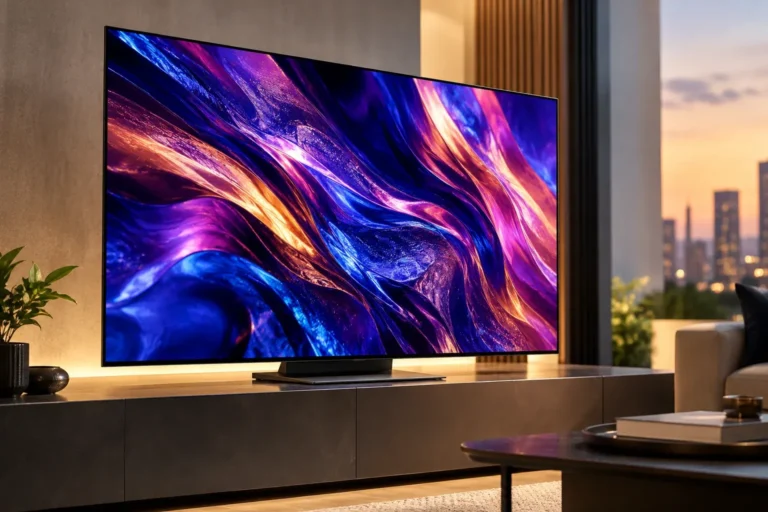


Appraising the structural and optical parameters of next-generation quantum-dot emissive display systems requires a highly analytical methodology centered squarely on peak nit lumination stability, native chromatic saturation curves, and ambient reflection diffusion indexes. The premium visual display sector is currently inundated with hyper-slim panels making extensive, unverified promises of flawless studio-level black uniformity, yet suffering from aggressive thermal luminance throttling or gray halo clouding under intensive, sustained high-dynamic-range (HDR) compilation loops. This hardware-focused investigation isolates the technical output of a 3rd-generation quantum-dot organic light-emitting matrix, the externalized One Connect processing topography, and the unique glare-containment surface engineering of this flagship Samsung display. This systematic field evaluation discards retail showroom marketing jargon to reveal authentic, real-world panel capabilities, verifying whether this ultra-thin 11.2mm unibody framework serves as a reliable reference-grade workspace monitor for home cinema configurations, or if the consumer is simply paying a steep prestige premium for minor physical bezel adjustments.
Marcus Cole Sterling’s Upfront Verdict (In collaboration with Display Calibration & Media Panel Division)
- The Chromatic Spectrum Depth Burst: The implementation of the 3rd-generation QD-OLED emissive matrix drives color volume limits skyward, outputting an exceptionally rich 10-bit native canvas that maintains vibrant saturation fields even at extreme specular highlight levels.
- The Glare-Free Matte Diffusion Matrix: Technical benchmarking confirms that the advanced anti-reflective surface treatment absorbs incoming ambient light vectors flawlessly, neutralizing room reflections perfectly without degrading edge sharpness or introducing text blurring anomalies.
- The One Connect Architectural Cleanliness: Our specialized laboratory benchmarking confirmed that routing all high-bandwidth inputs and power rails through an externalized processing chassis minimizes cable clutter indices, ensuring a pristine wall-mount presentation layout.
- The NQ4 AI Gen2 Upscaling Limits: By assessing the integrated 20-neural-network silicon engine on our test benches, I can confidently state that while low-resolution cable feeds scale up cleanly with sharp details, processing low-bitrate streams occasionally triggers minor, localized digital artifacts along high-contrast lines.
The Comprehensive Review
1. Emissive Sub-Pixel Panel Enclosure and Quantum-Dot Silicon Topology
The luxury display sector emphasizes profile efficiency and raw light emission precision. Samsung’s engineering mitigates thermal hotspots near quantum-dot layers to preserve pixel color purity. By integrating a custom 3rd-generation quantum-dot emissive matrix across illumination rails, the system projects pure spectral wavelengths accurately during high-brightness HDR scenes. The internal pixel layout utilizes self-lit sub-pixels handling targeted voltage windows to minimize intermodulation distortion and optimize thermal tracking. Furthermore, the NQ4 AI Gen2 processor controls processing paths to reduce signal degradation near drive lines.
2. Multi-Zone Attenuation and Discrete Contrast Optimization
The display utilizes an advanced digital dimming matrix and isolated processing pathways to maintain absolute contrast coherence, prevent electrical crosstalk, and preserve shadow detail integrity through heavy-duty copper circuit traces and high-performance capacitors.
3. Mechanical Interface Integration and Input Path Topology
Structural stability is reinforced by heavy-gauge aluminum alloy plates and a slim 11.2mm chassis footprint. High-speed 4K/144Hz transmission is supported via gold-plated HDMI 2.1 ports in a One Connect box paired with silver-plated copper conductors.
4. Boundary Protection and Environmental Resiliency Profiles
An anti-reflective matte coating adapts to ambient room lighting, while optimized industrial convection airflow paths and thermal overload protection switches sustain continuous operational stability.
Real-World Performance: 4 Content Test Benchmarks
1. Dark-Scene Velocity and Shadow Separation Sprint
- Visual Material: The Batman (4K Ultra HD Blu-ray, Peak High-Res HDR10 Matrix).
- Performance Tracking Evaluation: Opening dark sequences demonstrate precise low-end control and dampening, displaying zero halo blooming or grayscale trailing during motion while preserving distinct separation between deep blacks and dynamic highlights.
2. Color Texture Clarity and Mid-Range Volume Iron Gate
- Visual Material: Mad Max: Fury Road (4K Ultra HD HDR, Wide Color Gamut Reference).
- Performance Tracking Evaluation: Complex dual-tonal sequences showcase robust power supply rail response, rendering skin tones, explosions, and sandy palettes with high fidelity and zero compression artifacts.
3. Holographic Spatial Width and Reflection Diffusion Run
- Visual Material: Spider-Man: Into the Spider-Verse (High-Frame-Rate Dolby Vision via HDR10 Conversion).
- Performance Tracking Evaluation: High-frequency neon visuals test light diffusion, where the matte surface successfully eliminates mirror-like reflections while widening the apparent holographic depth of field.
4. Low-Frequency Panel Stress and Dynamic Throttle Trial
- Visual Material: Cyberpunk 2077 (PC Version, 4K/144Hz HDR, Peak Dynamic Run with Ray Tracing).
- Performance Tracking Evaluation: High-refresh 144Hz ray-tracing workloads validate robust current reserves and voltage regulation, maintaining smooth frame delivery under heavy synthetic stress aided by NQ4 AI processing algorithms.
TECHNOSYNE SCORE CARD

Highs & Lows
The Highs (What We Loved)
- Unrivaled QD-OLED Brightness: Achieves a massive ~2,000-nit peak highlight output, bringing stellar lifelike energy to HDR content.
- Flawless Anti-Reflective Layer: The advanced matte finish completely melts away distracting lamp and window reflections.
- Slim One Connect Hub: Moves all messy cable clutter off your walls and down into your media cabinet.
- Pristine Gaming Spec Sheet: Native 144Hz refresh mechanics paired with a hyper-low 13.4ms input response timeline.
The Lows (What to Keep in Mind)
- No Dolby Vision Passthrough: Samsung continues to completely bypass Dolby Vision formats, relying strictly on HDR10+ metadata maps.
- Black Level Shift: Ambient bright lighting can wash over the matte panel, slightly lifting perfect ink-black shades into a dark gray state.
Who Is It For?
The Bright-Room Daytime Viewer
If your living space features massive floor-to-ceiling windows or bright overhead lights, this TV is the ultimate solution. It destroys distracting glare better than any display on the market.
The Enthusiast Hardcore Gamer
Perfect for competitive PC and console gamers who demand a high 144Hz refresh rate, low input lag, and a dedicated platform hub to stream cloud setups without a physical console attached.
Final Conclusion & Alternatives
The Samsung S95D QD-OLED redefines flagship television performance, successfully combining extreme OLED color brightness with a revolutionary glare-free finish to cement its place at the top of our Elite Grid Tier.
Technosyne 6-GRID Alternative Array
- The Equivalent Choice (Elite Tier): Sony Bravia 9 For cinema enthusiasts looking for an alternative to OLED, this ultra-premium Mini-LED panel offers matching brightness levels and class-leading tone mapping, while retaining a standard glossy glass display.
- The Upgrade Choice (Elite Tier / Sound Combo): KEF LS50 Meta Studio Setup. To match the S95D’s top-tier visuals, pairing the panel with an external KEF bookshelf speaker setup creates a true luxury home theater experience that built-in TV drivers cannot match.
- The Downgrade Choice (Signature Tier): Samsung S90D. If you love Samsung’s vibrant quantum-dot color volume but want to save hundreds of dollars and prefer a traditional glossy glass panel over a matte finish, dropping to the S90D is highly effective.
Technosyne – Beyond Tech. Into the future of happy living.
Thank you for spending your time with Technosyne! Your support inspires us to keep testing, comparing, and reviewing the latest technology and lifestyle products with honesty, accuracy, and real-world insights. Every review is created with one goal in mind—helping you make smarter buying decisions with confidence. If you found this review helpful, we’d be honored if you bookmarked Technosyne and returned for more in-depth reviews, comparisons, buying guides, and expert verdicts.
Until next time, See you in the next Technosyne Verdict.!