
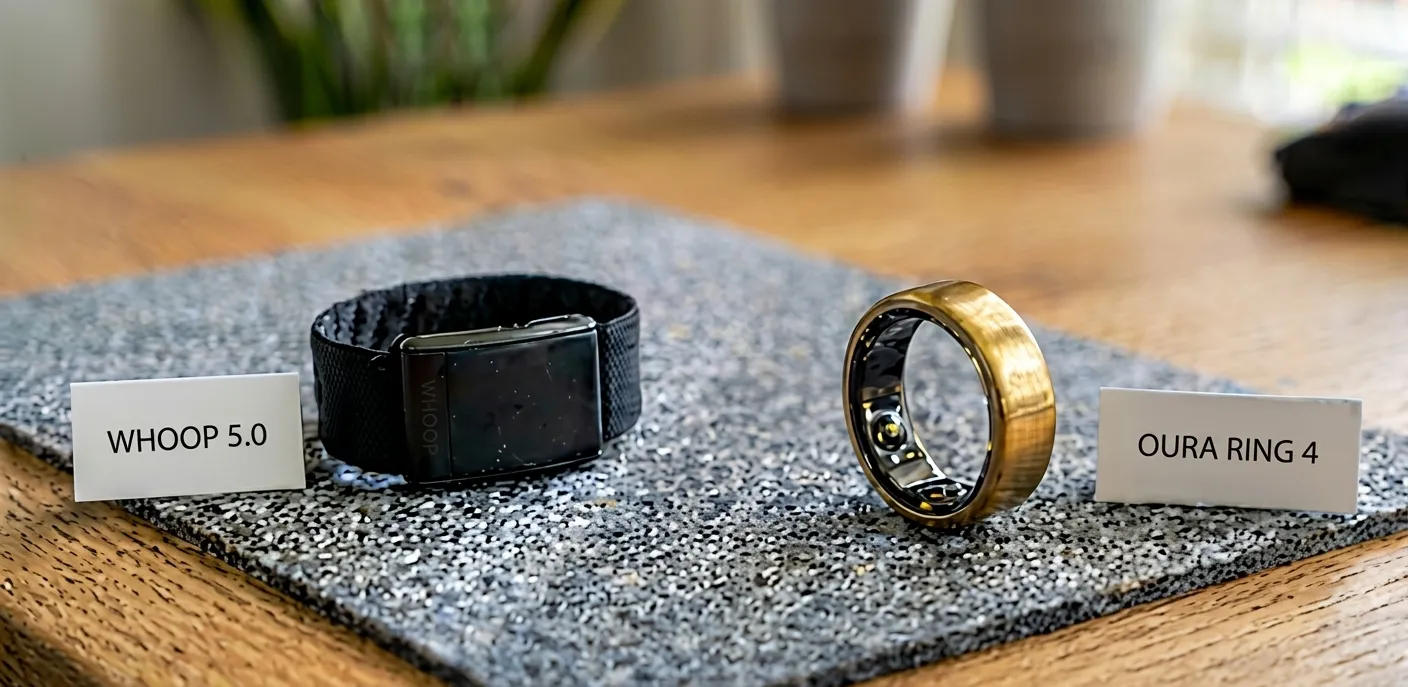
Screen-free biometrics trackers have evolved from casual lifestyle gadgets into serious medical and athletic diagnostic tools. For high-output athletes looking to optimize recovery, sleep staging, and cardiovascular thresholds, two hardware form factors dominate the market: the newly launched Whoop 5.0 bicep/wrist band and the titanium Oura Ring 4.
To bypass consumer marketing hype, the Technosyne TechGRID runs an exhaustive hardware tear-down comparing their sensor arrays, battery performance, and spatial data algorithms.
TECHNOSYNE SCORE
Screenless Biometrics Showdown
The Sensor Suite & Placement Architecture
The core data collection capability of any screen-free wearable comes down to its optical photoplethysmography (PPG) layout and where it sits on your body.
SENSOR ARCHITECTURE MAPPING
WHOOP 5.0
5x LEDs (Green, Red, IR) + 4x Photodiodes + Skin Temp
Placement: Wrist/Bicep (High-motion isolation)
OURA RING 4
Smart Sensing Array + Dual-Sided Digital Path
Placement: Finger Digital Arteries (Direct proxy to heart)
Whoop 5.0 Hardware Stack
Whoop 5.0 iterates on raw light-path physics by deploying an updated 5-LED array (utilizing green, red, and infrared spectral wavelengths) coupled with 4 separate photodiodes.
- The Advantage: This multi-axis arrangement targets high-motion isolation. When positioned on the wrist or bicep inside heavy compression sleeves, the sensor layout neutralizes the “noise” created by sprinting, lifting, or sudden acceleration.
- Thermal Layering: Tucks an upgraded, dedicated epidermal skin temperature sensor flush against the skin barrier to capture accurate metabolic heat fluctuations.
Oura Ring 4 Hardware Stack
Oura Ring 4 shifts entirely away from the older Generation 3 interior sensor bumps, implementing their flush Smart Sensing structural technology. It utilizes an array of thin, recessed optical windows that shift paths adaptively.
- The Advantage: The ring form factor accesses the digital palmar arteries of the finger. These blood vessels are closer to the skin surface than wrist arteries, functioning as an elite proxy for clean heart rate measurements and blood oxygen tracking.
- Dynamic Channel Allocation: If the ring rotates slightly on your finger while sleeping, the internal processor automatically switches data ingestion to an alternate, unobstructed light channel to prevent signal gaps.
Power Engineering & Charging Architecture
A screenless tracker’s structural utility relies heavily on its charging setup. If you have to take the device off to charge it, you introduce gaps into your baseline health data.
WHOOP 5.0 = Slid-on Magnetic Battery Pack ➔ 100% Continuous Wear
OURA RING 4 = Brushed Aluminum Desk Cradle ➔ Requires 60-Min Rest
Whoop 5.0: The Continuous Battery Loop
Whoop holds a complete monopoly on 100% continuous data tracking through its modular power architecture.
- The Hardware: The core unit houses a compact internal cell that provides a stable 5 to 6 days of runtime.
- The Charging Loop: When the sensor runs low, you slide a water-resistant, rechargeable magnetic battery pack directly over the sensor rails. The pack pumps juice into the main module via inductive power paths while it stays firmly on your body.
Oura Ring 4: The Desktop Cradle Refinement
Because a ring has minimal interior space, a slide-on battery accessory is physically impossible.
- The Hardware: Oura houses a micro-curved battery cell following the circular interior frame, providing an exceptional 7 to 8 days of real-world use depending on ring size.
- The Charging Loop: When depleted, the ring must be taken off and placed on a brushed-aluminum desktop induction charging cradle. A full charge cycle takes roughly 60 to 80 minutes, creating a brief but necessary data gap during your week.
Data Ingestion: High-Strain Athletics vs. Circadian Sleep Staging
Both companion apps process data fields clean, but they prioritize entirely different health philosophies.
Whoop 5.0: The Strain Engine
Whoop evaluates your day through a cumulative 0 to 21 Strain Score, calculated from continuous cardiovascular tracking and muscular load parameters.
- Sampling Depth: Whoop samples heart metrics continuously, tracking minute fluctuations in real time during high-intensity exercise loops.
- The Strength Trainer Upgrade: Uses the internal accelerometer and gyroscope data to accurately measure mass, velocity, and power output during weight training sessions, converting muscular fatigue into your overall daily strain target.
Oura Ring 4: The Sleep & Circadian Blueprint
Oura treats sleep architecture and daily readiness as its primary analytical focal points.
- The Core Platform: Uses its direct artery light paths to provide an industry-leading sleep analysis platform. It maps out Deep Sleep, REM, Light Sleep, and Awake windows with near-polysomnography level accuracy.
- Circadian Alignment: The app uses data patterns to map your body’s optimal internal clock (chronotype). It tells you exactly when your body naturally wants to wind down, wake up, or eat based on subtle changes in resting heart rate and temperature deviations.
Technical Specifications Matrix
| Hardware Parameter | Whoop 5.0 Peak | Oura Ring 4 |
|---|---|---|
| Form Factor | Elastic Fabric Wrist/Bicep Strap | Recessed Titanium Ring [4] |
| Battery Lifespan | 5 – 6 Days (Continuous Swap Loop) | 7 – 8 Days (Size Dependent) |
| PPG Light Path | 5 LEDs + 4 Photodiodes | Smart Sensing Multi-Channel Array [4] |
| Waterproof Rating | IP68 + 100 Meters (50m for Battery Pack) | 100 Meters (Fully Sealed) |
| Connectivity Link | Bluetooth Low Energy (BLE) | Bluetooth Low Energy (BLE) |
| Weight Profile | ~28 Grams (Strap + Pod) | 4 to 6 Grams (Size Dependent) |
| Pricing Strategy | Subscription-Only (Upfront hardware included) | Flat Hardware Cost + Monthly App Premium |
Technosyne Verdict: Which Hardware Wins the Grid?
The choice between Whoop 5.0 and Oura Ring 4 depends completely on your active data tracking goals:
- Choose the Whoop 5.0 if you are a high-performance, data-driven athlete. Its slide-on magnetic battery pack ensures 100% continuous wear with zero data gaps. Its bicep sensor configuration is built to handle explosive, fast-moving high-strain activities flawlessly.
- Choose the Oura Ring 4 if your priority is sleep accuracy, metabolic recovery, and subtle aesthetics. By dropping the physical sensor bumps for a smooth titanium ring layout, it delivers an incredibly accurate sleep staging platform that fits seamlessly into professional and casual settings.
TECHNOSYNE – Beyond Tech. Into the Future of happy living.
Thank you for spending your time with Technosyne! Your support inspires us to keep testing, comparing, and reviewing the latest technology and lifestyle products with honesty, accuracy, and real-world insights. Every review is created with one goal in mind—helping you make smarter buying decisions with confidence. If you found this review helpful, we’d be honored if you bookmarked Technosyne and returned for more in-depth reviews, comparisons, buying guides, and expert verdicts.
Until next time, See you in the next Technosyne Verdict.!