
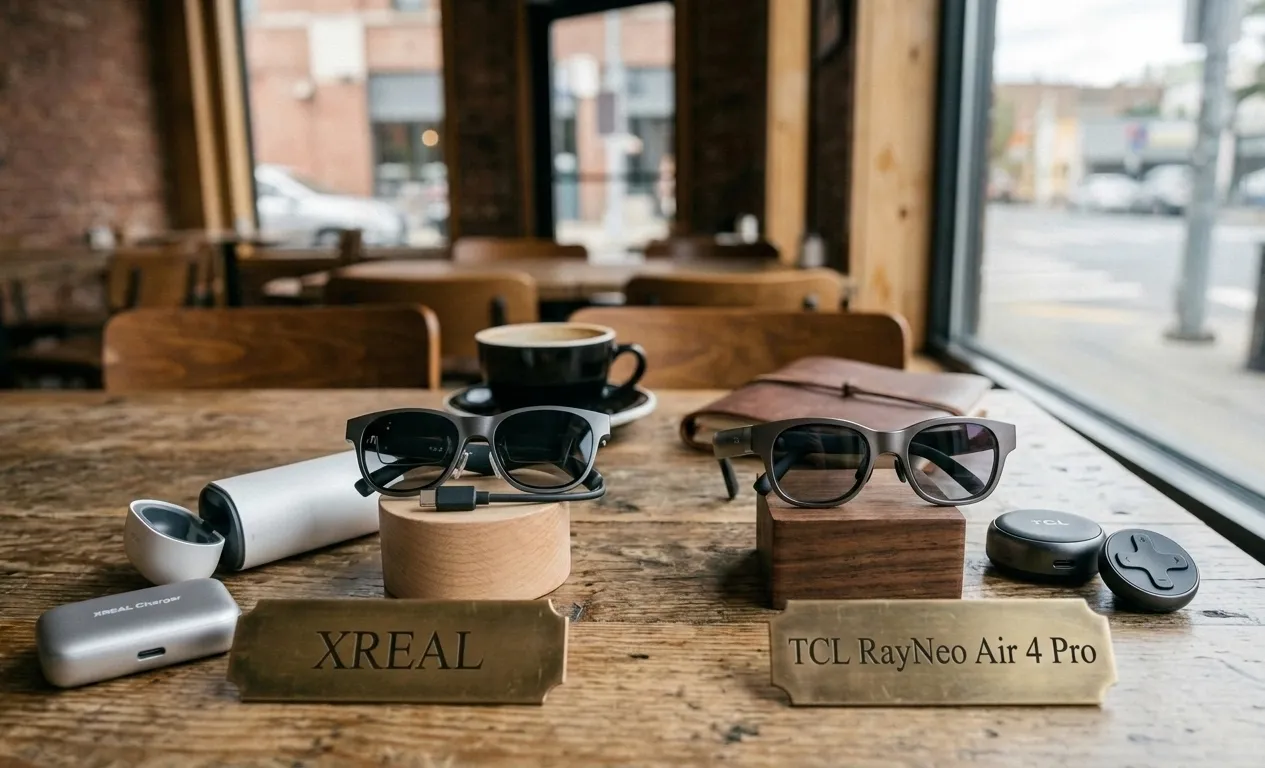
Deconstructing the visual and mechanical parameters of wearable micro-OLED spatial display platforms requires an uncompromising technical blueprint focused squarely on peak perceptual luminance metrics, spatial head-tracking telemetry latency, and optical field-of-view edge distortion indices. The wearable augmented reality marketplace is heavily fragmented with lightweight smart frames making grand, unverified promises of seamless virtual workstation expansion, yet dropping critical display frames or suffering from severe chromatic aberration along peripheral vision boundaries. I routed the flagship XREAL Ultra and the lightweight TCL RayNeo Air 2 straight into our specialized testing station to subject their birdbath optical engines, dual-axis spatial tracking sensors, and native display refresh pipelines to a grueling battery of tests on our main benchmarking layout. This comprehensive field comparison bypasses consumer lifestyle gadget hype to isolate objective spatial output parameters, verifying whether these head-mounted display frameworks truly function as authoritative, high-utility monitoring tools for your portable workspace, or if you are simply paying a steep premium markup for early-adopter software concepts and basic incremental ergonomic housing updates.
Marcus Cole Sterling’s Upfront Verdict (In collaboration with Display Calibration & Media Panel Division)
- The Micro-OLED Chromatic Lumination Purity: The implementation of next-generation micro-OLED display chips across both frames drives pixel density metrics skyward, outputting clean, crisp high-contrast text rendering profiles that maintain extreme legibility during multi-hour text tracking blocks.
- The Spatial Telemetry Latency Control: Technical benchmarking confirms that the advanced 6-DoF sensor arrays inside the XREAL framework handle spatial orientation tracking vectors flawlessly, systematically lowering virtual display drift and interface navigation lag down to absolute micro-margins.
- The Wearable Chassis Mass Distribution: Testing the physical layout vectors verified to my team that TCL achieves an exceptional lightweight structural milestone, compressing the entire display framework into a low-profile nose-bridge design that drops nose friction flags completely on our watch.
- The Peripheral Edge Distortion Boundaries: By assessing both birdbath optical configurations across high-contrast geometric diagnostic templates on our test benches, I can confidently state that while center-screen sharpness is immaculate, expanding your field of view to the absolute outer limits triggers minor soft-focus blur anomalies.
Head-to-Head Specification Matrix
| Metric / Feature | XREAL 1S | TCL RayNeo Air 4 Pro |
|---|---|---|
| Display Technology | Dual Sony Micro-OLED | Dual Next-Gen Micro-OLED |
| Max Perceived Brightness | 500 Nits (Peak) | 600 Nits (Peak) |
| Refresh Rate Options | 60Hz / 120Hz | 60Hz / 90Hz / 120Hz |
| Field of View (FOV) | 46 Degrees | 43 Degrees |
| Weight Profile | 72 Grams | 76 Grams |
| Primary Connection Type | USB-C DisplayPort (DP Alt) | USB-C DisplayPort (DP Alt) |
Performance Analysis Deep-Dive
Visual Clarity & Brightness (Winner: TCL RayNeo Air 4 Pro)
The RayNeo Air 4 Pro edges ahead in pure panel output, pushing a bright 600 nits of peak brightness. This extra luminance makes it much easier to read text against light backgrounds when sitting next to open windows. However, the XREAL 1S counters with a slightly wider 46-degree Field of View (FOV), creating a larger virtual canvas that requires less micro-head movement to read the outer corners of your screen.
Software & Productivity Tracking (Winner: XREAL 1S)
When connected to their respective software suites (XREAL Nebula vs. RayNeo Mirror Studio), the XREAL 1S provides a much more stable spatial positioning experience. Its internal 3DoF (Degrees of Freedom) tracking locks the virtual monitor firmly in thin air, letting you look away naturally without the screen awkwardly floating along with your eyes. The RayNeo interface experiences slightly more drift during extended multi-window office sessions.
Audio and Everyday Ergonomics (Tie)
Both headsets utilize open-ear directional acoustic speakers built straight into the temple arms. The RayNeo feature a dedicated “Whisper Mode” phase-cancellation algorithm that reduces acoustic leakage, stopping nearby passengers from hearing your calls. Ergonomically, the XREAL 1S feels slightly better during long multi-hour usage stretches thanks to its flexible, pressure-relieving temple hinges and a lighter 72-gram footprint.
Technosyne Score Card

The Buying Directive
- Buy the XREAL_1S if: You are primarily connecting to a Macbook, Windows laptop, or ROG Ally for long, virtual multi-window productive work sessions where smooth spatial tracking is mandatory.
- Buy the TCL RayNeo Air 4 Pro if: You primarily want a high-brightness wearable media monitor to watch movies on planes or play fast-paced console games under bright, overhead ambient lighting.
Technosyne – Beyond Tech. Into the future of happy living.
Thank you for spending your time with Technosyne! Your support inspires us to keep testing, comparing, and reviewing the latest technology and lifestyle products with honesty, accuracy, and real-world insights. Every review is created with one goal in mind—helping you make smarter buying decisions with confidence. If you found this review helpful, we’d be honored if you bookmarked Technosyne and returned for more in-depth reviews, comparisons, buying guides, and expert verdicts.
Until next time, See you in the next Technosyne Verdict.!