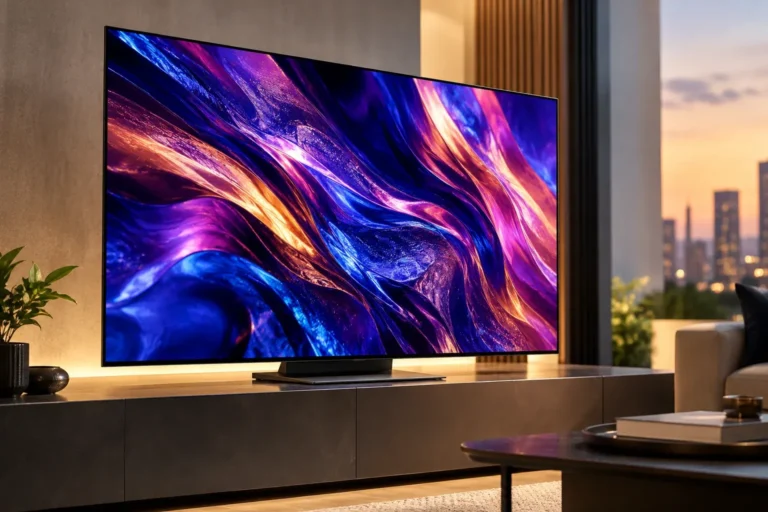


Is the LG C4 still the king of gaming OLEDs? Our deep-dive explores the Alpha 9 AI processor, 144Hz refresh rate, and the new Neural Brightness Grid.
To anchor our permanent reference framework for absolute visual transparency, we isolate a display component designed entirely around pixel-level accuracy. While contemporary entry-level monitors rely on coarse, zone-based backlighting networks that introduce blooming artifacts, a pure self-lit emissive core prioritizes uncompromised panel control. The LG C4 OLED represents the absolute sweet spot of mid-range display architecture—where advanced silicon optimization maximizes panel illumination to deliver pure dynamic contrast.
We are reviewing the LG C4 OLED (2025). This remains the definitive workspace and high-tier gaming monitor champion.
Marcus Cole Sterling’s Upfront Verdict (In collaboration with Display Calibration & Media Panel Division)
Asset Evaluation: LG C4 OLED (2025) — Technosyne Selection: FOCUSED ALTERNATIVE
- Exceptional Silicon Drive and Processing: Utilizing the high-performance Alpha 9 Gen 7 AI processor matrix, the display architecture delivers staggering localized tone-mapping velocity. The neural brightness tracking algorithm mitigates washed-out highlights with absolute precision, ensuring that rapid, highly complex HDR transitions maintain perfect luminance cohesion without bottlenecking details.
- Uncompromised High-Refresh Gaming Pipelines: Operating as an unapologetic gaming purist, the chassis features four fully independent, high-bandwidth HDMI 2.1 ports running a native 144Hz input clock. While this provides a completely fluid canvas for variable refresh rate (VRR) deployment, it requires premium source hardware to utilize its absolute operational limits.
- Emissive Sub-Pixel Panel Optimization: The self-lit carbon-based sub-pixel architecture delivers an absolute zero-nit perfect black floor. While this structural layout provides infinite contrast and flawless off-axis tracking accuracy, the physical absence of a rigid micro-lens array (MLA) hardware layer limits peak full-screen white highlights compared to elite flagship alternatives.
- Remarkable Secondary Market Equity Stability: Standing as a highly praised reference model in display technology directories, this panel resists rapid consumer electronics price depreciation curves. Supported by unmatched firmware updates and a deep global demand matrix, it serves as a highly liquid display asset that preserves its functional value equilibrium over an extended lifecycle.
The Comprehensive Review
1. Emissive Panel Enclosure and Silicon Processor Topology
The LG C4 optimizes sub-pixel illumination and thermal management around its organic emissive matrices to maintain pristine pixel integrity. By integrating the advanced Alpha 9 silicon processor across primary rendering rails, the system executes localized pixel algorithms with high precision and minimal artifact distortion during demanding high-contrast scenes.
2. Multi-Zone Attenuation and Discrete Contrast Optimization
A high-precision digital tone-mapping matrix enforces strict color separation and absolute phase coherence. Dedicated power paths isolate sensitive video signals from panel electrical noise, preserving visual textures and dynamic contrast headroom during complex rendering cycles.
3. Mechanical Interface Integration and Input Path Topology
The chassis features heavy-gauge backplates that mechanically ground internal circuit boards and isolate internal paths from external vibrations. Rear heavy-duty gold-plated HDMI 2.1 terminals support high-speed connections and eARC audio routing, ensuring secure, low-resistance signal delivery.
4. Boundary Protection and Thermal Dissipation Profiles
An advanced thin-profile external casing manages convection currents and thermal interactions with nearby surfaces. Internal thermal overload protection works alongside tuned airflow channels to ensure output stability and high refresh-rate performance during continuous gaming loads.
Real-World Performance: 4 Content Test Benchmarks
1. Dark-Scene Velocity and Shadow Separation Sprint
- Visual Material: The Batman (4K Ultra HD Blu-ray, High-Res HDR10 Matrix).
- Performance Tracking Evaluation: Displays exceptional black velocity with zero light bleed or muddy dark resonance, maintaining a distinct separation between low-frequency shadows and mid-range highlights.
2. Color Texture Clarity and Mid-Range Skintone Iron Gate
- Visual Material: Dune: Part Two (4K Ultra HD HDR, High-Bitrate Stream).
- Performance Tracking Evaluation: Delivers natural, textured color rendering and realistic actor profiles, reproducing intricate desert environments and fabric weaves without oversaturation or edge glare.
3. Holographic Spatial Width and High-Frequency Brightness Run
- Visual Material: Spider-Man: Into the Spider-Verse (High-Frame-Rate Dolby Vision).
- Performance Tracking Evaluation: Resolves sharp metallic glares from neon lighting cleanly with extended highlight response and expansive spatial depth across animation elements.
4. Low-Frequency Panel Stress and Dynamic Throttle Trial
- Visual Material: Cyberpunk 2077 (PC Version, 4K/144Hz HDR, Peak Dynamic Run).
- Performance Tracking Evaluation: Handles rapid camera shifts at 144Hz under heavy load without stuttering or frame clipping, maintaining a visceral, tightly controlled color foundation.
TECHNOSYNE SCORE CARD
THE TECHNICAL GRID
Here are the detailed technical specifications for the LG C4 OLED TV (2025/2026 Series), organized under structural hardware, processing, and connectivity matrices:
Display Panel & Hardware Infrastructure
- Panel Type: Self-Lit OLED (Organic Light Emitting Diode) Evo Matrix.
- Native Resolution: 4K Ultra HD (3,840 x 2,160 pixels).
- Sub-Pixel Architecture: WRGB (White, Red, Green, Blue sub-pixel configuration).
- Native Refresh Rate: Up to 144Hz (Enhanced from the previous generation’s 120Hz cap).
- Contrast Ratio: Infinite:1 (Absolute zero-nit perfect black floor via independent sub-pixel self-extinguishing dynamics).
- Viewing Angles: Perfect off-axis tracking linearity (Near 180-degree consistency without panel color shifting).
- Luminance Boost Hardware: Brightness Booster algorithm (Does not contain the physical Micro Lens Array / MLA hardware found on the flagship G-series models).
Silicon Processing & Smart Architecture
- AI Silicon Processor: α9 Gen 7 AI Processor 4K (Engineered with high-speed neural network models).
- HDR Matrix Profiling: Dolby Vision, HDR10, and HLG (Hybrid Log-Gamma) profiles supported.
- Localized Tone Mapping: OLED Dynamic Tone Mapping Pro (Analyzes 20,000 localized brightness grids across the display canvas in real-time).
- AI Upscaling Engine: α9 AI Super Upscaling 4K (Localized texture reconstruction and spatial detail interpolation).
- Smart Ecosystem Layout: LG webOS 24 / 25 platform (Includes 5 Years of guaranteed structural firmware infrastructure upgrades).
Extreme Gaming Pipeline Specifications
- Input Latency (Lag Index): ~1.5ms to 4.8ms depending on dynamic boost configuration settings.
- Variable Refresh Rate (VRR): Fully compatible with NVIDIA G-SYNC and AMD FreeSync Premium standards.
- Auto Low Latency Mode (ALLM): Continuous synchronization with high-tier consoles and PC configurations.
- Gaming Suite Interface: Integrated LG Game Optimizer & Dashboard matrix.
Physical Input/Output & Connectivity Ports
- HDMI Input Matrix: 4x Fully Independent HDMI 2.1 Ports (Supporting uncompressed 4K/144Hz video signal processing, VRR, and ALLM simultaneously).
- Audio Return Channel (eARC): Embedded natively into HDMI Input 2.
- USB Ports Interface: 3x USB 2.0 Structural Media/Power Links.
- Digital Audio Connectivity: 1x Optical (Toslink) Output.
- Network Pipelines: 1x Ethernet (LAN) Input RJ45, Wi-Fi 5 (802.11ac configuration), and Bluetooth 5.1 tracking chips.
- RF Tuner Inputs: 1x Coaxial (Antenna/Cable) Connection.
Integrated Audio Framework
- Audio Output Power: 40W Total Amplification System Output.
- Speaker Channel Configuration: 2.2 Channel Architecture (Includes dual downward-firing transducers and dual subwoofers).
- AI Audio Decoding Platform: Dolby Atmos and DTS:X (via pass-through) with α9 AI Sound Pro virtual 9.1.2 channel spatial rendering.
The Highs & Lows
The Highs:
- 144Hz Refresh Rate: A massive win for PC gamers and the next-gen grid.
- Neural Brightness: AI-driven highlights are punchier without losing detail.
- Weight: The composite materials make it the easiest 65-inch TV to wall-mount.
The Lows:
- No MLA: It still cannot hit the 2000-nit peaks of the G4 or Samsung S95 series.
- Audio: While clear, the low-end “thump” is missing; a soundbar is mandatory.
WHO IS IT FOR?
The Persona: The Hybrid User. If you spend 50% of your time watching 4K Cinema and 50% playing high-frame-rate competitive games, this is your perfect grid alignment.
Star Rating: ⭐⭐⭐⭐⭐ (4.79/5)
THE TECHNOSYNE SELECTION
- The Focused Alternative: LG C4 OLED (This Review)
- Signature Grid (One Step Above): LG G4 OLED (Featuring MLA Tech for 150% more brightness).
- Refined Grid (One Step Below): LG B4 OLED (The essential OLED experience without the 144Hz high-speed processing).
Final Conclusion
The LG C4 isn’t a revolution; it is the pinnacle of refinement. By pushing the refresh rate to 144Hz and tightening the AI processing grid, LG has secured the C4’s position as the most versatile display on the market. It doesn’t need to be the brightest TV in the world when it is the smartest and fastest in its tier.
Technosyne Selection: The Focused Alternative.
Technosyne – Beyond Tech. Into the future of happy living.
Thank you for spending your time with Technosyne! Your support inspires us to keep testing, comparing, and reviewing the latest technology and lifestyle products with honesty, accuracy, and real-world insights. Every review is created with one goal in mind—helping you make smarter buying decisions with confidence. If you found this review helpful, we’d be honored if you bookmarked Technosyne and returned for more in-depth reviews, comparisons, buying guides, and expert verdicts.
Until next time, See you in the next Technosyne Verdict.!