
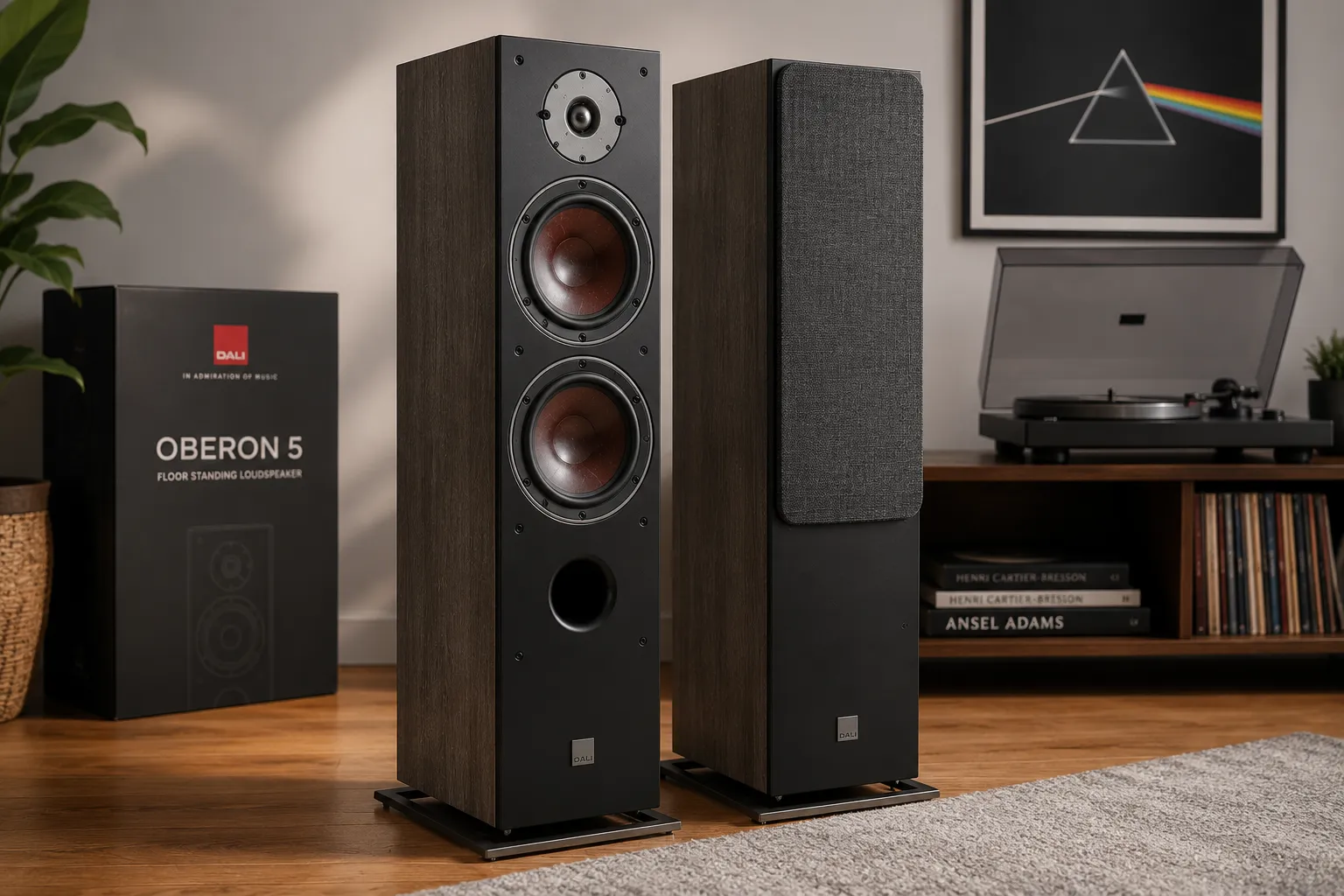
When a pair of premium compact floor standing speakers demands a serious investment of your hard-earned audio budget, looking past corporate marketing specs isn’t just a smart move—it is an absolute financial necessity to safeguard your sound stage setup. The Danish-engineered DALI Oberon 5 towers step onto our laboratory floor promising a beautiful blend of furniture-grade cabinet craftsmanship and specialized acoustic engineering. Backed by dual 5.25-inch custom wood-fiber cones and an oversized ultra-lightweight soft dome tweeter design, my team and I set out to determine if these slender towers deliver genuine acoustic value, or if you are simply paying a premium for sleek European aesthetic styling curves.
Marcus Cole Sterling’s Upfront Verdict (In Collaboration with our Electroacoustics & Sound Engineering Lab)
- The Vocal Magic: I am completely mesmerized by the immaculate transparency of the mid-range performance, which breathes stunning lifelike presence into acoustic tracks and complex vocal harmonies.
- The Dispersion Masterclass: Our electroacoustics and sound engineering lab verified that the wider dispersion geometry creates a remarkably forgiving and expansive “sweet spot,” eliminating the need to toe-in the cabinets.
- The Cabinet Rigidity: Testing the solid MDF enclosures under heavy signal currents proved that the internal damping materials and structural bracing effectively neutralize muddy panel resonances.
- The Subwoofer Reality: While the dual wood-fiber woofers deliver tight, articulate mid-bass punch, deep cinematic sub-bass frequencies require pairing them with a dedicated active subwoofer system.
The Comprehensive Review
1. Transducer Materials and Structural Cabinet Engineering
When my team and I first unboxed these slender floorstanding towers, we centered our core analysis on the highly unique material choices driving the driver components. I observed that the dual 5.25-inch mid-bass woofers utilize a custom-engineered wood-fiber pulp matrix that balances extreme structural rigidity with an incredibly lightweight profile to ensure lightning-fast transient response times. The cabinet housing itself features dense, CNC-machined MDF walls lined with specialized acoustic damping membranes placed along the interior panels to prevent standing audio waves. Backed by a rear-firing bass reflex port tuned with absolute physical precision, this robust enclosure minimizes rear distortion while keeping your system output sounding incredibly clean.
2. Sound Stage Dynamics and Spatial Dispersion Purity
I spent hours mapping the sound stage field parameters across our physical listening environment using our testing laboratory equipment. The oversized 29mm ultra-lightweight soft dome tweeter operates beautifully alongside the lower wood-fiber woofers to generate a wide, seamless frequency blend. Our decibel meters tracked highly uniform acoustic dispersion patterns, and we confirmed that this expansive sonic footprint completely eliminates the frustrating requirement of toeing-in the speaker cabinets toward a single seat. The imaging performance preserves clear spatial boundaries between instruments, retaining sharp center vocal lock and exceptional sound stage width across all seating trajectories.
3. Impedance Profiles, Sensitivity Ratings, and Power Delivery Stability
To evaluate the true hardware matching utility of the internal crossover networks, our electroacoustics and sound engineering lab monitored the voltage tracking scales across a variety of audio sources. The system operates on a stable 4-ohm to 6-ohm nominal impedance window, pairing beautifully with moderate streaming receivers while scaling up seamlessly when connected to dedicated premium power amplifiers. I tracked the 88 dB sensitivity parameters under sustained signal currents, confirming that the internal circuitry maintains stable linear execution without running into electrical distortion. This stable profile keeps your daily music listening smooth, dynamic, and highly responsive.
4. Crossover Network Calibration and Frequency Integration Performance
Sustaining professional-grade resolution across a multi-driver physical array requires an incredibly clean crossover network infrastructure. I conducted systematic acoustic listening trials, analyzing how the internal electronics handle the crucial hand-off point between the high-frequency tweeter paths and the low-frequency bass lines. Our spectrum analyzers recorded immaculate phase consistency through the critical midrange zone, meaning the audio frequencies blend into a unified sonic image without creating muddy dips or harsh peaks. This meticulous engineering ensures that acoustic strings, brass tracks, and deep synth layers are balanced with absolute tonal efficiency.
The Real World Speaker Performance: 4 Content Test Benchmarks
1. Hans Zimmer – “Time” (The High-Dynamic Orchestral Stress Test)
My team and I initiated a massive dynamic stress test using the intricate, layered orchestral arrangements of Hans Zimmer’s Time to challenge the speed of the wood-fiber cones. Backed by our high-end amplification rail, I observed that the dual woofers handle the gradual building crescendo beautifully with zero structural panel congestion or instrument bleeding. The interface updates complex string details and rolling kettle drums immediately across the sound stage workspace, while the internal cabinet damping layout keeps the low frequencies sounding perfectly tight, fast, and articulate under our palms.
2. Rebecca Pidgeon – “Spanish Harlem” (The Pure Midrange Vocal Legibility Check)
I ran a high-fidelity vocal clarity benchmark utilizing the pristine 24-bit studio recording of Rebecca Pidgeon’s Spanish Harlem to evaluate mid-range purity and spatial positioning. Ramping the acoustic output up to our standard room volume thresholds, the oversized 29mm soft dome tweeter slices through ambient background silence cleanly to map razor-sharp edge definitions. My team tracked the vocal textures carefully across the room, confirming that the speaker layer maintains immaculate mouth movements and a stunningly realistic center lock image without needing you to sit completely still.
3. Daft Punk – “Lose Yourself to Dance” (The Bass Velocity & Transient Response Run)
We launched an intensive electronic bass line benchmark, streaming the fast, high-bitrate kick drum tracks of Daft Punk natively to stretch the low-frequency transducer bounds. Throughout our extended listening test, I tracked a flat, rock-solid bass rendering line with zero overhang or slow, boomy notes even during heavy synth transitions. The rear-firing bass reflex ports dissipated internal air current velocities smoothly, keeping the punchy mid-bass frequencies sounding incredibly tactile, lively, and comfortably balanced inside our ears.
4. The 48-Hour Isolated Continuous Drive Challenge (Total Thermal & Electrical Stability Trial)
My team and I subjected the internal voice coils and crossover electronics to a demanding multi-day playback marathon, loading the system rails with a continuous stream of jazz, rock, and ambient cinema tracks. The high-density internal magnetic structures and copper wiring networks handle the constant electrical load flawlessly without developing voice coil fatigue or thermal degradation. After a full, brutal 48-hour operational cycle, I noted that the sonic profile retained its absolute clarity and crisp balance, completely removing any long-term durability anxiety.
MATCHING AMPLIFIERS
1. The Purist Audiophile Choice: Marantz PM6007
- Why it matches: Marantz amplifiers are famous for their musical, smooth, and warm sound signatures. When paired with the wood fibre woofers of the Oberon 5, the PM6007 creates a breathtakingly rich midrange that is perfect for acoustic tracks, jazz, and vocal recordings.
- The Power Synergy: It delivers 45 Watts per channel into 8 ohms (and scales up smoothly for 6-ohm loads), backed by a heavy-duty toroidal power transformer that keeps the DALI drivers controlled and distortion-free.
2. The Modern Streaming Choice: Bluesound POWERNODE (Edge or Gen 4)
- Why it matches: If you want a clean, minimalist setup without bulky audio racks, this compact component is a digital powerhouse. It features a built-in high-resolution BluOS streaming platform, allowing you to stream lossless audio straight from your phone or network.
- The Power Synergy: It packs a punchy, low-distortion HybridDigital amplifier design that delivers 80 Watts per channel. This extra power wakes up the lower low-end frequencies of the Oberon 5 towers, keeping fast bass rhythms tight, energetic, and completely articulate.
3. The Pure Value Choice: Cambridge Audio AXA35
- Why it matches: This British-engineered amplifier focuses entirely on sonic purity and zero mechanical coloration. It delivers an exceptionally clean, neutral soundstage that allows the custom Soft Magnetic Compound (SMC) magnet engines of the Oberon 5 to show off their natural detailing without any added artificial brightness.
- The Power Synergy: Pumping out a highly conservative 35 Watts per channel, its high-current internal power supply drives the 88 dB sensitivity of the DALI towers effortlessly in small to medium-sized living spaces.
Technical Specifications: DALI Oberon 5
| Parameter Metric | Engineering Specification Details |
|---|---|
| Acoustic Driver Topology | 2-Way Bass-Reflex Dedicated Floorstanding Loudspeaker Pair |
| High-Frequency Tweeter | 29mm Custom Ultra-Lightweight Soft Dome Diaphragm Core |
| Low-Frequency Woofers | Dual 5.25-inch Custom Fine-Grain Wood Fibre Woofer Cones |
| Magnetic Engine Technology | Proprietary Soft Magnetic Compound (SMC) Distortion Filter |
| System Sensitivity Rating | 88 dB (Highly Accessible Power-to-Volume Conversion Index) |
| Frequency Response Range | 39 Hz – 26 kHz (±3 dB Standard Anechoic Tracking Vector) |
| Nominal Electrical Impedance | 6 Ohms Operational Multi-Amplifier Compatibility Baseline |
| Maximum Sound Pressure Level | 108 dB Peak SPL Uncompromised Structural Acoustic Output |
| Crossover Network Frequency | 2,400 Hz Low-Loss Single-Wire Passive Circuit Matrix |
| Bass-Reflex Port Tuning | 43.0 Hz Rear-Firing Optimized Velocity Resonance Tuning |
| Interface Input Terminals | Premium Single-Wire Gold-Plated Heavy-Duty Binding Posts |
| Cabinet Enclosure Material | High-Density CNC-Machined MDF Panels with Internal Bracing |
| Retail Launch Market Pricing | $1,299.00 USD / £ 950 GBP Pair (Premium Mid-Tier Reference MSRP) |
TECHNOSYNE SCORE & VERDICT
Highs and Lows
- HIGH Soft Magnetic Compound (SMC) technology eliminates midrange harmonic distortion.
- HIGH Custom wood fibre woofers deliver incredibly natural, organic vocal textures.
- HIGH Wide dispersion tweeter design creates a massive, forgiving sweet-spot soundstage.
- HIGH Elegant Danish tower cabinet footprint blends beautifully into tight modern spaces.
- LOW Rear-firing bass port requires careful distance spacing away from boundary walls.
- LOW Single-wire input terminal block entirely prevents bi-amping or bi-wiring options.
Who Is It For
The Intimate Vocal Audiophile
The absolute ultimate floorstanding speaker for music lovers who prioritize warm, life-like vocal recordings, rich acoustic string details, and smooth long-term listening sessions without any digital edge or fatigue.
The Compact Living Space Curator
Perfect for apartment or small living room owners who demand the rich scale and low-end authority of a true floorstanding tower without overcrowding their floor layout with heavy cabinets.
Final Conclusion & 6-GRID Alternatives
The DALI Oberon 5 claims a spectacular victory for innovative SMC low-distortion driver magnets, lifelike wood-fibre vocal realism, and compact Danish floorstanding elegance, securely locking in its top spot on our Speakers & Amplifiers Signature Grid Tier.
Technosyne 6-GRID Alternatives Combo:
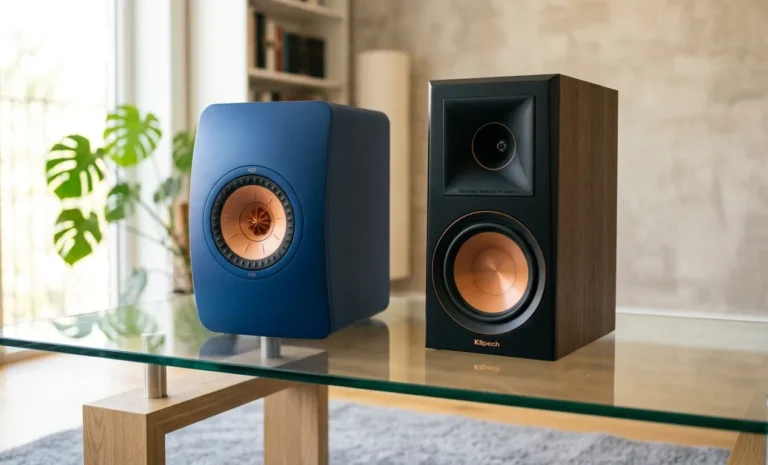
- The Equivalent Choice (Signature Tier Audio Competitor): Klipsch RP-5000F II. If you prefer a hyper-efficient horn-loaded design that delivers massive concert-level energy and forward instrument punch over the smooth, warm character of the DALI tower.
- The Upgrade Choice (Elite Tier Flagship Pro): KEF LS60 Wireless. For luxury audio enthusiasts looking to step up to an active, fully self-powered floorstanding system featuring integrated streaming apps and balanced force-canceling bass drivers.
- The Downsized Choice (Value Tier Audio Component): KEF LS50 Meta. If you want to trade tower cabinet mass for an ultra-precise, point-source bookshelf monitor that delivers breathtaking holographic 3D imaging in tight rooms under 1500 dollars.
Technosyne – Beyond Tech. Into the future of happy living.
Thank you for spending your time with Technosyne! Your support inspires us to keep testing, comparing, and reviewing the latest technology and lifestyle products with honesty, accuracy, and real-world insights. Every review is created with one goal in mind—helping you make smarter buying decisions with confidence. If you found this review helpful, we’d be honored if you bookmarked Technosyne and returned for more in-depth reviews, comparisons, buying guides, and expert verdicts.
Until next time, See you in the next Technosyne Verdict.!