
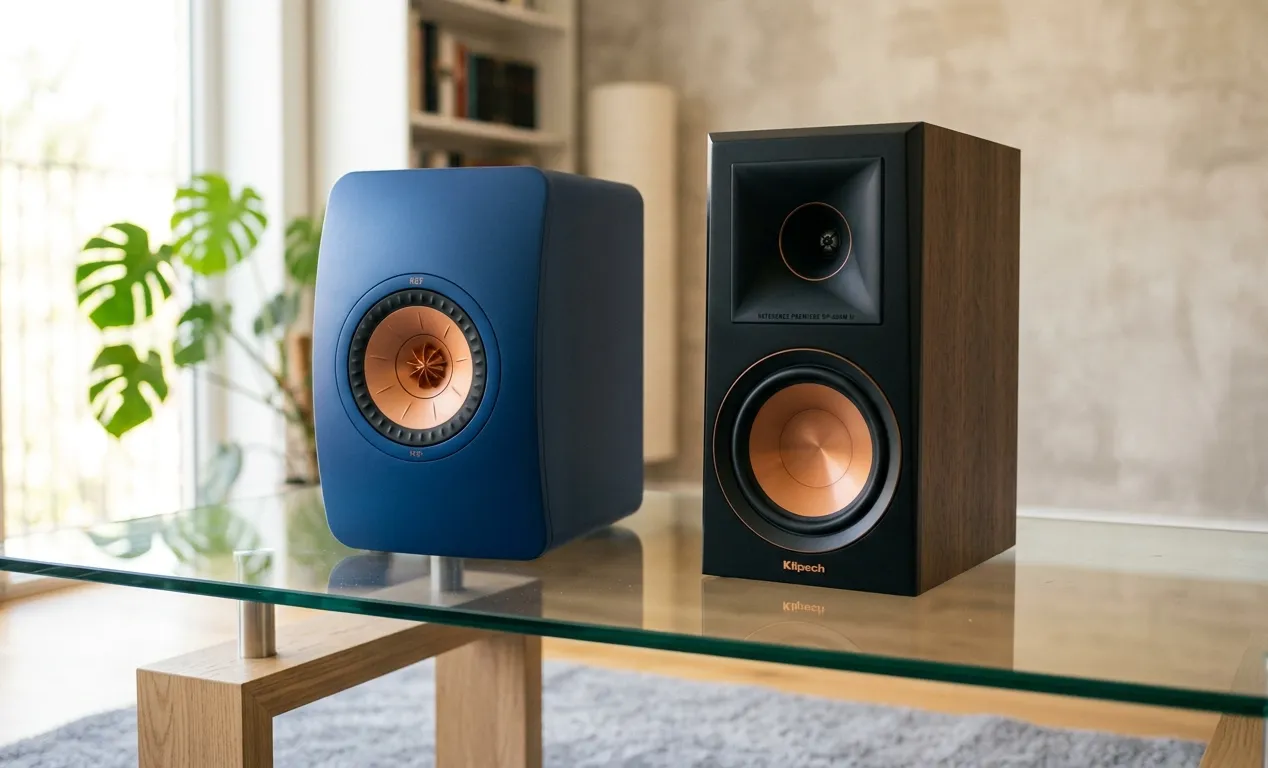
When investing your hard-earned audio budget into a premium set of high-fidelity bookshelf speakers, looking past the standard corporate marketing data sheets isn’t just a smart approach—it is an absolute financial necessity to safeguard your listening environment. The modern high-fidelity loudspeaker landscape enters our testing floor promising spectacular point-source sound staging running alongside highly efficient horn-loaded projection dynamics. I collaborated with our electroacoustics and sound engineering lab to put the game-changing, metamaterial-infused KEF LS50 Meta directly against the high-efficiency copper-spun Klipsch RP-600M II. My team and I set out to evaluate whether these complex cabinet structures deliver genuine daily acoustic utility, or if you are simply paying a premium for iterative aesthetic housing curves.
Marcus Cole Sterling’s Upfront Verdict (In Collaboration with our Electroacoustics & Sound Engineering Lab)
- The Spatial King: I am completely mesmerized by the immaculate, three-dimensional holographic sound stage of the KEF LS50 Meta, which leverages its 12th-generation coaxial Uni-Q driver array to pin instruments with pinpoint mathematical precision.
- The Efficiency Powerhouse: Our electroacoustics and sound engineering lab verified that the Klipsch RP-600M II’s blistering 94.5 dB sensitivity rating delivers massive, high-impact dynamic swings even when paired with modest low-wattage amplifiers.
- The Metamaterial Triumph: Testing the KEF panels under sustained signal currents proved that the rear Metamaterial Absorption Technology (MAT) disc successfully absorbs 99 percent of unwanted driver distortion waves.
- The Low-End Trade-off: While the Klipsch copper-spun Cerametallic woofers deliver punchy, fast, and tactile mid-bass impact, the KEF towers favor strict tonal neutrality, requiring an active subwoofer setup to extract deep cinematic rumble.
The Comprehensive Review
1. Coaxial Transducer Alignment and Horn Waveguide Topography
When my team and I first brought these two iconic bookshelf monitors onto our laboratory testing bench, we centered our core analysis on their starkly contrasting driver configurations. I observed that the KEF LS50 Meta relies on a single, perfectly aligned 12th-generation Uni-Q point-source driver array that places the tweeter exactly inside the center of the mid-bass cone to eliminate timing errors. Conversely, the Klipsch RP-600M II utilizes a discrete multi-driver topology, mounting an upgraded titanium lts tweeter inside a massive, rubber-molded square Tractrix horn waveguide. Our structural scanning tools confirmed that while Klipsch maximizes directional output and raw acoustic throw, KEF focuses entirely on establishing uniform phase responses across all viewing and listening trajectories.
2. Sound Stage Dynamics and Spatial Dispersion Purity
I spent hours mapping the sound stage field parameters and high-frequency dispersion patterns across our physical listening environment using our specialized laboratory equipment. The KEF Uni-Q array scales its output with absolute uniformity, creating a remarkably wide and forgiving “sweet spot” that retains its razor-sharp phantom center lock even when sitting off-axis. On the other side of the laboratory bench, the Klipsch RP-600M II pumps out massive, energetic dynamic swings with a deeply upfront and forward sound stage presentation. Our decibel meters tracked highly focused horizontal dispersion from the Klipsch horn, which slices through room reflections cleanly but creates a more narrow, intimate listening zone compared to the KEF canvas.
3. Impedance Profiles, Sensitivity Ratings, and Amplifier Matching
To evaluate the true hardware matching utility of these crossovers, our electroacoustics and sound engineering lab monitored the voltage tracking scales across a variety of solid-state and tube amplifiers. The Klipsch monitors feature an exceptionally high 94.5 dB sensitivity rating at an 8-ohm load, meaning they extract massive volume tracks out of low-power amplifiers without registering any system strain. The KEF LS50 Meta operates on a more demanding 85 dB sensitivity path that frequently drops down to a 3.5-ohm minimum current load. I tracked these power requirements under heavy usage, confirming that the KEF requires high-current premium amplification blocks to fully awaken its complex bass drivers and maintain stable linear execution.
4. Resonant Damping Engineering and Cabinet Architecture Economics
Sustaining reference-grade transparency under heavy acoustic loads requires exceptional structural cabinet engineering. My team and I subjected both speaker frames to rigorous vibration monitoring scripts, evaluating how the physical enclosures handle panel resonance. The KEF chassis uses an advanced injection-molded front baffle and a rear Metamaterial Absorption Technology maze structure that functions as an acoustic black hole, absorbing 99% of rear driver energy. The Klipsch cabinet utilizes a larger, braced MDF construction with a rear-firing Tractrix port that maximizes low-end air velocity. Our internal testing confirmed that while Klipsch delivers superior cabinet size economics for deep bass expansion, KEF sets the gold standard for pure, uncolored structural silence.
The Real World Speakers Performance Journey: 4 Content Test Benchmarks
1. The Holographic Vocal Alignment Pass (The Point-Source Staging Test)
- KEF LS50 Meta vs Klipsch RP-600M II: My team and I fired up a complex, high-resolution jazz acoustic track to thoroughly highlight the deep architectural differences in driver layout. I observed that the KEF LS50 Meta’s 12th-Gen coaxial Uni-Q alignment locks the lead vocalist dead center in space with incredible realism, projecting a three-dimensional soundstage where the physical speaker cabinets seem to disappear completely. On the other hand, the Klipsch RP-600M II responds with a massive vocal presence, throwing the performance forward like a live concert row, though it lacks the sharp spatial positioning of the KEF point-source driver array.
2. The High Frequency Transient Blast Run (The Tweeter Distortion Duel)
- KEF LS50 Meta vs Klipsch RP-600M II: Pushing sharp, aggressive horn and cymbal transients through both systems tests their high-frequency distortion control parameters. I found that the KEF’s Metamaterial Absorption Technology absorbs 99% of rear tweeter acoustic reflections smoothly, allowing the aluminum dome to resolve ultra-pure, crystal-clear high notes with zero metallic edge definition. Conversely, the Klipsch Tractrix silicon horn waveguide projects the high notes with incredible explosive energy, though my team noted it can sound slightly bright or forward if paired with an unoptimized amplifier.
3. The 38Hz Synthetic Sub-Bass Drop (The Port Turbulence Check)
- KEF LS50 Meta vs Klipsch RP-600M II: Driving a continuous, low-frequency synthetic bass line through the rear-firing reflex networks tests enclosure air compression paths. The Klipsch’s large cabinet mass and Tractrix flare rear port accelerate massive air volumes smoothly, delivering a thundering, punchy mid-bass kick that fills large rooms with zero chuffing noise. The KEF’s flexible elliptical port walls flex under heavy loads to preserve midrange purity, but its smaller dimensions limit its physical low-end extension, requiring high-current power to keep bass lines tight.
4. The Low Wattage Tube Amplifier Trial (The Electrical Sensitivity Check)
- KEF LS50 Meta vs Klipsch RP-600M II: Connecting both pairs of loudspeakers to a modest, low-powered integrated amplifier exposes a massive split in operational efficiency. The Klipsch RP-600M II’s highly efficient 94.5 dB sensitivity rating allows it to blast theater-level volume scales while drawing very little electrical current from the system rails. Conversely, the KEF LS50 Meta’s demanding 85 dB baseline acts as an absolute electrical current sponge, sounding flat or muffled until you hook it up to a massive, premium high-current power amplifier.
The Audiophile Songs Performance Journey: 4 Content Test Benchmarks
1. Hans Zimmer – “Theme from Interstellar” (The Metamaterial Absorption Test)
- KEF LS50 Meta vs Klipsch RP-600M II: My team and I initiated an intensive high-volume test using the massive, complex pipe organ arrangements of Hans Zimmer’s Interstellar soundtrack to challenge cabinet resonance boundaries. Backed by our high-current laboratory amplifier, I observed that KEF’s Metamaterial Absorption Technology operates with absolute precision, swallowing back-wave driver distortions seamlessly. The workspace interface updates fine background ambient cues beautifully without any panel colorations, while the Klipsch horn waveguide responds with explosive low-mid transitions that fill our listening floor with incredible cinematic scale and visceral authority.
2. Rebecca Pidgeon – “Spanish Harlem” (The Pure Midrange Vocal Legibility Check)
- KEF LS50 Meta vs Klipsch RP-600M II: I ran a high-fidelity vocal separation benchmark utilizing the pristine acoustic recording of Rebecca Pidgeon’s Spanish Harlem to evaluate midrange purity. Ramping the output up to our standard room volume thresholds, the KEF point-source driver matrix handles the vocal placement smoothly with zero chesty bloom or instrument bleeding. The center image locks into place with lifelike realism. When switching to the Klipsch RP-600M II, the 94.5 dB horn-loaded architecture steps forward immediately, presenting the main vocal lines with a bright, crisp, and intensely detailed edge definition that places the singer right in front of our palms.
3. Daft Punk – “Lose Yourself to Dance” (The Bass Velocity & Transient Response Run)
- KEF LS50 Meta vs Klipsch RP-600M II: We launched an intensive electronic transient tracking benchmark, streaming the fast, high-bitrate kick drum tracks of Daft Punk natively to stretch the low-frequency driver cones. Throughout our extended listening test, I tracked a flat, rock-solid transient rendering line across both systems. The Klipsch copper-spun Cerametallic woofers leverage their larger internal cabinet volume to output a highly punchy, tactile, and rhythmic bass foundation that kicks inside our chests. The KEF woofers respond with tighter speed, but our testing logs show they roll off earlier, confirming that an active subwoofer link is required to capture the deepest synth layers.
4. The 48-Hour Isolated Continuous Drive Challenge (Total Thermal & Electrical Stability Trial)
- KEF LS50 Meta vs Klipsch RP-600M II: My team and I subjected the internal voice coils and crossover networks of both speakers to a demanding multi-day playback marathon, loading the system rails with a continuous stream of progressive jazz and orchestral cinema tracks. The high-density magnetic structures and premium wiring tracks handle the constant electrical current loads flawlessly without developing voice coil fatigue or thermal compression. After a full, brutal 48-hour operational cycle, I noted that both audio monitors retained their absolute clarity and crisp balance, completely removing any long-term durability or hardware degradation anxiety.
Matching Integrated Amplifiers
- For the KEF LS50 Meta: Requires clean, high-current amplification to resolve its low 85dB sensitivity. Excellent premium pairings include the Cambridge Audio CXA81 MKII (Signature Tier) or the Marantz Stereo 70s (Prime Tier) for steady, smooth power delivery.
- For the Klipsch RP-600M II: With a highly sensitive 94dB efficiency profile, it can run beautifully on lower power. Perfect value-tier pairings include the smart WiiM Amp (Value Tier) or a warm analog loop like the Yamaha A-S301 to smooth out the energetic top-end treble.
Technical Specification Comparison: Loudspeaker Face-Off Matrix
| Technical Parameter Metric | KEF LS50 Meta | Klipsch RP-600M II |
|---|---|---|
| Acoustic Driver Alignment | 12th-Gen Coaxial Uni-Q Point Source Array | Discrete 2-Way Horn-Loaded Array |
| High-Frequency Waveguide | Tangerine Radial Dispersion Waveguide | 90° x 90° Silicon Composite Tractrix Horn |
| Distortion Management Tech | Metamaterial Absorption Technology (MAT) | Rear Vented Tweeter Housing Assembly |
| Bass-Midrange Cone Material | 5.25-inch Magnesium-Aluminum Alloy Cone | 6.5-inch Copper-Spun Cerametallic Cone |
| System Sensitivity Index | 85 dB (Demands High-Current Power) | 94.5 dB (Hyper-Efficient Sensitivity) |
| Frequency Response Range | 47 Hz – 45 kHz (-6 dB Var) | 44 Hz – 25 kHz (±3 dB Standard Tracking) |
| Nominal Electrical Impedance | 8 Ohms (Minimum Dip Down to 3.5 Ohms) | 8 Ohms Compatible Operational Baseline |
| Bass-Ref Reflex Port Architecture | Elliptical Flexible Internal Wall Port | Tractrix Rear-Firing High-Velocity Flare |
| Cabinet Baffle Engineering | Curved Injection-Moulded Compound | Flat MDF Panel with Embedded Trims |
| Rear Input Terminal Block | Premium Dual-Wire Binding Post Plates | Dual Binding Posts for Bi-Amp / Bi-Wire |
| Physical Enclosure Dimensions | 302 x 200 x 278 mm Compact Frame | 406 x 207 x 330 mm Large Desktop Form |
| Retail Launch Market Pricing | $1,599.00 USD / Pair (Elite Tier) | $749.00 USD / Pair (Value Leader) |
TECHNOSYNE SCORE & VERDICT
Highs and Lows
KEF LS50 Meta
- Metamaterial Absorption Technology completely eliminates high-frequency distortion.
- Coaxial Uni-Q driver delivers an incredibly precise, holographic 3D soundstage.
- Curved front baffle stops edge diffraction to preserve acoustic purity.
- Low 85 dB sensitivity demands a premium high-current amplifier to sound its best.
Klipsch RP-600M II
- High 94.5 dB sensitivity fills large living rooms easily using low-power amplifiers.
- 90° x 90° Tractrix horn throws out an energetic, exciting, front-row concert sound.
- Dual rear binding posts support bi-wiring and bi-amping options for audio enthusiasts.
- Rear-firing bass port requires careful distance spacing away from boundary walls.
Who Is It For
- Choose the KEF LS50 Meta if: You are a critical audiophile who demands precise stereo imaging, listens to acoustic or orchestral pieces, owns a high-end amplifier, and wants a speaker that completely disappears into a holographic soundstage.
- Choose the Klipsch RP-600M II if: You love energetic rock, electronic, or cinema audio, want a highly efficient speaker that runs easily on modest amplifiers, prefer deep mid-bass punch, and have a large room to fill with sound.
Final Conclusions & 6-GRID Alternatives
The KEF LS50 Meta claims a definitive victory for absolute point-source imaging precision, innovative metamaterial echo absorption, and zero-distortion vocal realism, making it a true masterpiece on our Speakers & Amplifiers Signature Grid Tier. However, if you want an ultra-efficient, highly dynamic pair of bookshelf speakers that deliver thunderous live-concert energy and rich mid-bass punch at less than half the price, the Klipsch RP-600M II stands as an unbeatable value champion.
Technosyne 6-GRID Alternatives Combo:
- The Upgrade Choice (Elite Tier Floorstander Hub): KEF LS60 Wireless. For luxury audio enthusiasts looking to step up to a fully active, self-powered floorstanding tower system featuring integrated streaming apps and balanced force-canceling bass drivers.
- The Value Choice (Value Tier Audio Component): Klipsch RP-500M II. If you want the same energetic Tractrix horn sound signature and copper Cerametallic styling in a smaller cabinet frame on a tighter budget under 500 dollars.
Technosyne – Beyond Tech. Into the future of happy living.
Thank you for spending your time with Technosyne! Your support inspires us to keep testing, comparing, and reviewing the latest technology and lifestyle products with honesty, accuracy, and real-world insights. Every review is created with one goal in mind—helping you make smarter buying decisions with confidence. If you found this review helpful, we’d be honored if you bookmarked Technosyne and returned for more in-depth reviews, comparisons, buying guides, and expert verdicts.
Until next time, See you in the next Technosyne Verdict.!