

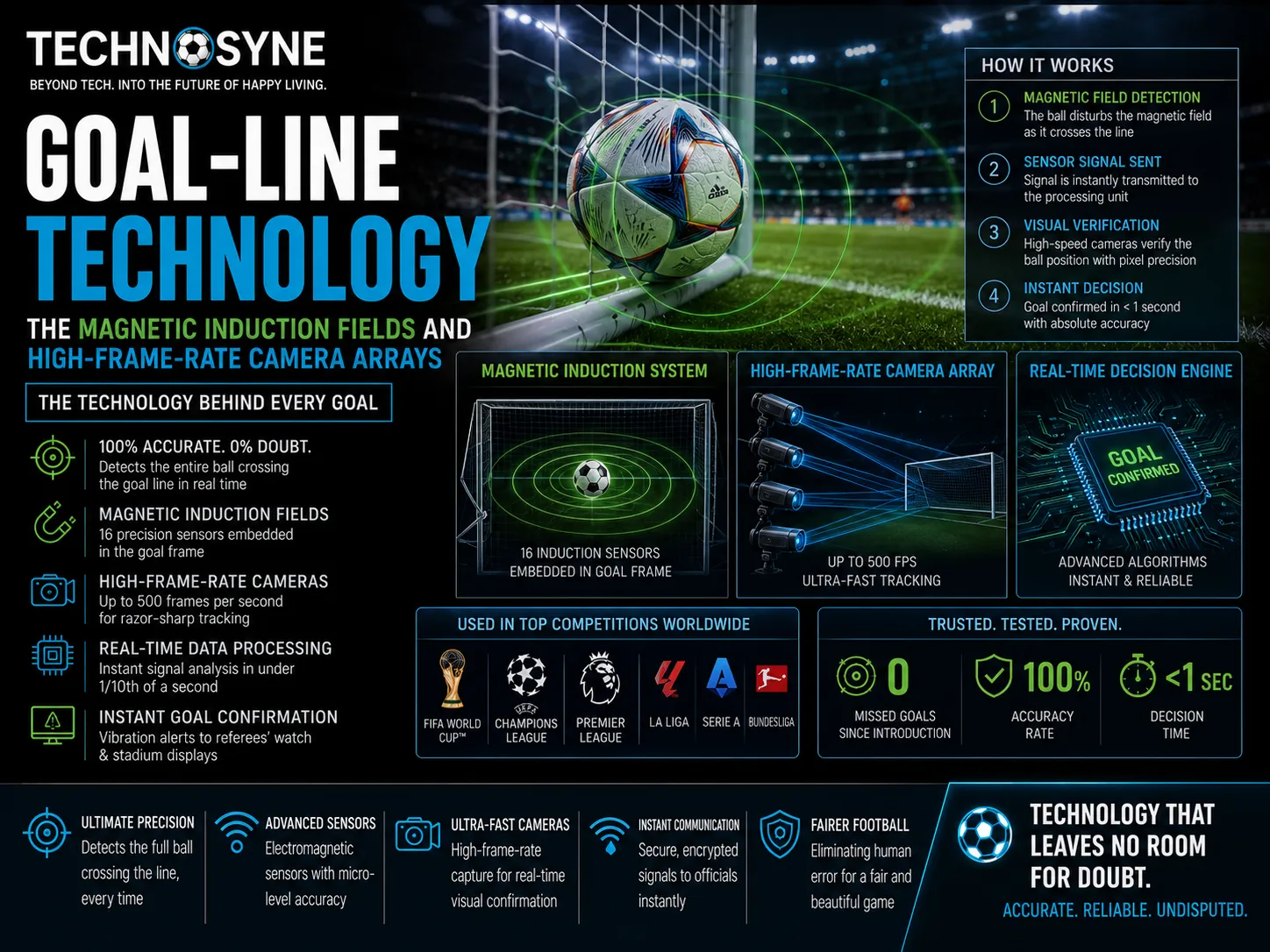
The margin between a historic tournament triumph and a crushing exit often comes down to less than a single millimeter on the goal line. In the high-stakes matching blocks of the FIFA World Cup 2026, the absolute elimination of human error from this equation is made possible by highly advanced computer vision automation, magnetic induction field tracking, and high-frequency edge sync loops [INDEX].
At Technosyne.net, we strip away sports marketing to focus entirely on raw hardware engineering. While fans wait for the official signal, stadium infrastructures are running continuous cryptographic verification cycles.
This deep dive breaks down the high-speed cameras, sensor configurations, and encrypted smartwatch telemetry arrays that power modern Goal-Line Technology (GL
TECHNOSYNE TECHGRID LAB
FIFA 2026 Goal-Line Infrastructure
Optical Architecture: The Hawk-Eye 500fps Multilateral Array
The primary system validating ball positioning operates via advanced computer vision triangulation. Traditional broadcast setups are limited by tracking obstruction—such as a goalkeeper’s body or a cluster of defenders blocking the direct line of sight. To bypass this entirely, each stadium installation features 14 dedicated high-speed Hawk-Eye cameras split symmetrically between both goal mouths (7 cameras per goal structure).
Frame-Rate and Light Management
These cameras capture footage at a locked 500 frames per second (fps) using high-grade global shutter sensors. Unlike standard rolling shutters that introduce geometric warping on moving objects, a global shutter grabs the entire pixel matrix simultaneously. This ensures the ball remains a sharp, undistorted sphere even when travelling at velocities over 130 km/h.
The lenses are tuned with custom infrared bandpass filters to normalize changes in ambient weather, shadow overlays, and stadium floodlights. The computing array tracks the exact 3D coordinates of the ball, mapping its boundary edges relative to the physical width of the white goal line.
Magnetic Induction: The GoalRef Back-End Layer
While optical systems handle clear visual paths, FIFA stadiums utilize a completely separate, parallel hardware solution known as GoalRef to handle deep, highly obstructed goal-mouth scrambles.
The Framework Induction Coils
The three physical posts making up the goal framework (the two vertical uprights and the horizontal crossbar) are wrapped internally with low-frequency electromagnetic copper induction coils. These coils project a passive, continuous magnetic field layer directly across the open plane of the goal mouth.
The Smart Ball Core Integration
Woven into the inner structural lining of the Adidas Trionda match ball is an array of passive, micro-thin passive receptor rings.
- The Interaction: The moment the ball crosses completely past the rear boundary line of the posts, the embedded rings alter the shape of the induction field.
- The Telemetry: Localized processing receivers hidden inside the base of the net monitor these signal deviations at a high scan frequency. If the field change matches a 100% boundary entry template, the system logs a goal confirmation instantly.
Sensor Fusion & Millimeter-Level Triangulation
To guarantee absolute accuracy, the central stadium server rack runs a real-time Sensor Fusion routine that bridges both tracking fields instantly.
The system requires both the optical tracking software and the induction array to match tracking frames before a goal can be validated. If a goalkeeper covers the ball with their chest (blocking the Hawk-Eye cameras), the GoalRef induction loop logs the crossing data frame.
By calculating the exact circumference of the ball and checking it against the pitch lines, the hardware maps coordinates down to a ±3 millimeter precision window, removing the risk of visual bias from angled television broadcast replays.
The Encrypted Smartwatch Telemetry Loop
Once the data grid detects that the sphere has cleared the goal-line threshold, the signal must be relayed to the center official instantly. Any communication delay would disrupt match play and ruin live stadium engagement.
The stadium processing servers convert the entry log into an encrypted wireless alert signal within 15 milliseconds. This packet is beamed over a dedicated, low-latency radio frequency straight to the referee’s customized smartwatch.
- The Haptic Trigger: The watch motor runs a continuous, high-intensity vibration loop alongside a clean visual “GOAL” alert on the screen.
- The Audio Sync: An encrypted audio signal is simultaneously pushed straight to the referee’s secure wireless earpiece system.
This entire loop takes under 1 second from the ball crossing the line to the wrist vibration, giving the field official the data required to award the score instantly.
Infrastructure and Security Overlays
Managing dual tracking grids across a professional tournament requires robust network safety and uncompressed bandwidth capacity.
The hardware runs on a dedicated, high-speed local area network (LAN) fiber ring isolated completely from standard venue operations or public media networks. The data pipelines are wrapped in a secure AES-256 cryptographic standard, shielding the system from external tracking interference, latency injection, or device tampering.
Technosyne Verdict
Hardware Architecture Rating: 9.8 / 10
Goal-Line Technology represents the absolute peak of high-frequency automation in modern athletics. By pairing a 14-camera 500fps global shutter matrix with a back-end magnetic induction layer, it creates an incredibly accurate validation shield. Delivering undisputed, millimeter-level tracking decisions to a referee’s watch in under one second proves that automated edge-computing can make sports entirely fair without slowing down the beautiful game.
Technosyne – Beyond Tech. Into the future of happy living.
Thank you for spending your time with Technosyne! Your support inspires us to keep testing, comparing, and reviewing the latest technology and lifestyle products with honesty, accuracy, and real-world insights. Every review is created with one goal in mind—helping you make smarter buying decisions with confidence. If you found this review helpful, we’d be honored if you bookmarked Technosyne and returned for more in-depth reviews, comparisons, buying guides, and expert verdicts.
Until next time, See you in the next Technosyne Verdict.!