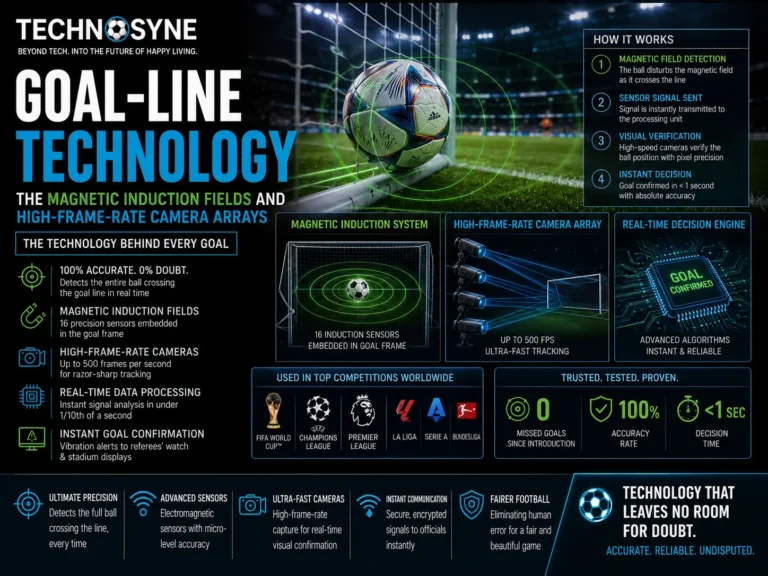


The FIFA World Cup 2026 is the largest live laboratory for computer vision and spatial computing in sports history [INDEX]. While television broadcasts focus on the human drama in the referee booth, the real power shifts to a complex infrastructure of artificial intelligence, high-frequency skeletal tracking, and edge cloud processing.
At Technosyne.net, we evaluate sports infrastructure through a raw hardware lens. The updated Video Assistant Referee (VAR) suite is no longer a basic multi-screen video replay system. It functions as a automated data engine processing millions of spatial metrics per second.
This review provides an exhaustive look into the microchips, camera frame rates, and automated offside algorithms powering the modern game.
TECHNOSYNE STADIUM SCORE CARD
FIFA 2026 VAR Infrastructure
The Camera Architecture: Tracking 29 Skeletal Points in Real-Time
The foundation of the 2026 VAR upgrade rests on an intricate optical matrix array [INDEX]. Standard broadcast cameras capture gameplay at a base rate of 25 to 50 frames per second, which can blur the ball or limbs during explosive sprints. To prevent this, FIFA stadium installations now deploy a dedicated network of 12 specialized tracking cameras mounted high beneath the roof structure.
These cameras operate completely independently from the standard television broadcast feed. Working at a locked rate of 50 frames per second, they track the physical coordinate changes of all 22 players on the turf.
The core software layer uses highly advanced artificial intelligence computer vision models to instantly build a live tracking skeleton for every athlete. The algorithm maps out 29 distinct data points per player, focusing intensely on all limbs and extremities that can legally touch the ball under the laws of the game:
- Upper Extremities: Shoulder tips, elbow joints, wrist points.
- Lower Extremities: Hip joints, kneecaps, ankles, heels, and the tips of the boots.
- Center Mass: Sternum, pelvic floor, and structural head orientation.
This tracking mesh processes positional data points constantly, logging precisely where every legal playing surface of an attacker’s body sits relative to the last defender and the goal line.
500Hz Sensor Fusion: The Kinexon Ball Synchronization Loop
Optical cameras alone cannot perfectly verify the moment a pass is made. If a player kicks a ball while running at top speed, the exact frame of foot-to-ball contact can fall between the 50-frame capture cycles of the tracking lenses. This is where Sensor Fusion changes the game.
The system relies on data streaming from the Adidas Trionda official match ball. Suspended right at the center of the ball is an Inertial Measurement Unit (IMU) microchip that beams data at an ultra-precise 500Hz sampling rate.
When an attacking midfielder strikes a forward pass, the ball’s internal accelerometer detects the exact millisecond of impact, timestamping the data packet instantly. This metric is transmitted via low-latency Ultra-Wideband (UWB) radio frequencies to the stadium’s server racks [INDEX].
The VAR software layer then acts as a central processing alignment engine:
- It reads the 500Hz data packet identifying the exact touch frame.
- It grabs the matching frame slice from the 50fps camera tracking array.
- It combines the player’s skeletal position with the precise launch frame of the ball.
This sensor fusion loop completely eliminates manual line-drawing errors, providing an automated foundation for offside checking.
Semi-Automated Offside Technology (SAOT) Explained
When an attacker moves past the defensive backline, the Semi-Automated Offside Technology (SAOT) automation engine swings into action behind the scenes.
The Spatial Validation Boundary Check
The local computing cluster monitors the spatial boundaries between the attacking forward’s 29 skeletal points and the defender’s positioning. If the automated check notes a boundary violation at the exact millisecond of ball contact, the software triggers an immediate Offside Alert to the video review booth within three seconds.
The Automated Line-Draw Overlay
Instead of forcing a human technician to manually click across a video feed to draw crosshair paths on the pitch, the SAOT system draws them automatically:
- The Defensive Blue Line: Snaps onto the exact trailing limb coordinate of the last defender.
- The Attacking Red Line: Snaps onto the forward-most playing extremity of the attacking winger.
The video review team simply double-checks the automatically generated kick point and line selections, verifying the decision before communicating it directly to the field official via the encrypted referee headset system.
The 3D Avatar Engine: Transforming Spatial Data into Live Replays
One of the biggest historical complaints regarding VAR was the complete lack of stadium transparency. Fans in the stands and viewers at home were left staring at empty grass pitches while referees debated abstract geometric lines. The 2026 suite solves this using an automated 3D Avatar Rendering Engine.
The moment the VAR review booth confirms an offside call, the system transforms the text coordinates from the 29 skeletal tracking cameras into a photorealistic 3D rendering. Powered by localized Lenovo edge server arrays, the animation builder sets up a detailed virtual camera angle tracking the play:
- It creates individual, accurate digital twins of the players’ physical body shapes.
- It highlights the exact illegal limb crossing the defensive threshold.
- It renders a clear vertical perspective alignment across the pitch.
This entire animation pipeline is rendered and exported in under 25 seconds. The 3D video file is pushed directly to the venue’s massive jumbotrons—like the Samsung Infinity Screen at Los Angeles Stadium—and global television feeds simultaneously, giving the audience clear insight into the call.
The Infrastructure Pipeline: Network Routing and Security
Managing this massive data load requires an enterprise-grade broadcast network backbone built directly into each venue.
The stadium routing paths migrate away from legacy SDI cables in favor of an uncompressed SMPTE ST 2110 IP network infrastructure running over high-bandwidth 100Gbps fiber lines. This keeps video signals entirely lag-free, delivering tracking data to the servers with zero compression artifacts.
Cryptographic Security Overlays
Because live officiating data is highly sensitive, the wireless telemetry loops running from the match ball to the stadium antennas use strong cryptographic protection layers. The data streams are wrapped in an AES-256 encryption standard, preventing any external signal hijacking or tracking manipulation across the tournament grounds.
Technosyne Verdict
Hardware Architecture Rating: 9.6 / 10
The 2026 VAR suite successfully moves video review out of the slow, manual era into a fast, automated system. By combining an extensive 12-camera 29-point optical tracking network with the 500hz Adidas Trionda smart ball sensor, it drastically lowers review times while making complex calls completely transparent. It functions less like a video replay monitor and more like an elite spatial operating platform—making it one of the absolute most impressive technology deployments in modern sports history.
TECHNOSYNE – Beyond Tech. Into the Future of happy living.
Thank you for spending your time with Technosyne! Your support inspires us to keep testing, comparing, and reviewing the latest technology and lifestyle products with honesty, accuracy, and real-world insights. Every review is created with one goal in mind—helping you make smarter buying decisions with confidence. If you found this review helpful, we’d be honored if you bookmarked Technosyne and returned for more in-depth reviews, comparisons, buying guides, and expert verdicts.
Until next time, See you in the next Technosyne Verdict.!