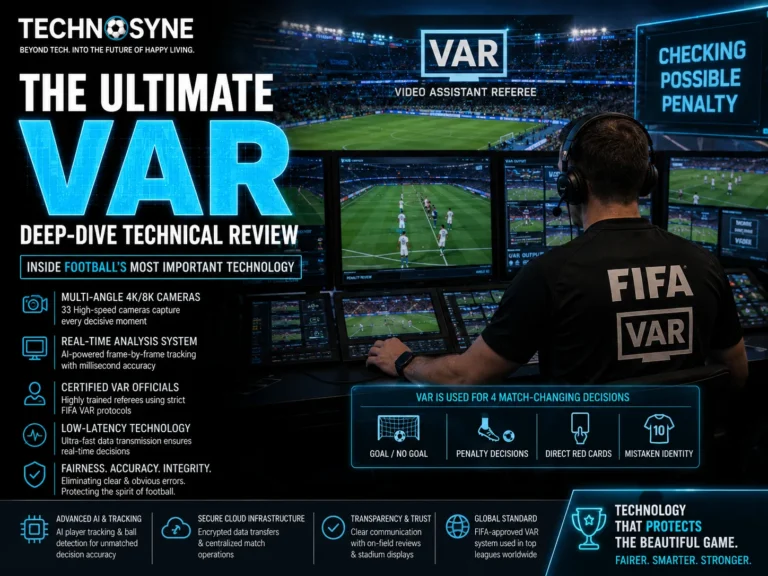

The FIFA World Cup 2026 has fundamentally changed how we monitor physical gameplay. While fans focus heavily on player tracking vests and smart stadiums, the single most critical tech tool on the pitch is the ball itself: the Adidas Trionda.
For the first time in tournament history, we are watching a football that functions like a high-end mobile device. It holds internal computer chips, runs on a battery, and requires a power outlet. The Technosyne TechGRID steps inside the lab to break down the internal hardware, battery systems, and aerodynamic engineering redefining soccer telemetry.
TECHNOSYNE SCORE CARD
Adidas Trionda Smart Ball
The Internal Core: Anatomy of the 500Hz Motion Sensor
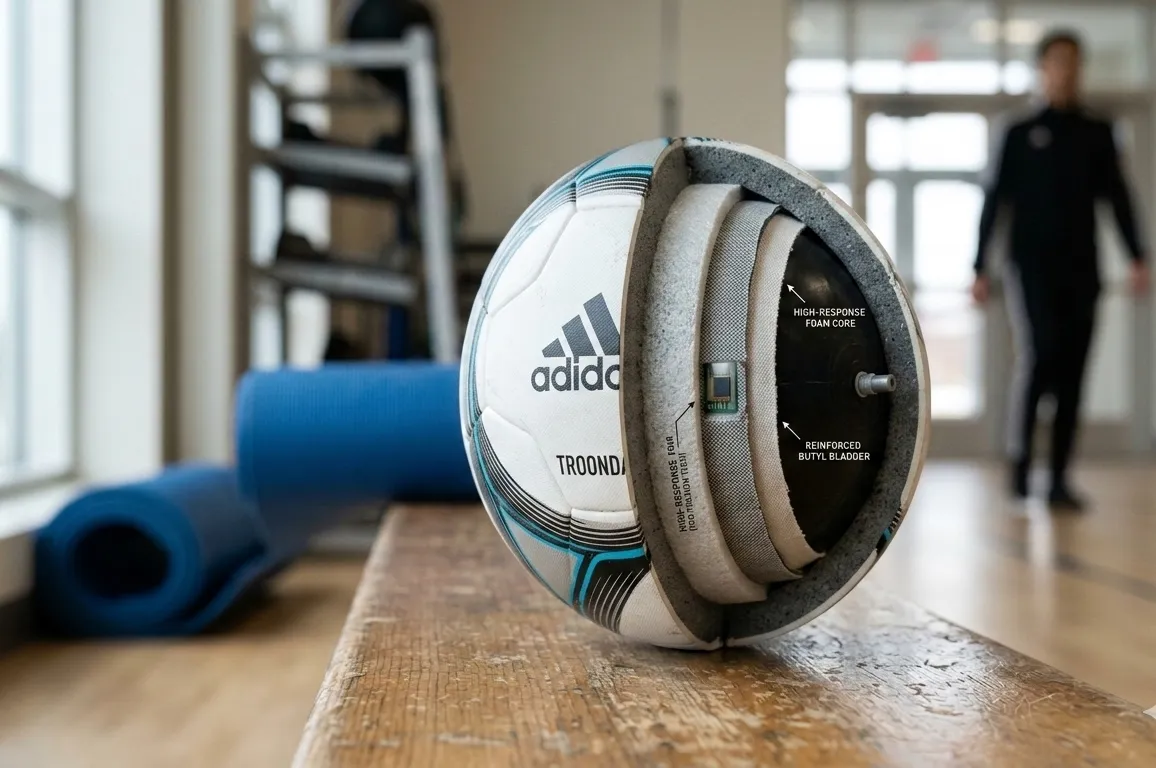
At the literal center of the Adidas Trionda is an intricately suspended tracking core. Developed in deep partnership with German enterprise positioning specialists Kinexon, this core houses a highly customized microchip architecture.
Unlike previous iterations that were loosely mounted inside the casing, the 2026 model uses an array of ten high-tensile, elastomeric structural tension struts. These lines span from the interior butyl bladder wall directly to a rigid, ultra-lightweight central capsule shell. This guarantees that no matter how hard the ball is kicked, twisted, or pressurized, the micro-sensor remains perfectly fixed at the exact spatial center of gravity.
The processor itself is an advanced Inertial Measurement Unit (IMU). It packages two primary micro-electromechanical systems (MEMS):
- A High-G Accelerometer: Tracks multi-axis speed changes up to 400G of immediate structural force.
- A Precision Gyroscope: Logs rotational velocity, mapping spin metrics accurately in three-dimensional space.
The tracking chip operates at a blinding 500Hz sampling frequency. This means the chip logs data exactly 500 times per second—or once every two milliseconds. It notes acceleration, rotation, and force profiles, generating a dense stream of physical match data.
Wireless Connectivity: Why Bluetooth Was Ditched for UWB
A common question among tech fans is whether the match ball communicates via standard Bluetooth protocols. The short answer is: Absolutely not.
Bluetooth is fundamentally unsuited for live professional sports telemetry for three critical structural reasons:
- Signal Absorption Latency: Bluetooth operates on the crowded 2.4GHz spectrum. Water blocks these radio waves easily. When a human body (which is mostly water) blocks the path between the ball and a receiver, the signal drops out.
- Slow Data Streams: Bluetooth lacks the bandwidth required to send 500 packets of information per second without dropping frames.
- High Power Demands: Keeping a high-power Bluetooth link stable drains compact cell batteries rapidly.
Instead of Bluetooth, the Adidas Trionda uses a localized Ultra-Wideband (UWB) network topology.
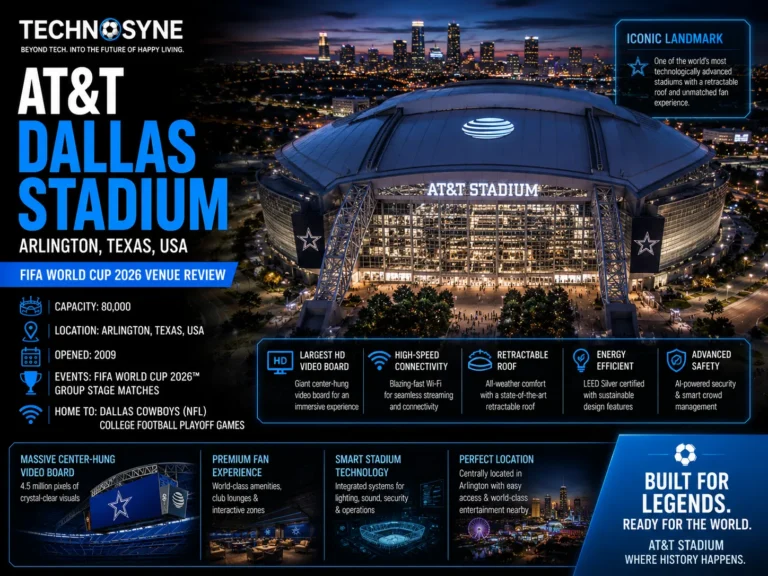
The UWB transmitter inside the core sends low-power, high-frequency radio pulses across a wide spectral band. Twelve specialized receiver antennas are positioned at fixed geometric points around the perimeter of each World Cup stadium structure. This creates a localized real-time positioning matrix. The position of the ball is measured down to the millimeter, with data arriving in the video assistant referee (VAR) booth in less than 20 milliseconds.
The Power Grid: Inside the Lithium-Ion Battery & Hibernation Loop
Turning a standard piece of sports equipment into a live tracking accessory requires a dedicated power system. The internal electronics are driven by a specialized, ultra-lightweight lithium-ion polymer battery cell.
Inductive Charging & Cradle Integration
Because adding a physical USB port to the outside of the ball would ruin its aerodynamic balance and structural integrity, the battery utilizes wireless induction charging paths.
Before kickoff, the match balls are placed on specialized inductive charging cradles inside the equipment rooms. A full charge cycle takes roughly 90 minutes and provides six hours of continuous, active gameplay tracking.
The Smart Hibernation Loop
To prevent the battery from draining completely while stored in shipping crates or on the sidelines, the Kinexon chip relies on a clever hibernation software routine.
The system utilizes the internal accelerometer as a power switch. When the ball rests completely still for more than ten minutes, the processor powers down into a deep sleep mode that draws mere micro-amps of power. The moment an official picks up the ball or a player touches it, the vibration trips the sensor switch, waking the UWB transmitter in less than a millisecond.
Aerodynamic Engineering: Balancing the 14-Gram Payload
Adding a battery, an induction coil, tension struts, and a micro-sensor tracking capsule inside a ball introduces a major physical challenge: Weight and Equilibrium.
The entire internal hardware array weighs exactly 14 grams. While that sounds light, adding 14 grams to one side of an object would cause it to wobble wildly mid-flight, making clean passing paths impossible.
To preserve a perfectly stable trajectory, Adidas implemented a precise Counter-Balancing Panel Configuration. The Trionda ball features a clean, thermally bonded four-panel outer layout.
The tech module is embedded into the interior face of the primary panel. To completely balance this payload, identical 4.66-gram patches of synthetic material are welded into the interior faces of the other three remaining panels. This spreads the mass symmetrically across the outer sphere, ensuring the ball flies cleanly through the air without any drifting bias.
On-Field Impact: Faster VAR and Real-Time “Snicko” Visuals
The data generated by this high-tech setup feeds directly into the tournament’s officiating booth to resolve complex match moments instantly.
Cutting Down Offside Delays
Historically, checking an offside position via traditional VAR required a human operator to manually scroll through video frames to find the exact millisecond a passer’s boot touched the ball. This process caused long, frustrating delays on the pitch.
The Trionda’s sensor completely solves this issue. The 500Hz accelerometer detects the exact spike in pressure that occurs when a boot makes contact with the surface. By syncing this precise time frame with the stadium’s 29-point player tracking cameras, FIFA’s automated AI systems can generate a clear offside decision instantly.
The Rise of Football’s “Snicko”
The chip also provides a brilliant solution for disputed handballs and deflections. Similar to the “Snickometer” technology used in international cricket, the VAR booth can pull up a live audio-style waveform of ball impact data.
If a ball brushes a defender’s hand or the edge of a striker’s boot, the sensor logs the slight micro-vibration instantly. Television broadcasts can show this waveform chart directly to fans, displaying a sharp peak at the exact moment of touch to eliminate all controversy.
Technosyne Verdict
Hardware Architecture Rating: 9.5 / 10
The Adidas Trionda marks the complete transformation of sports equipment from passive objects into connected computers. By bypassing the lag issues of Bluetooth in favor of a fast Ultra-Wideband network link, and balancing its internal components perfectly, Adidas has built an incredible piece of athletic engineering. It keeps gameplay totally accurate and fair—making it the ultimate smart device of the 2026 tournament.
TECHNOSYNE – Beyond Tech. Into the Future of happy living.
Thank you for spending your time with Technosyne! Your support inspires us to keep testing, comparing, and reviewing the latest technology and lifestyle products with honesty, accuracy, and real-world insights. Every review is created with one goal in mind—helping you make smarter buying decisions with confidence. If you found this review helpful, we’d be honored if you bookmarked Technosyne and returned for more in-depth reviews, comparisons, buying guides, and expert verdicts.
Until next time, See you in the next Technosyne Verdict.!