
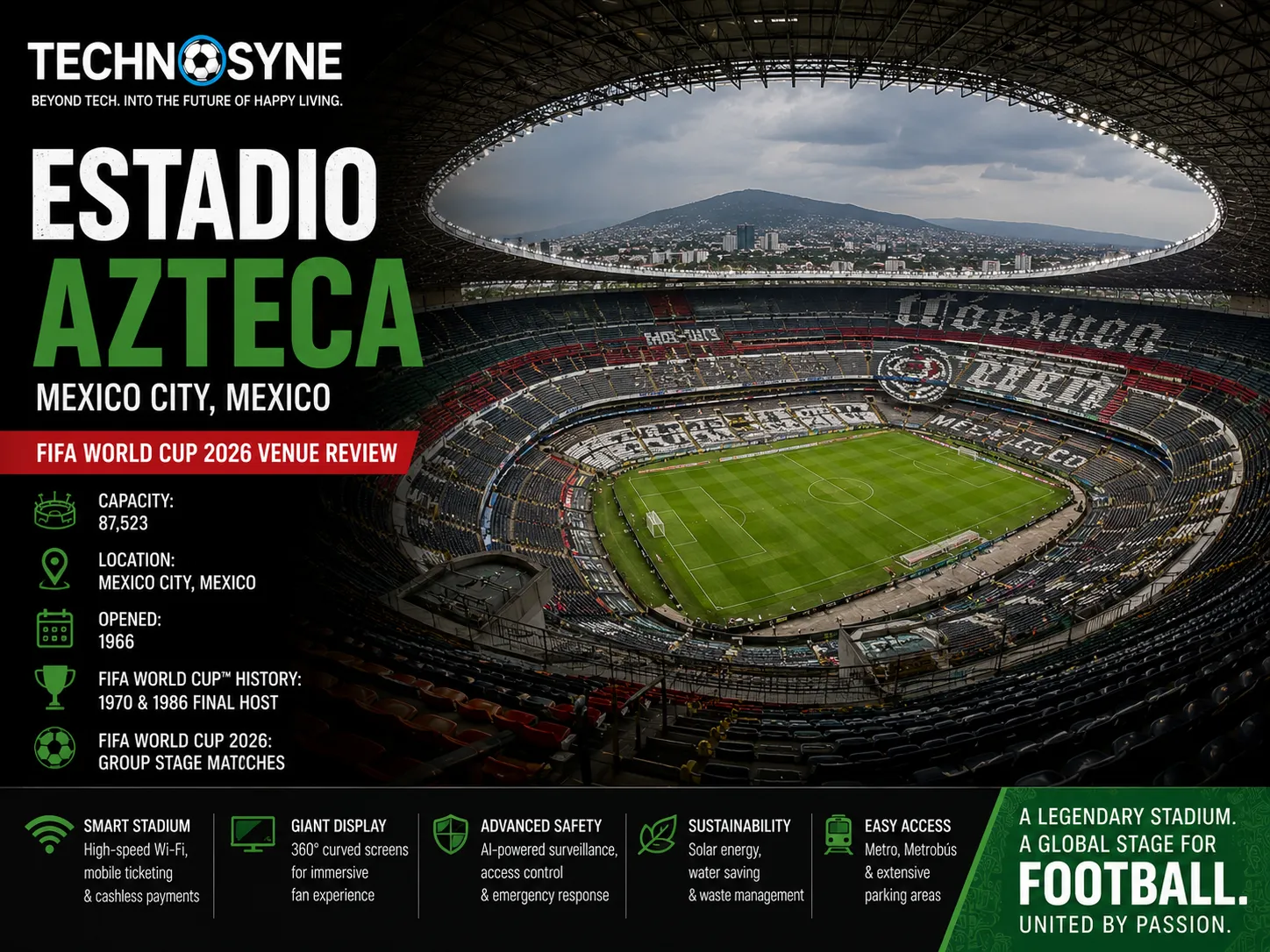
The FIFA World Cup 2026 pays tribute to football history at Mexico City Stadium (Estadio Azteca). As the first venue to host three different World Cup tournaments, this historic cathedral has received a massive modern technology upgrade to prepare for the 2026 games.
Technosyne Score Card : Verdict
Mexico City Stadium (Estadio Azteca)
Estadio Azteca Mexico City stadium Details
Estadio Azteca Quick-Facts
Mexico City, Mexico 🇲🇽
Core Hardware Layers
- Skeletal Tracking: 12 optical tracking cameras capturing 29 skeletal body points per player at 50fps.
- Smart Illumination: Upgraded Signify LED sports lighting systems reducing power usage by over 30%.
- Hawk-Eye Fusion: 7 high-speed tracking cameras per goal mouth looping encryption pulses to the referee’s smartwatch in < 1 second.
Stadium Overview
- Stadium Name: Mexico City Stadium (Officially known as Estadio Azteca)
- Location: Santa Úrsula Coapa, Mexico City, Mexico
- Capacity: ~83,264 seats
- Opened: May 29, 1966
- Home Teams: Club América (Liga MX), Cruz Azul (Liga MX), Mexico National Team
- FIFA World Cup 2026 Role: Host of the Historic Opening Match [1]
- Expected Matches: 5 Total Fixtures (Including the Opening Ceremony) [1]
Why This Stadium Matters
Brief History
Estadio Azteca is a legendary cathedral of football. It is the iconic pitch where Pelé lifted the trophy in 1970 and where Diego Maradona scored his famous “Hand of God” and “Goal of the Century” matches in 1986.
Why FIFA Selected It
FIFA selected this venue to host the official opening match of the 2026 tournament to honor its incredible World Cup legacy. To meet modern hosting rules, the stadium completed a multi-million-dollar tech and structural remodel between 2024 and early 2026.
Stadium Architecture & Design Engineering
Design Philosophy
Originally designed by master architects Pedro Ramírez Vázquez and Rafael Mijares Alcérreca, the stadium is famous for its massive concrete columns and towering design that traps sound inside, creating a highly intense atmosphere.
Structural & Seating Upgrades
The 2025 structural remodel focused heavily on modernizing the executive luxury boxes and expanding media zones. The seating bowl layout was also optimized to keep fans safe while maintaining perfect, clear views of the field.
Fan Experience & Premium Hospitality
- Accessibility: Upgraded with brand-new wheelchair access ramps, elevators, and modern accessible pathways.
- Premium Seating: Features extensive executive suite boxes built across the middle levels.
- Hospitality Areas: The updated hospitality lounges combine classic Mexican football heritage with high-end premium dining and digital entertainment arrays.
Technology Inside the Stadium
High-Speed Connectivity
- Smart Network Overlays: Since the building is made of heavy concrete, engineers installed a modern CommScope Wi-Fi 6 network mesh, hiding high-density antennas along roof beams and under seats.
- 5G Connectivity: Upgraded with high-capacity 5G transmitters to ensure fast mobile data speeds across the venue during matches.
- Digital Access Controls: Standard turnstiles were replaced with smart electronic gates that scan digital tickets on mobile devices.
Modern Digital Displays
- New High-Definition Videoboards: The old video displays were replaced with two massive, state-of-the-art Panasonic 4K LED screens hung behind the goals, keeping graphics sharp under direct sun.
- Ribbon Displays: Modern LED ribbon boards were installed along the tier lines to show live stats and match updates.
Broadcast Technology & Spatial Offside Systems
FIFA Production Infrastructure
The media center received a complete technology overhaul, adding high-speed fiber-optic lines to transmit uncompressed live video feeds to global broadcasters.
- 4K UHD Workflows: Processes and transmits live match feeds in Ultra-HD.
- Camera Mounts: Features over 40 camera locations, including overhead cable-cams and specialized slow-motion tracking arrays.
Automated VAR & Goal-Line Fusion
- The Connected Ball System: Integrates with match ball telemetry sensors at 500Hz to accurately track pass data frames.
- Skeletal Camera Tracking: 12 tracking cameras follow player skeletal structures at 50fps to log real-time positions.
- Hawk-Eye Goal-Line Technology: Tracks the goal line via 7 high-speed cameras, sending an instant cryptographic confirmation pulse to the official’s watch in under 1 second if the ball fully crosses the line.
Sustainability & Green Technology
- Energy Upgrades: The stadium retrofitted its light fixtures with high-efficiency Signify LED lighting systems, reducing energy use by over 30%.
- Water Conservation: Features a modernized wastewater recycling layout designed to handle venue maintenance demands efficiently.
Transportation, Access & Logistics
- Airports: Serviced by Mexico City International Airport (MEX) and Felipe Ángeles International Airport (NLU).
- Public Transport: Accessible via the city’s light rail system (Tren Ligero), dropping fans off directly at the Estadio Azteca Station.
- Travel Tip: Avoid using rideshares near the stadium on match days due to heavy traffic on Calzada de Tlalpan; taking the light rail train is much faster.
Nearby Attractions: Top 5 Places to Explore
- Coyoacán District: A beautiful historic neighborhood nearby, famous for its colonial architecture and art markets.
- Frida Kahlo Museum: The famous “Blue House” dedicated to the life and art of the legendary painter.
- Xochimilco Floating Gardens: A unique historic canal network where visitors can tour on colorful traditional boats.
- National Museum of Anthropology: A world-class museum in Chapultepec Park exploring Mexico’s ancient civilizations.
- Zócalo (Central Square): The historic main square in downtown Mexico City, packed with culture and landmark buildings.
Upcoming FIFA World Cup 2026 Matches at This Venue
| Date (2026) | Match Fixture | Stage / Group |
|---|---|---|
| June 11 | 🇲🇽 Mexico vs. TBD | World Cup Opening Match [1] |
| June 17 | TBD vs. TBD | Group Stage |
| June 24 | 🇲🇽 Mexico vs. TBD | Group Stage |
| June 30 | TBD vs. TBD | Round of 32 Knockout |
| July 5 | TBD vs. TBD | Round of 16 Knockout |
Players Likely to Highlight the Pitch
- Santiago Giménez (Mexico): Tipped to lead the national team’s attack on this historic home field during the opening game.
- Edson Álvarez (Mexico): The veteran midfielder expected to anchor his squad’s defensive data metrics.
- Lionel Messi (Argentina): If his squad routes through the early knockout stages here, tracking cameras will capture his high-efficiency play style on this legendary field.
Technosyne Verdict
Hardware Rating: 9.2 / 10
Estadio Azteca combines legendary football history with smart modern technology. While it lacks the futuristic look of newer venues, its upgraded Wi-Fi 6 mesh network, fresh 4K screens, and incredible historic atmosphere make it a truly legendary venue for the World Cup.
TECHNOSYNE – Beyond Tech. Into the Future of happy living.
Thank you for your time and for reading our review! Your support means the world to us here at Technosyne. We are constantly testing the latest gear, so bookmark our page and check back often for our next deep-dive breakdown.
See you in the next hardware verdict!