
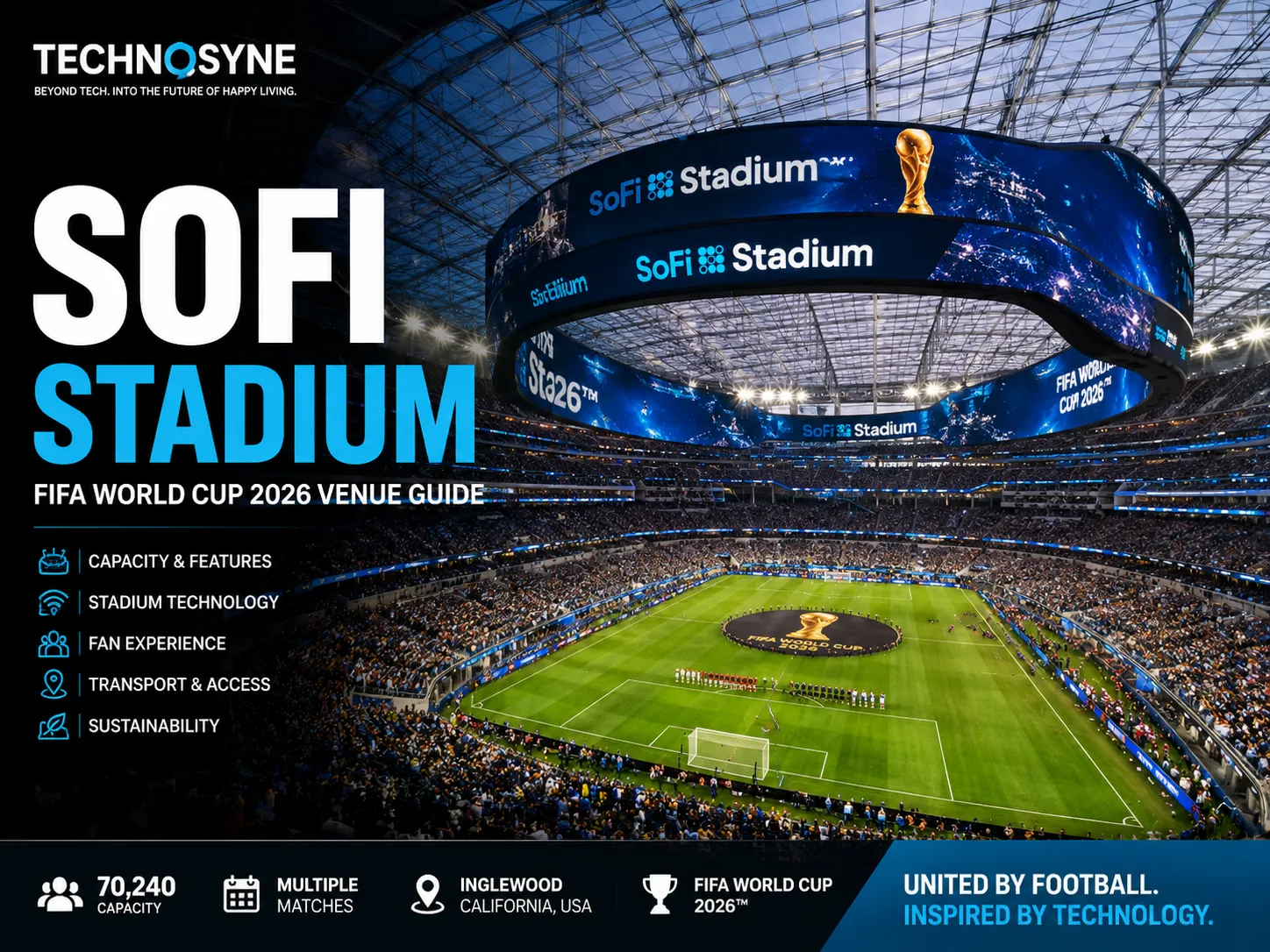
The FIFA World Cup 2026 is fully underway, and all eyes are on the tournament’s most expensive, technologically aggressive engineering marvel: Los Angeles Stadium (SoFi Stadium). Nestled in Inglewood, California, this multi-billion dollar colosseum functions less like a traditional arena and more like a giant, living consumer tech product.
Below is our exhaustive Technosyne.net technical audit of how the venue’s massive infrastructure, AI edge processing, and digital displays shape the future of sports.
TECHNOSYNE SCORE CARD : VERDICT
Los Angeles Stadium (SoFi)
Stadium Overview
- Stadium Name: Los Angeles Stadium (Known natively as SoFi Stadium)
- Location: Inglewood, Los Angeles County, California, USA
- Capacity: ~70,000 seats (Scalable up to 100,000 for massive non-sporting events)
- Opened: September 8, 2020
- Home Teams: Los Angeles Rams (NFL), Los Angeles Chargers (NFL)
- FIFA World Cup 2026 Role: Prime West Coast Marquee Venue
- Expected Matches: 8 Total Fixtures (Including the highly anticipated United States Men’s National Team Opening Group Match)
Why This Stadium Matters
Brief History
Commissioned by real estate magnate and Arsenal FC owner Stan Kroenke, the stadium broke ground in 2016 as the structural centerpiece of the massive Hollywood Park development project. cost a staggering $5.5 billion to build, completely shattering records to become the single most expensive sports complex ever conceived on Planet Earth.
Why FIFA Selected It
While Southern California has immense historical soccer heritage (hosting the 1994 World Cup Final at the Rose Bowl), FIFA required an elite venue that matched the modern, hyper-commercialized needs of global sponsors. Los Angeles Stadium won the bid due to its unrivaled VIP infrastructure, immediate proximity to Los Angeles International Airport (LAX), and its capability to provide a high-tech corporate canvas for global streaming broadcasts.
Stadium Architecture & Design Engineering
Design Philosophy
Architectural powerhouse HKS Inc. designed the stadium to function as an extension of Southern California’s relaxed indoor-outdoor climate. The structure is entirely open-air along its sides, letting coastal Pacific breezes freely sweep through the lower bowls, while an overarching canopy protects the crowd from the direct midday sun.
Excavation Style & Construction Method
Because the venue sits directly under the primary flight radar descent paths for airplanes landing at LAX, designers faced a strict FAA altitude cap. To bypass this, engineers excavated the earth down 100 feet deep, building the entire seating bowl entirely underground
Seating Bowl & Sightline Optimization
To prepare the pitch for soccer, extensive corner modifications were executed in late 2025. The original American football concrete retaining walls were excavated to expand the pitch width to meet strict FIFA Category 1 pitch dimensions. HKS utilized sophisticated computational spatial modeling to ensure that despite these wide-angle modifications, all 70,000 seats maintain an completely unobstructed, direct sightline to the corner flags without geometric blind spots.
Fan Experience & Premium Hospitality
- Accessibility: Accessible via 16 sweeping architectural canyons, offering continuous concrete ramp inclines, oversized glass elevators, and tactile guidance systems for impaired fans.
- Premium Seating: Over 260 luxury executive suites configured into distinct, climate-controlled tiers.
- Hospitality Areas: Features the field-level Pechanga Founders Club, allowing VIP ticket holders to watch players line up in the tunnel through high-grade acoustic glass panels before walking directly out behind the team benches.
Technology Inside the Stadium
High-Speed Connectivity
- Stadium Wi-Fi: Features the single largest deployment of Cisco Wi-Fi 6 nodes anywhere on earth. Over 2,500 individual Wi-Fi antennas are placed directly underneath the venue’s seats, providing dedicated, gigabit-speed coverage to every spectator simultaneously.
- 5G Edge Network: In partnership with Verizon and AT&T, the venue hosts a localized 5G Millimeter-Wave (mmWave) grid. This edge processing architecture ensures zero packet loss, allowing fans to upload 4K video instantly despite the massive network strain of 70,000 devices.
- Mobile Ticketing: Fully integrated with NFC Apple Wallet and Google Wallet tokens. Gate sensors use encrypted proximity tracking to scan incoming crowds without requiring fans to slow down or physically tap screens.
Next-Gen Digital Displays
- The Samsung Infinity Screen: The undeniable crown jewel of the stadium is a dual-sided, 360-degree ovular halo videoboard suspended from the steel roof truss. Weighing a massive 2.2 million pounds, it holds over 80 million pixels of continuous 4K LED real estate. Because it is double-sided, fans sitting in the lower bowls look up to see the interior screen, while upper deck seats view the exterior screen flawlessly.
- The LED Canopy Roof: The roof consists of a semi-translucent ETFE membrane embedded with 27,000 programmable LED puck lights. At night, the entire roof turns into a massive, animated television screen displaying live matches and graphics directly to commercial aircraft flying over head into LAX.
Smart Crowd Management & Safety AI
The operations center uses an automated software layer to predict gate bottlenecking. Thermal imaging cameras track human flow density across the outer concourses, automatically alerting staff to deploy mobile barricades or redirect fans to shorter security lines via real-time digital signage updates.
Broadcast Technology & Spatial Offside Systems
FIFA Production Infrastructure
The media facilities house an uncompressed SMPTE ST 2110 fiber network backbone. This allows the localized production truck compound to feed raw, latency-free audio and video arrays directly to global broadcast rights holders.
- 4K UHD & HDR Coverage: Every fixture is mixed natively in High Dynamic Range (HDR) using BT.2020 color spaces.
- Camera Systems: Over 42 host broadcast cameras are positioned around the stadium pitch, including ultra-high-speed slow-motion arrays, robotic rail cams tracking the sidelines, and twin overhead Spidercams sweeping the spatial field.
Automated VAR & Goal-Line Fusion
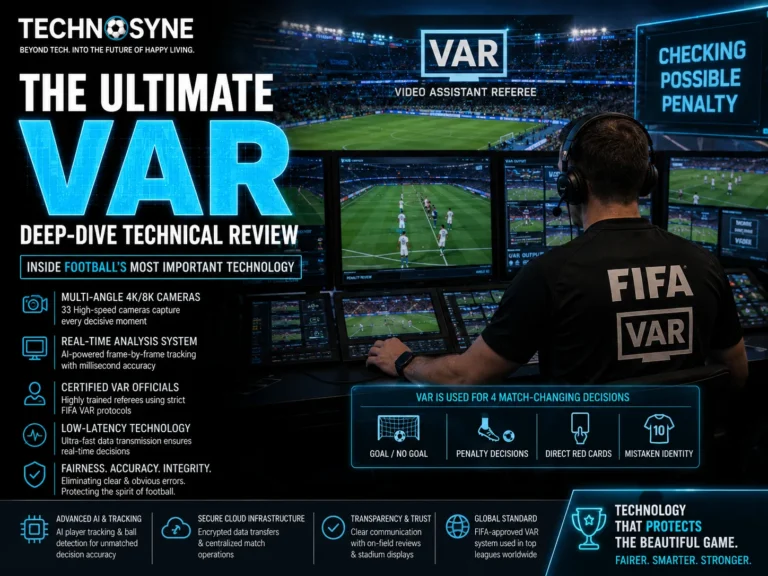
- The Adidas Trionda Connected Ball: The match ball transmits localized positional telemetry 500 times per second via a built-in sensor suspension system, tracking the exact millisecond it leaves a kicker’s boot.
- Skeletal Camera Tracking: 12 dedicated tracking cameras capture 29 distinct skeletal structural points on each player, calculating real-time body positions at 50 frames per second. This data feeds into automated offside algorithms, creating a 3D digital twin animation of contentious plays within seconds for instant review.
- Hawk-Eye Goal-Line Technology: 7 high-frame-rate tracking cameras are dedicated to each goal mouth. If the ball completely crosses the line, an encrypted radio pulse is beamed to the referee’s smartwatch in under 1 second, showing a vibrant “GOAL” alert.
Sustainability & Green Technology
Water & Landscape Conservation
The landscape engineering is a blueprint for urban water resilience in arid environments. The facility surrounds a central, 6-acre artificial body of water known as Lake Park, which captures urban stormwater runoff. The stadium retains 75% of total stormwater on-site, filtering it through natural bio-swales before recycling it to handle 100% of the property’s massive landscape irrigation demands.
Energy Management & ETFE Engineering
The translucent ETFE roof film is precisely tinted to reflect ultraviolet light while allowing natural sunlight through. This passive engineering prevents greenhouse heating within the underground bowl, slashing the electricity required to drive mechanical cooling fans by thousands of kilowatts daily.
Transportation, Access & Logistics
Airports & Transit Hubs
- LAX Airport: Located exactly 4 miles west of the venue, making it an ideal drop point for international tourists flying into California.
- Metro K-Line (Downtown Inglewood Station): The primary light rail option. Shuttle buses pick up fans directly from the platform on match days, bypassing local gridlock entirely.
Parking & Travel Tips
- Parking Infrastructure: The venue splits parking across multiple zones (Brown, Orange, Purple, Blue Lots).
- Crucial Match-Day Tip: Due to massive traffic snarls on Century Boulevard and Prairie Avenue, pre-booking parking passes online is strictly mandatory. Alternatively, utilizing rideshare drop-offs at Hollywood Park Casino saves up to 45 minutes of idling in stadium ingress lines.
Nearby Attractions: Top 5 Places to Explore
If you are visiting Los Angeles for a World Cup fixture, explore these top 5 local destinations:
- Hollywood Park Casino: Located directly on the stadium campus property, featuring high-stakes gaming tables and dining options.
- The Kia Forum: The iconic retro-cool concert arena situated right next door to the stadium.
- Manhattan Beach Pier: Located 15 minutes west, providing classic Southern California surf culture, ocean dining, and coastal sunsets.
- The Broad Museum (Downtown LA): A quick trip north via public transit to see elite modern art and architecture.
- Venice Beach Boardwalk: The world-famous eclectic beach stretch filled with street performers, visual murals, and open-air athletic courts
Upcoming FIFA World Cup 2026 Matches at This Venue
| Date (2026) | Match Fixture | Stage / Group |
|---|---|---|
| June 12 | 🇺🇸 United States vs. 🇵🇾 Paraguay | Group Stage (USA Opener) |
| June 15 | 🇩🇪 Germany vs. 🇳🇱 Netherlands | Group Stage |
| June 18 | 🇨🇭 Switzerland vs. 🇧🇦 Bosnia & Herzegovina | Group Stage |
| June 21 | 🇧🇪 Belgium vs. 🇮🇷 Iran | Group Stage |
| June 25 | TBD vs. TBD | Round of 32 Knockout |
| June 29 | TBD vs. TBD | Round of 32 Knockout |
| July 2 | TBD vs. TBD | Round of 16 Knockout |
| July 6 | TBD vs. TBD | Quarter-Finals |
Players Likely to Highlight the Pitch
Keep your eyes on these global superstar athletes locked in to display their performance metrics on this turf during the tournament:
- Christian Pulisic (USA): Captaining the home nation on this specific turf for the opening match.
- Kevin De Bruyne (Belgium): Masterfully orchestrating midfield analytics and high-efficiency passing lines on June 21.
- Florian Wirtz (Germany): The high-acceleration German star whose tracking metrics will put the ball sensors to work on June 15.
Technosyne Verdict
Hardware Rating: 9.5 / 10
Los Angeles Stadium is the definitive blueprint for 21st-century sports entertainment infrastructure. By combining an underground architectural build with massive technological elements like the double-sided Samsung Infinity Screen and a fully loaded Wi-Fi 6 mesh grid, it transcends its basic purpose to offer an unforgettable visual experience. It treats live sport like a premier piece of consumer consumer tech hardware—making it the ultimate cathedral for the beautiful game.
TECHNOSYNE – Beyond Tech. Into the Future of happy living.
Thank you for spending your time with Technosyne! Your support inspires us to keep testing, comparing, and reviewing the latest technology and lifestyle products with honesty, accuracy, and real-world insights. Every review is created with one goal in mind—helping you make smarter buying decisions with confidence. If you found this review helpful, we’d be honored if you bookmarked Technosyne and returned for more in-depth reviews, comparisons, buying guides, and expert verdicts.
Until next time, See you in the next Technosyne Verdict.!