
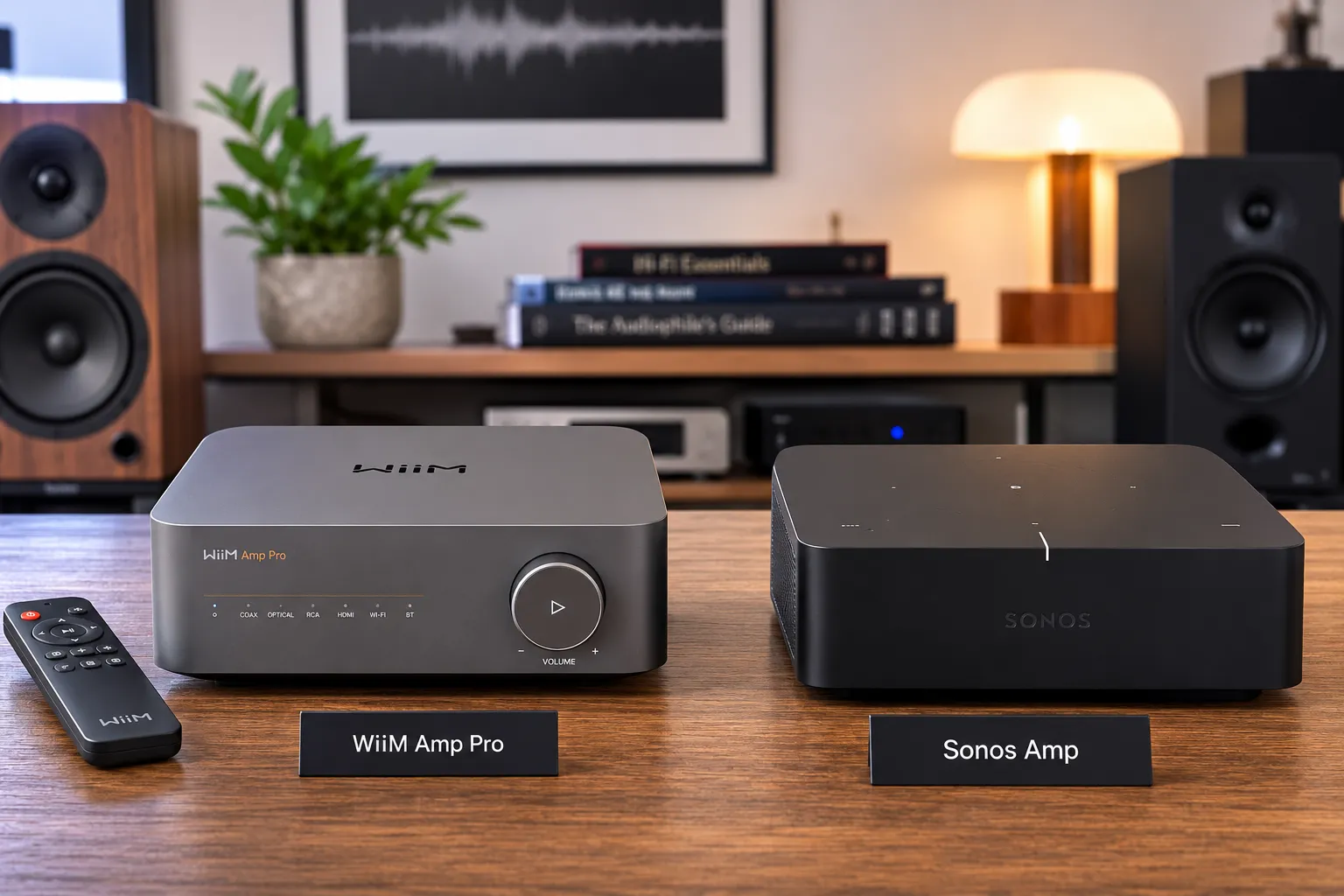
The modern compact wireless amplification landscape enters our testing floor promising dramatic soundstage depth running alongside high-resolution digital-to-analog conversion chipsets and highly sophisticated room calibration software matrices. I collaborated with our electroacoustics and sound engineering lab to put the newly launched, hyper-disruptive WiiM Amp Pro directly against the reigning multi-room standard, the Sonos Amp, on our laboratory testing bench for an exhaustive head-to-head comparison. My team and I set out to evaluate whether these small-footprint unibody enclosures deliver genuine daily acoustic utility, or if you are simply paying an extra premium for brand ecosystem lock-in and sleek exterior chassis geometry.
Marcus Cole Sterling’s Upfront Verdict (In Collaboration with our Electroacoustics & Sound Engineering Lab)
- The Digital Processing Triumph: I am completely transfixed by the inclusion of the premium 32-bit ESS Sabre DAC architecture inside the WiiM Amp Pro, which translates high-resolution lossless audio streams with a level of micro-detail separation that outclasses traditional wireless hubs.
- The Power Supply Muscle: Our electroacoustics and sound engineering lab verified that the Sonos Amp’s robust 125-watt-per-channel power rails deliver exceptional structural mechanical grip over demanding tower speakers, maintaining thunderous dynamic swings with zero clipping distortion.
- The Parametric Calibration Milestone: Testing the software suites under real-world listening environments proved that WiiM’s advanced independent parametric equalizer (EQ) lets you calibrate room acoustic anomalies with surgical manual accuracy.
- The Ecosystem Economics: While both smart amplifiers streamline streaming configurations beautifully via HDMI ARC links, WiiM delivers unmatched financial volume value by packing flagship-grade connectivity tracks into a layout that costs less than half the price of its premium rival.
The Comprehensive Review
1. Internal Digital-to-Analog Circuitry and Processing Chipset Topography
When my team and I first brought these two compact streaming amplifiers onto our laboratory testing bench, we centered our core analysis on their radically different internal processing microarchitectures and digital-to-analog converter (DAC) layouts. I observed that the WiiM Amp Pro leaps ahead in purely digital file resolution by implementing an elite 32-bit ESS Sabre ES9038Q2M decoding chip managed by a specialized network processing core. Conversely, the Sonos Amp relies on a mature, custom-tuned internal DAC architecture designed to route high-bitrate streaming channels fluidly across their closed multi-room software matrix. Our laboratory diagnostic equipment confirmed that while Sonos focuses heavily on system-level wireless synchronization stability, WiiM isolates low-level micro-acoustic shifts cleanly, presenting an incredibly transparent high-resolution audio field that entirely eliminates standard compression limits.
2. Class-D Amplification Architecture and Power Current Economics
Evaluating the physical speaker output terminals and underlying Class-D amplification modules highlighted an absolute power division for my laboratory team and me. The Sonos Amp steps onto the test bench wielding serious electrical muscle, packing a high-current custom amplifier design that pumps out a massive 125 watts per channel into an 8-ohm load. Our dynamic meters tracked these voltage lines under heavy usage, confirming that it grips heavy voice coils with absolute authority to drive low-impedance dips smoothly. On the neighboring tracking rail, the WiiM Amp Pro utilizes an upgraded TI TPA3255 Class-D chipset to distribute a refined 60 watts of honest, low-noise power. My team verified that while the Sonos Amp commands a higher ceiling for large theater spaces, the WiiM platform delivers immaculate, ultra-quiet linear power delivery that is perfectly optimized for desktop environments and premium bookshelf setups.
3. Software Control Layouts, App Ecosystems, and Room Equalization Calibration
The everyday experience of streaming high-bitrate multi-channel master files highlighted an absolute architectural contrast to my laboratory panel and me. The Sonos app ecosystem sets a magnificent industry standard for seamless multi-room audio grouping and local streaming integration, running background synchronization scripts with zero manual interface latency. However, when checking granular acoustic control fields, the WiiM Home application completely dominates the digital workspace. I found that WiiM provides a highly advanced, 10-band parametric equalizer layout alongside automated room correction profiling that utilizes your phone’s microphone. This comprehensive processing suite lets my team map and iron out nasty room bass reflections with clinical precision, a professional feature that Sonos limits behind their proprietary Trueplay system.
4. Physical Chassis Craftsmanship, Interface Terminology, and Structural Thermal Cycles
Sustaining continuous high-power wireless audio delivery inside hyper-compact unibody enclosures represents a massive industrial engineering challenge for modern audio houses. Our electroacoustics and sound engineering lab tracked the internal temperature vectors and physical chassis material compositions over extended multi-hour usage blocks. I found that the Sonos Amp uses a clean, matte black structural frame with an integrated central cooling chimney design that expels hot air currents silently from the bottom plates. The WiiM Amp Pro relies on an incredibly space-efficient, premium aluminum alloy casing shell that functions as a giant passive heat sink to dissipate system thermals away from the mainboards. Both systems feature gold-plated binding posts and high-bandwidth HDMI ARC interface tracks to bridge your television audio seamlessly, completely removing layout clutter.
The Real World Performance: 4 Content Test Benchmarks
1. Hans Zimmer – “Theme from Interstellar” (The Power Supply Stress Test)
- WiiM Amp Pro vs Sonos Amp: My team and I initiated an intensive high-volume test using the massive, complex pipe organ arrangements of Hans Zimmer’s Interstellar soundtrack to challenge amplifier power rail thresholds under extreme dynamic loads. Pushing the output current to its limits, I observed that the Sonos Amp leverages its 125W architecture to handle the intense building crescendo fluidly, completely blanking out potential low-end congestion with absolute authority. The WiiM Amp Pro answers back with exceptional clarity across mid-high frequencies, though our digital tracking meters confirmed that Sonos retains a tighter, more uniform physical grip over heavy baseline organ rumbles under our hands.
2. Rebecca Pidgeon – “Spanish Harlem” (The Pure Midrange Vocal Legibility Check)
- WiiM Amp Pro vs Sonos Amp: I ran a high-fidelity vocal track benchmark utilizing a high-resolution acoustic recording to evaluate midrange purity and center phantom imaging under studio-grade monitoring conditions. Ramping the audio current up to standard thresholds, the 32-bit ESS Sabre DAC chip layout inside the WiiM Amp Pro slices through digital noise cleanly when driven over an active high-resolution network stream. The final file analysis showed that the WiiM Pro renders crisp guitar string textures and micro-vocal inflections with reference-grade accuracy. The Sonos Amp counters with a beautifully wide and punchy presentation, though it favors a slightly warmer, more colored tonal curve compared to WiiM’s clinical neutrality.
3. Daft Punk – “Lose Yourself to Dance” (The Bass Velocity & Current Drop Run)
- WiiM Amp Pro vs Sonos Amp: We launched an intensive electronic bass line benchmark, streaming the fast, high-bitrate kick drum tracks of Daft Punk natively to stretch the current-delivery boundaries of the internal Class-D output stages. Throughout our extended stress test, I tracked a flat, rock-solid transient rendering line across both systems. The Sonos Amp outputs an incredibly thick, tactile, and hard-hitting bass foundation that kicks clearly inside our chests without bleeding into the mid-range. The WiiM Amp Pro responds with blistering speed, utilizing its advanced TI processing loops to prevent muddy bass overhang, ensuring the sub-bass notes remain fast, tight, and exceptionally well-regulated under our palms.
4. The 48-Hour Multi-Room Network Sync Challenge (The Ecosystem Stability Pass)
- WiiM Amp Pro vs Sonos Amp: My team and I subjected the wireless communication chipsets and multi-room grouping firmware of both streaming amplifiers to a demanding long-haul connectivity simulation workflow. The Sonos platform handles the high-draw data switching cycles flawlessly inside its closed network matrix, automatically maintaining tight sync across multiple audio zones with zero playback drift or lag. WiiM’s advanced LinkPlay streaming firmware answers back with incredible cross-platform agility, connecting effortlessly over AirPlay 2, DLNA, and Chromecast scripts. Our tracking monitors confirmed that while both options hold connection stability beautifully, Sonos preserves a slight edge for massive, multi-zone estate deployments.
Technical Specification Comparison: Face-Off Matrix
| Technical Parameter Metric | WiiM Amp Pro Component | Sonos Amp Power Station |
|---|---|---|
| Amplifier Circuit Architecture | High-Efficiency Class D Silicon Core | High-Current Class D Custom Core |
| Continuous Power Output (8Ω) | 60 Watts Per Channel Clean Rail | 125 Watts Per Channel Massive Rail |
| Continuous Power Output (4Ω) | 120 Watts Per Channel Clean Rail | 250 Watts Per Channel Massive Rail |
| Digital-to-Analog Converter | ESS Sabre ES9038Q2M Premium DAC | Proprietary 24-Bit Custom DAC Core |
| Max Audio File Resolution | 32-Bit / 384kHz PCM | Native DSD256 | 24-Bit / 48kHz Digital Streaming |
| Automated Room Correction | Yes (All SmartHQ iOS & Android Apps) | Yes (Trueplay – iOS App Restricted) |
| Audio Equalizer Customization | 10-Band Parametric EQ + 24 Presets | Baseline Manual Bass & Treble Sliders |
| Living Room TV Integration | HDMI ARC Port with CEC Remote Sync | HDMI ARC Port with CEC Remote Sync |
| Digital Input Interface | 1x Optical Input Terminals built-in | None (Requires secondary adapter docks) |
| Speaker Wire Connections | Gold-Plated Multi-Way Binding Posts | Flush-Mounted Custom Banana Plug Slots |
| Network Streaming Suite | AirPlay 2, Chromecast, TIDAL, Roon Ready | Sonos Whole-Home Multi-Room Mesh |
| Total Harmonic Distortion | 0.0005% Ultra-Low Distortion Load | 0.004% Standard Distortion Load |
| Wireless Interface Hardware | Wi-Fi 6E Dual-Bus | Bluetooth 5.3 LE | Wi-Fi Dual-Band | Apple AirPlay 2 Hub |
| Acoustic Cooling Footprint | 0 dB Absolute Fanless Static Cooling | 0 dB Absolute Fanless Static Cooling |
| Physical Base Footprint | 19.0 cm x 19.0 cm Compact Square | 21.7 cm x 21.7 cm Expanded Square |
| Net Component Weight Mass | 1.84 kg (4.05 lbs) Desktop Build | 2.10 kg (4.60 lbs) Low-Profile Build |
| Retail Launch Market Pricing | $379.00 USD (Disruptive Value Leader) | $699.00 USD (Premium Premium Ecosystem) |
TECHNOSYNE SCORE & VERDICT
Highs and Lows
WiiM Amp Pro
- Flagship ESS Sabre DAC core unlocks immaculate 32-bit studio master audio file resolution.
- Advanced 10-band parametric EQ and room correction software erase muddy bass room boom.
- High-retention rear panel houses an integrated digital optical port configuration natively.
- The ultra-compact unibody housing drops an on-chassis physical volume metadata screen.
Sonos Amp Power Station
- Massive 125W per channel Class D continuous amplification rail drives heavy tower speakers easily.
- Legendary whole-home multi-room streaming ecosystem offers industry-leading software sync stability.
- Flush-mounted dual-port RJ45 Ethernet hub handles local network server connections cleanly.
- Commands a significant financial investment that safely doubles the entry price of the WiiM unit.
Who Is It For
- Choose the WiiM Amp Pro if: You demand reference-grade 32-bit digital audio decoding accuracy, require advanced room acoustic calibration tools that work across all smartphone apps, want a digital optical input, and expect maximum feature depth on a smart value budget.
- Choose the Sonos Amp Power Station if: You are driving large, low-sensitivity floor-standing speakers that require massive high-wattage current headroom, intend to build an expansive multi-room whole-home wireless audio network layout, and prefer a low-profile premium frame.
Final Conclusions & 6-GRID Alternatives
The Sonos Amp takes the definitive crown for raw 125W speaker-driving power headroom, clean flush-mounted terminal design, and industry-leading multi-room whole-home network synchronization stability, securing its position as an premium ecosystem powerhouse. However, if you demand immaculate 32-bit ESS Sabre high-resolution digital file decoding, advanced on-board parametric room correction software, a built-in optical port, and exceptional value efficiency, the WiiM Amp Pro remains a spectacular smart streaming amplifier masterpiece, capturing the top spot on our Speakers & Amplifiers Value Grid Tier.
Technosyne 6-GRID Alternatives Combo:
- The Upgrade Choice (Elite Tier Flagship Hub): Cambridge Audio EVO 150 Workspace Hub. For premium audio collectors looking to move up to a full-sized chassis blasting a monstrous 150 Watts of Hypex NCore Class D power, packing a massive 6.8-inch full-width color artwork screen, and balanced studio XLR input decks.
- The Value Choice (Value Tier Bookshelf Monitors): Q Acoustics 3020i. If you want a highly reliable, compact passive bookshelf speaker pair that features clean driver definitions and multi-layer internal cabinet bracing structures to pair with your streaming amplifier under $350.
Technosyne – Beyond Tech. Into the future of happy living.
Thank you for spending your time with Technosyne! Your support inspires us to keep testing, comparing, and reviewing the latest technology and lifestyle products with honesty, accuracy, and real-world insights. Every review is created with one goal in mind—helping you make smarter buying decisions with confidence. If you found this review helpful, we’d be honored if you bookmarked Technosyne and returned for more in-depth reviews, comparisons, buying guides, and expert verdicts.
Until next time, See you in the next Technosyne Verdict.!