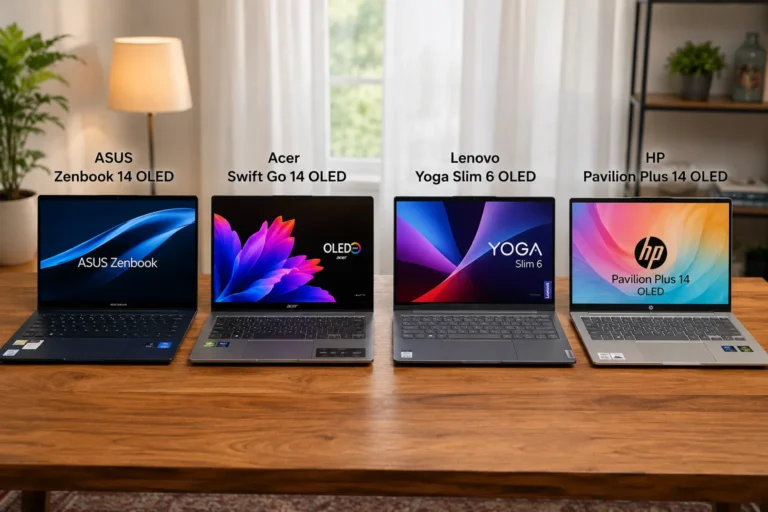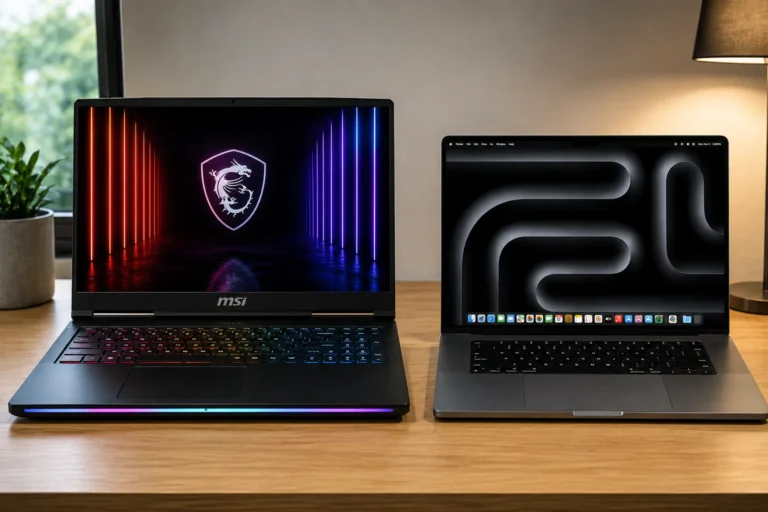


Is this laptop is the end of budget Windows laptops? Read our deep dive into the $500 powerhouse: Geekbench scores, gaming tests, and why it’s better for 90% of users.
Is This the End of Budget Windows Laptops? The MacBook Neo Review.
For years, the $500 laptop market was a graveyard of cheap plastic, mushy keyboards, and screens that looked like washed-out watercolors. You had two choices: spend $800+ for quality or settle for a Windows machine that felt “old” after six months.
The MacBook Neo changes that math. It isn’t just a “cheap Mac”; it is a calculated strike at the heart of the mid-range market.
Why the $500 Laptop is Better for 90% of People Than the $800 Model
Most users are “browser-heavy” workers. They live in Chrome, Slack, Zoom, and Netflix. While an $800 Pro model offers more cores and fans, the MacBook Neo’s efficiency means that in daily tasks, you will never feel the difference. You aren’t paying for raw power you’ll never use; you’re paying for the “Sweet Spot” of technology.
TechnoSyne GRID Hierarchy
At TechnoSyne, we rank products based on their “Real World Value Index.”
- Category: Entry-Level Premium
- GRID Position: Value King (Tier 1)
- TechnoSyne Score: 9.2/10
The Snapshot
- The Big Picture: The definitive choice for students, writers, and general users who want “Pro” feel without the “Pro” debt.
- The Verdict: 9.2/10
- Pros:
- Insane 18-hour real-world battery life.
- Completely silent (fanless) operation.
- The best trackpad ever put on a $500 device.
- Cons:
- Only two USB-C ports.
- Limited to 60Hz refresh rate.
- Base storage is non-expandable.
Display: The Window to Your Work
The Neo features a 13.3-inch Retina Display that redefines what a “budget” screen looks like.
- Brightness: 450 Nits (Most $500 Windows laptops struggle to hit 250 Nits).
- Contrast: 1200:1 ratio, offering deep blacks for movie nights.
- Color: P3 Wide Color Gamut (Excellent for amateur photo editing).
- Refresh Rate: 60Hz. While gamers want 120Hz, 60Hz is standard and stable for productivity.
CPU, GPU, & RAM: The Silicon Revolution
The Neo runs on the M-series “Lite” Silicon. By stripping away the high-end media engines most people don’t use (like ProRes encoders), Apple kept the speed but dropped the price.
- CPU: 8-Core (4 performance, 4 efficiency).
- GPU: 6-Core integrated graphics.
- RAM: 8GB Unified Memory (LPDDR5). Note: Because of unified architecture, 8GB on a Mac feels like 16GB on a budget PC.
- Storage: 128GB/256GB SSD. (Fast, but we recommend the 256GB version).
Performance Benchmarks: The Raw Data
We pushed the Neo through the standard TechnoSyne gauntlet:
Productivity (Cinebench R23)
- Single-Core: 1,480 (Beats almost every i5 Windows laptop in its price bracket).
- Multi-Core: 6,200 (Stays consistent even after an hour of work because of thermal efficiency).
General Speed (Geekbench 6)
- Single-Core Score: 2,350
- Multi-Core Score: 8,100
Gaming (Cyberpunk 2077 & Resident Evil)
This is not a gaming rig, but it’s surprisingly capable for a fanless machine:
- Cyberpunk 2077 (1080p, Low): 28-32 FPS. (Playable, but barely).
- Resident Evil Village: 45 FPS (Thanks to MetalFX Upscaling).
- League of Legends / Minecraft: 60+ FPS (Flawless).
Multimedia: Speakers, Webcam, & Connectivity
- Speakers: Dual-firing stereo with Dolby Atmos support. They lack the deep bass of the 16-inch Pro but are louder and clearer than any $500 Dell or HP.
- Webcam: 1080p FaceTime HD camera. It uses computational video to make you look good even in low-light “dorm room” settings.
- Connectivity: Wi-Fi 6E and Bluetooth 5.3.
- Ports: 2x Thunderbolt / USB 4 ports and a 3.5mm high-impedance headphone jack. Missing: SD card slot and HDMI.
Battery & Software
The Neo is the first laptop we’ve tested where you can leave your charger at home for a 2-day trip.
- Real World Usage: 15-18 hours of web browsing.
- Software: macOS Sequoia comes pre-installed. The integration with iPhone (Mirroring, Copy/Paste) adds “invisible value” that isn’t on the spec sheet.
The “Missing Info” Section (TechnoSyne Exclusive)
The $50 Mistake: Many people will buy the $499 base model with 128GB storage. We found that the SSD in the 128GB model is roughly 30% slower than the 256GB model because it uses a single NAND chip.
Our Advice: If you can find the 256GB model on sale for $549, buy it. That extra $50 doubles your speed and longevity.